Beijing to Chongqing Train vs Flight 2026: Which Is Better?

Contents
- Beijing to Chongqing at a Glance
- Flights from Beijing to Chongqing
- Which airports you will use
- Flight prices and how far ahead to book
- Getting to and from each airport
- Beijing to Chongqing by High-Speed Train
- Stations at each end
- Beijing to Chongqing train timetable
- Train fares by class
- How to book with a foreign passport
- Overnight and Slower Train Options
- From Chongqing North or West into the City
- What to Do in Chongqing
- Hongya Cave
- Ciqikou Town
- Yangtze River Cableway
- Jiefangbei Pedestrian Street
- Three Gorges Museum
- Liziba Station
- Where to Stay in Chongqing
- Jiefangbei and Hongya Cave
- Riverside rooms in Hongyadong
- Ciqikou and Shapingba
- More Beijing and Chongqing Guides
Show more
Chongqing sits about 1,460 km (910 miles) southwest of Beijing. A nonstop flight covers the distance in roughly three hours; the fastest high-speed train takes just under seven. This guide compares both, with the full Beijing to Chongqing train timetable, ticket prices by class, the stations you will use at each end, passport booking rules, and a short list of what to see and where to stay in Chongqing.
There are two realistic choices. Fly from Beijing Capital (PEK) or Beijing Daxing (PKX) into Chongqing Jiangbei (CKG) in about three hours, or take a high-speed train from Beijing West that runs 7 to 11 hours depending on the departure. The train leaves and arrives at city-centre stations, so there is no airport transfer at either end. Once you count door-to-door time, a 7-hour train and a 3-hour flight plus two airport transfers land within an hour or two of each other.
| Option | Journey time | Typical one-way fare | Best for |
| Nonstop flight | 2 h 45 m – 3 h 10 m | ¥500–1,100 economy | Travellers short on time, or anyone continuing beyond Chongqing |
| High-speed train (G) | 6 h 54 m – 11 h 15 m | ¥858–1,041 second class | Travellers who want city-centre to city-centre with no luggage limits |
| Overnight train (D/T/K) | 17 h 35 m – 25 h 21 m | ¥397–640 sleeper | Budget travellers who would rather sleep than pay for a hotel night |
Two airports on the Beijing side serve the route. Beijing Capital International (PEK) is 25 km northeast of downtown and handles most legacy-carrier departures. Beijing Daxing International (PKX) is 46 km south of the centre and carries the bulk of China Southern and China Eastern flights. Both land at Chongqing Jiangbei International (CKG), about 19 km northeast of Jiefangbei. Nonstop flights take 2 hours 45 minutes to 3 hours 10 minutes depending on the aircraft and routing.
Economy fares on the route commonly sit between ¥500 and ¥1,100 one-way (roughly US$70–155). That makes flying competitive with second-class rail, especially on weekday morning departures. Book three to six weeks out for the lowest buckets, avoid Friday evening and Sunday afternoon if you can, and compare PEK and PKX departures — the airport you fly from can change the fare by several hundred yuan.
From PEK, the Airport Express reaches Dongzhimen in about 25 minutes for ¥25, and a taxi to the city centre costs ¥100–120 and takes 40–60 minutes. Our PEK airport guide covers terminals, transfers and where to sleep before an early flight. From PKX, the Daxing Airport Express runs to Caoqiao in about 20 minutes for ¥35; a taxi into town is ¥180–220, and the PKX airport guide explains the rail, bus and 24-hour options in detail. At the Chongqing end, Metro Line 10 connects Jiangbei Airport with Chongqing North Railway Station, where you change to Line 3 for Jiefangbei — allow about an hour with luggage. A taxi from CKG to Jiefangbei costs ¥80–100 and takes 35–50 minutes.

The high-speed route runs south on the Beijing–Guangzhou line to Wuhan, then west along the Wuhan–Chongqing line. It is the most comfortable way to cover the distance overland, with 3+2 second class, 2+2 first class and lie-flat business class on every G train.
In Beijing, G trains leave from Beijing West (Metro Lines 7 and 9) or Beijing Fengtai (Metro Lines 10 and 16, 19 km southwest of downtown). In Chongqing, they arrive at Chongqing North (Metro Lines 3, 4, 10 and the Loop Line) or Chongqing West (Metro Lines 5 and the Loop Line). The pair matters: Chongqing North is 10 km from Jiefangbei and about 40 minutes by metro, while Chongqing West is 17 km southwest and takes about an hour. If your hotel is in Yuzhong district, favour a departure that terminates at Chongqing North.
| Train | Departs | Time | Arrives | Time | Duration |
| G329 | Beijing West | 06:55 | Chongqing North | 13:55 | 7 h 00 m |
| G1197 | Beijing West | 07:44 | Chongqing North | 17:10 | 9 h 26 m |
| G1015 | Beijing West | 09:45 | Chongqing North | 19:18 | 9 h 33 m |
| G1307 | Beijing Fengtai | 09:29 | Chongqing West | 20:44 | 11 h 15 m |
| G1149 | Beijing West | 11:10 | Chongqing North | 20:35 | 9 h 25 m |
| G331 | Beijing West | 15:10 | Chongqing North | 22:04 | 6 h 54 m |

The six daytime G trains above are the published reference timetable; with the overnight and slower services, Trip.com currently lists around 14 daily departures on the route. China Railway adjusts schedules a few times a year, and extra services appear around public holidays, so confirm live times and seat availability when you book rather than planning around a printed table. G331 is the fastest departure and the best pick if you want a full day in Beijing before leaving; G329 is the choice for a full afternoon in Chongqing on arrival day.
| Class | Seating | Typical fare | What you get |
| Second class | 3+2, five abreast | ¥858–1,041 | Reclining seat, power socket, snack trolley; the value pick for a 7–11 hour run |
| First class | 2+2, four abreast | ¥1,373–1,668 | Wider seat with more legroom, complimentary water and a snack box |
| Business class | 2+1 or 1+1 | ¥2,715–3,262 | Lie-flat leather seat, meal service, slippers and dedicated boarding |
Children under 6 travel free without their own seat, and children aged 6 to 14 pay roughly half fare. Fares move with dynamic pricing on some departures, so the ranges above are a planning guide rather than a fixed quote.
Chinese train tickets go on sale 15 days before departure, and popular G trains on this route sell out on holiday weekends. Book through Trip.com: enter Beijing and Chongqing, pick a departure, add each passenger's passport number exactly as printed, and pay. You receive an e-ticket — there is no paper ticket to collect at most stations. At the gate, place the passport on the reader and the barrier opens; if the reader fails, staff at the manual lane can look up the booking. Keep the passport with you for the whole journey, since conductors check it on board.
If you are building a longer loop, our guide to the Chongqing to Zhangjiajie high-speed train covers the onward leg, and how many days to spend in Beijing will help you fit the departure into a wider itinerary.
If the daytime departures do not suit, four slower services cover the route. The D trains are 200–250 km/h overnight services with sleepers and are the most practical budget option; the T and K trains are classic 120–160 km/h services that take a full day and night. All four leave from Beijing West.
| Train | Departs | Time | Arrives | Time | Duration |
| D95 | Beijing West | 17:52 | Chongqing North | 11:27 (+1) | 17 h 35 m |
| D3 | Beijing West | 18:04 | Chongqing North | 12:02 (+1) | 17 h 58 m |
| T9 | Beijing West | 15:06 | Chongqing West | 15:39 (+1) | 24 h 33 m |
| K507 | Beijing West | 07:12 | Chongqing North | 08:28 (+1) | 25 h 16 m |
On the classic trains, a soft sleeper costs ¥611–640, a hard sleeper ¥397–416 and a hard seat ¥217–229. The D-train sleepers sit between the two and are the sweet spot: you board after dinner, sleep through Hubei, and arrive in Chongqing around lunchtime with the whole afternoon free.
Chongqing North is the easier arrival. Metro Line 3 runs from the station concourse to Jiefangbei in about 25 minutes, Line 10 reaches Hongtudi for the Line 2 interchange, and a taxi to Hongya Cave costs ¥30–40 outside rush hour. Chongqing West is further out: Line 5 connects to the Loop Line, and the full run to Jiefangbei takes around an hour; a taxi is ¥50–70. Both stations have left-luggage counters if your hotel check-in is later, and both are signed in English throughout.
Once you are in Yuzhong, the city is walkable in patches but vertical — expect stairs and escalators between street levels, and use Metro Line 2 for the riverfront stretch towards Liziba. For the classic skyline view, walk from Jiefangbei down to Qiansimen Bridge at dusk; the bridge deck looks straight onto the lit terraces of Hongya Cave.
The city rewards two days: one for the Yuzhong peninsula and its river views, one for the old town and the museum. All of the following are reachable by metro from Jiefangbei, and most are free.
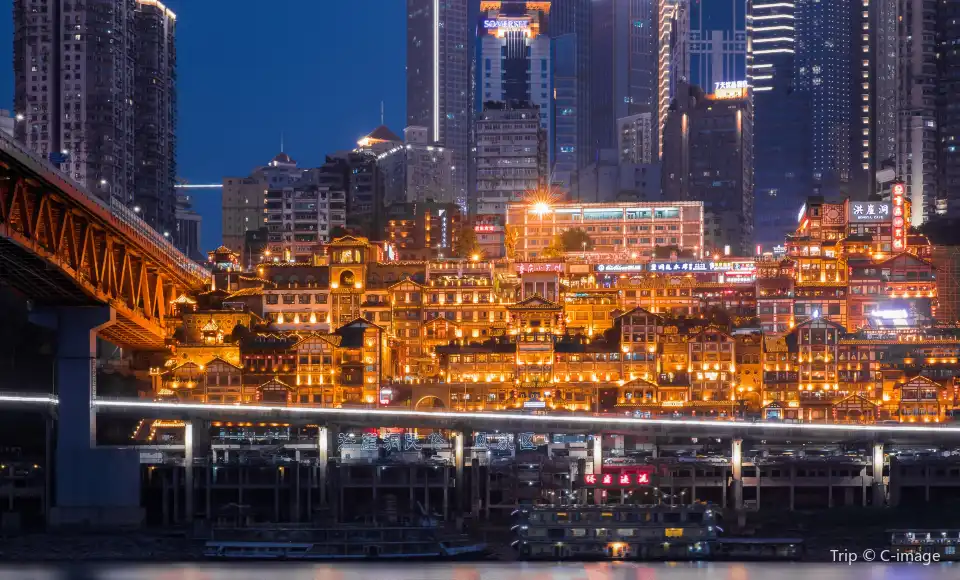
A eleven-storey stilt-house complex stacked up the Jialing riverbank, free to enter and open around the clock. Come after 19:00 when the timber facades are lit, walk up to the Qiansimen Bridge for the postcard view, then eat your way back down through the snack floors. Metro Line 1 or 6 to Xiaoshizi.

 The ferry offers commentary on the scenery along both sides of Chongqing, including iconic landmarks like Hongyadong and Raffles City. Enjoying the ferry ride while sightseeing is a very pleasant experience! The price could be lowered to make it more affordable.
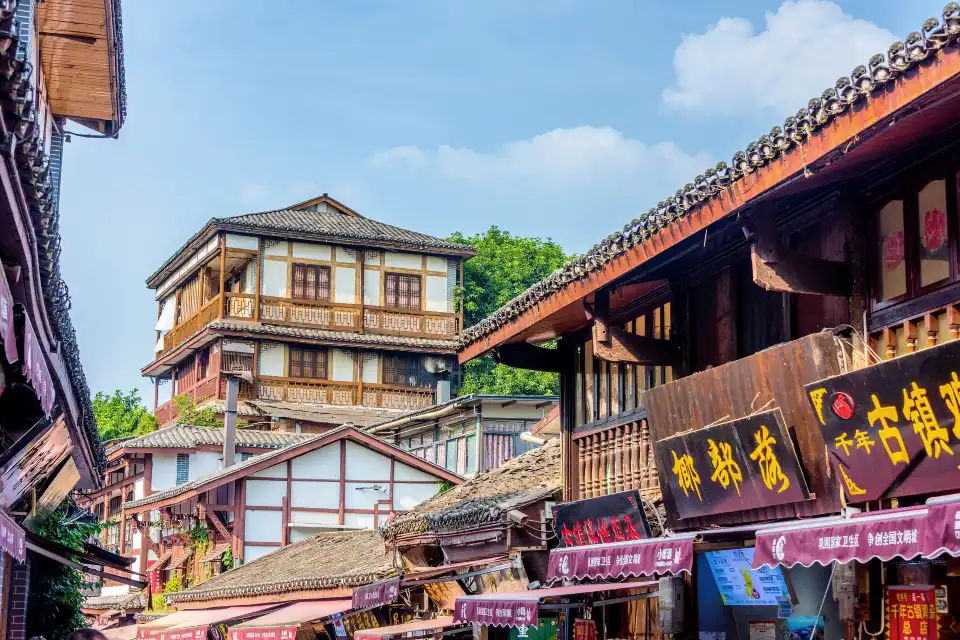
A preserved Ming and Qing river port of stone lanes, teahouses and pickle shops, 2–3 hours on foot and free to enter. It is busiest from mid-morning; arrive by 09:00 or come for the evening lights. Metro Line 1 to Ciqikou, one stop from Shapingba and close to Chongqing West if you are heading out by train.


A cable car that crosses the Yangtze between Yuzhong and Nan'an in about four minutes. Open 08:00–22:00 with last admission at 21:00, and the night crossing is the one worth queuing for. Buy a single rather than a return if you plan to walk the Nan'an riverside afterwards.


The commercial heart of the peninsula, anchored by the 1940s People's Liberation Monument and ringed by department stores and hotpot restaurants. It is the natural base for a first visit and the easiest place to find breakfast at 07:00.

Opposite the Great Hall of the People, this free museum explains the reservoir project, the region's archaeology and the wartime capital period. Open 09:00–17:00 with last entry at 16:30; closed Mondays. Allow two hours.

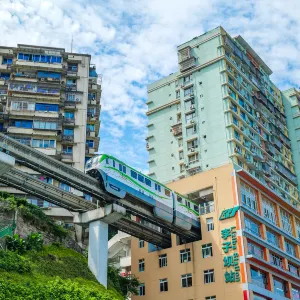
The monorail that passes through a residential tower on Line 2, six stops from Jiefangbei. There is a viewing platform outside Exit 1; the train runs every few minutes, so wait for one to appear rather than photographing the empty track.

If you want pandas without the Chengdu crowds, Chongqing Zoo keeps them in a hillside enclosure 20 minutes from the centre by Metro Line 2 — see our panda park guide for how it compares.
Chongqing's hotels cluster in three areas, and the right one depends on whether you want the view, the quiet or the train station.
The default for a first trip: walk to Hongya Cave, the cableway and Jiefangbei within 15 minutes, with Metro Lines 1, 2 and 6 on the doorstep. Riverside rooms facing the Jialing cost more but deliver the skyline at night.

Ascott Raffles City Chongqing
 No. 4 of Premium Hotels in Chongqing
A step below the skyline hotels but right on the Jialing waterfront, where balconies look straight at the lit terraces. It suits couples and photographers, and you can walk to Jiefangbei in ten minutes without changing metro lines.
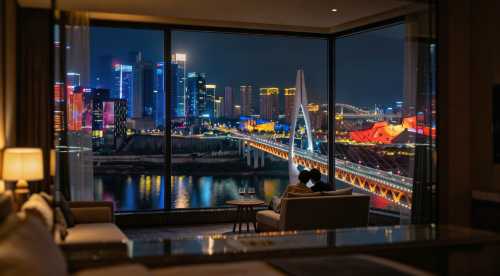
Holiday River View Hotel,Hongyadong,Jiefangbei,Chongqing
No. 3 of 4-Star Select Hotels in ChongqingBetter value, walkable to Ciqikou's old lanes and 20 minutes from Chongqing West by metro, which makes it the sensible base if you are arriving late or leaving early. The trade-off is a 30–40 minute metro ride to the river views.

Holiday Inn Express CHONGQING CIQIKOU ANCIENT TOWN by IHG
Popular recommendations

7 Reasons to Put Cancun Mexico Into Your Vacation Bucket List.
 _TS***4m

Latest Trip.com Promo Codes, Flight Discounts & Hotel Savings (Weekly Update)
 Trip.com Official

6 Things to know before Exploring the Montmorency Falls, Quebec
_TS***4m
2026 Guide to Shanghai Pudong Airport: Transit Visa & PVG Airport Shuttle
_TS***4m