China Visa Application Online: 6 Steps From Form to Passport Return

Contents
- Who Still Needs a China Visa in 2026?
- The 240-hour transit shortcut
- Which China Visa Type Fits Your Trip
- Documents to have scanned before you start
- China Visa Application Online: Step by Step
- China Visa Fees, Fingerprints and Processing Time
- Fingerprints: who can skip them
- How long the passport takes
- Why China Visa Applications Get Rejected Online
- Before You Fly: China Arrival Card, eSIM and Payment
Show more
China has no e-visa. Applying online in 2026 means you fill in the form and upload your documents on a visa-centre or foreign ministry website, wait for an online review, and then bring your passport to a visa centre once — usually without an appointment.
Check the visa-free list before you start. Ordinary passport holders from 50 countries, including the UK, most of the EU, Australia, New Zealand, Japan, South Korea and Canada, can enter China for up to 30 days without a visa until 31 December 2026. If your passport is from the US, India or anywhere else outside that list, or your trip runs longer than 30 days, or you are going to work, study or report, the application below is your route. Book refundable flights while the visa is pending — the decision is the consulate's, not the form's.
Start with your passport and your trip length, not with the form. The visa waiver covers short visits only, and a refused boarding pass at the airport is the expensive way to find out you needed a visa.
| Your situation | Do you need a visa? |
| Passport from one of the 50 waiver countries, tourism, business, family visit or transit, 30 days or less | No |
| Same passport, but work, study, journalism, or a stay longer than 30 days | Yes |
| US, Indian or other passport outside the waiver list, any length of stay | Yes |
| Transiting to a third country within 240 hours on a passport from one of 57 countries | No, under the transit policy |
Visa-free stays are counted from the day after you arrive and run for 30 calendar days. There is currently no cap on how many times you can use the waiver, but you cannot work, study or report on it.
Travellers from 57 countries, including the US, the UK and Canada, can enter China without a visa for up to 240 hours when they are passing through to a third country. You need an ordinary passport valid for at least three months and a confirmed onward ticket leaving within 240 hours, and you must enter through one of 65 ports in 24 provinces and stay inside the permitted area for that port. The 240 hours start at 00:00 on the day after entry.
Transit status is not a short holiday visa. Work, study and news reporting are excluded, and if your route ends in the country you came from, you are not transiting.
The form asks you to choose a visa category on its second page, and choosing the wrong one gets an application returned faster than almost anything else. Match the category to what you will actually do in China.
| Category | Who it is for |
| L | Tourism, including group tours and long sightseeing trips |
| M | Commercial and trade activity: meetings, exhibitions, supplier visits |
| F | Exchanges, visits and study tours that are not business |
| Q2 | Visiting relatives who are Chinese citizens or permanent residents |
| S2 | Visiting a foreign family member who works or studies in China |
| X1 / X2 | Study in China for more than 180 days / up to 180 days |
| Z | Employment, arranged through your employer's work permit |
| G | Transit through China |
| J1 / J2 | Resident journalists / short reporting trips |
Our China visa reference lists the documents each category asks for, country by country.
Which website you use depends on where you apply. Most countries route you to the visa centre network at visaforchina.cn; some missions, including the US consulates, use the foreign ministry's China Online Visa Application system at consular.mfa.gov.cn/VISA/. The sequence is the same on both.

1. Choose the centre that serves your address. Consular districts are strict: a centre only accepts applications from its own area, and the wrong one is the most common reason an application is turned back.
2. Register with an email address and select your application location. Nothing at the online stage is paid, so there is no card to enter and no payment page to complete.
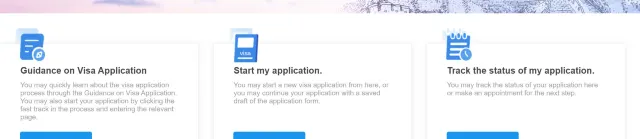
3. Fill in the nine sections of the form. They run in this order: personal information, type of visa, work information, education, family information, information on your travel, information on previous travel, other information, and declaration. The system reads your passport data page and fills in your name, nationality and passport details, so check what it entered before you continue. Each page can be saved, and drafts sit in your account under Personal Center.
4. Upload your documents. Sections with a red dotted border are mandatory; grey ones only apply in certain cases. JPG, PNG and PDF all work, as long as the scans are sharp and the whole page is visible.
5. Submit, then wait for the online review. If the status still reads PENDING, you have not clicked submit on the final page. Once it moves to Under review, watch your inbox and your account; some centres quote about two working days for this stage, and it can change if they ask for more.
6. Act on the email you get. Four outcomes matter:
The form only accepts entry dates within the next 90 days. If you are planning further ahead, wait — and once your application is approved, go to the centre promptly, because an approved application left sitting can lapse.
The online step is free; every fee is paid at the counter when you hand over your passport. Bring the printed and signed first and last pages of the form, your original passport, one 48 mm by 33 mm photo, and whichever supporting documents your centre lists. Most centres take submissions on working days between 9:00 and 15:00, and no appointment is needed.
Fees are set per embassy, and the visa centre adds a service fee on top, so the number on your receipt depends on your nationality and where you apply. China's reduced fee schedule currently runs to 31 December 2026.
| Applicant | Regular fee | Notes |
| US passport | US$140 | Covers single, double and multiple entry; J1/J2 is US$171 |
| UK passport | £64 | 5-year multiple £128; 10-year multiple £191 |
| Other nationalities | Set by your embassy | Usually lower than the US rate; the centre's fee table is the figure that counts |
Express service costs extra — US$25 per visa at the US missions — and the centre's own service fee is charged separately.
Until 31 December 2026, every short-term visa applicant staying 180 days or less is exempt from fingerprinting. Holders of D, J1, Q1, S1, X1 and Z visas, who need a residence permit after arrival, are still fingerprinted, and so is anyone the centre specifically asks to attend. Children under 14 and adults over 70 are exempt permanently. If you do need to give fingerprints, you have to be there in person.
Processing starts when you hand in your passport, not when you submit online. Most centres quote around four working days for regular service, with express and urgent options that shorten it and cost more. Chinese public holidays and the weeks around them slow everything down, so build a buffer before a fixed flight date, and collect your passport on the date printed on your receipt.
Almost every rejection is fixable in a few minutes, which is why the review stage exists.
A visa gets you to the immigration queue; three small things get you through it smoothly.
The arrival card is now online. Since 20 November 2025, foreign travellers fill in the arrival card before landing, through the National Immigration Administration website, the NIA 12367 app, or the WeChat and Alipay mini-programs. It is free on every official channel, and the immigration authority has warned about look-alike sites that charge for the same form. Fill it in during the 72 hours before arrival, save the QR code as a screenshot, and show it at the counter. Paper cards and airport kiosks still exist as a fallback.
Sort out your internet before you board. The arrival card QR code, your hotel address and your first DiDi ride all need data, and roaming can be slow or blocked. A China eSIM installs at home and connects when you land, so you are not setting it up in the arrivals hall — compare China eSIM plans before you fly.
Link a payment card to Alipay or WeChat Pay. QR payment is the default in China, from metro gates to noodle shops, and both apps accept foreign cards. Set one up while you still have a stable connection.
For the paperwork that comes after the visa, our China arrival card walkthrough covers each screen, and the 240-hour visa-free transit rules explain who can skip the visa entirely.
Popular recommendations

Top 19 Hippest Mid-Size US Cities
 _TS***4m

Latest Trip.com Promo Codes, Flight Discounts & Hotel Savings (Weekly Update)
 Trip.com Official

6 Things to know before Exploring the Montmorency Falls, Quebec
_TS***4m
2026 Guide to Shanghai Pudong Airport: Transit Visa & PVG Airport Shuttle
_TS***4m