Ultimate Guide to Cathedral Duomo Florence

Contents
- The man behind the cathedral: filippo brunelleschi
- Duomo cathedral:exterior
- Duomo cathedral:interior
- The baptistery
- Climb the largest masonry dome
- Climb the campanile
- Museo del opera del duomo
- Ticket info
Show more
Basilica di Santa Maria del Fiore or The Cathedral of Florence is also known as il Duomo di Firenze, it is a 13th-century catholic church dedicated to Madonna, with the title 'Santa Maria Del Fiore'. The Florence Cathedral was constructed in 1296 on the ruins of an old church 'Santa Reparata', built between the 5th and 6th century. The old cathedral was too small for the city of Florence, thus, the need for a larger cathedral emerged and the Florence government became keen on making a new cathedral with an enormous Duomo. Boniface VIII’s legate and Cardinal Valeriano laid the first stone of the new church which was being enlarged and architected by the then famous architect Arnolfo De Cambio.
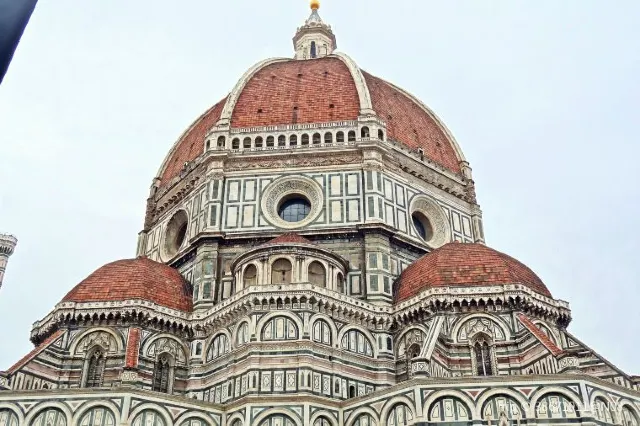
Although the construction of the cathedral and the Giotto's bell tower was finished before the beginning of the 15th century, the construction of the Florence Dome started in the year 1420 when Opera del Duomo announced a design contest for the dome of the cathedral. Filippo Brunelleschi's design won the competition and the gigantic dome was finished in 1436 and the final piece of the magnificent il Duomo, Florence was put together in 1466. After that, the cathedral went under many interior and exterior changes between the period of 1572-1579 and 1881-1887. The cathedral, Saint John Baptistery (Battistero) and the Giotto's bell tower (campanile) are a significant part of the world history and to honor and preserve this iconic landmark it was declared as a UNESCO World Heritage Site in 1982.
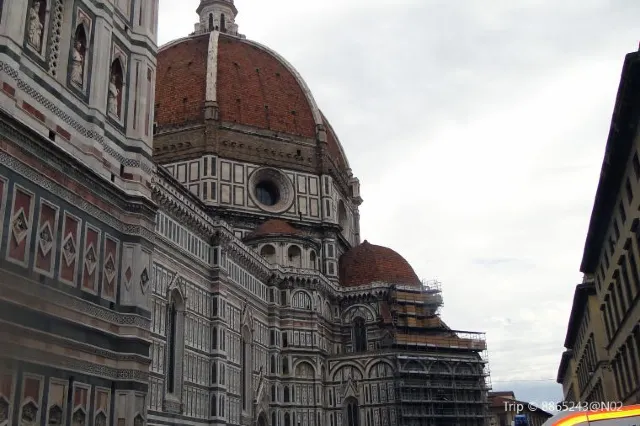
Filippo Brunelleschi was the genius man behind the construction of Duomo, Brunelleschi was a young goldsmith with no prior experience in architecture when Opera del Duomo announced a public competition to build the Florence Dome of the unfinished cathedral which was under construction for more than a decade. Best architects of the time ventured to Florence to present their ideas, while most of them proposed a wooden structure to support the dome, Brunelleschi proposed a controversial method involving an egg theory that won him the competition and 200 gold florins against his best competition Lorenzo Ghiberti. With the absence of any architectural technology, Brunelleschi took this monolith task of constructing the largest dome. Filippo Brunelleschi was a secretive man, so much so that he left no evidence on the construction of the dome. He placed a flower on the base and used ropes to guide the layout for placing the bricks in the herringbone layout and gave an inverted curve to the dome which used the gravity to reinforce the structure. He used over 4 million bricks to build the dome and with great mastery over technical knowledge, Brunelleschi finished the Florence Dome in just 16 years from the start in 1420 which was a remarkable achievement of the time. He also invented a crane, a fixed oxen three-wheel cogged system to pull and retreat heavy items from the dome and also designed the Duomo's Lantern with Michelozzo.
The Florence Cathedral as we see it today did not look the same in 1296, the original design plans for the enlargement of the church went under many modifications in 170 years of its construction time. Like, the original plan by Arnolfo di Cambio for church's side had much narrower and closer windows than those toward the east, this was due to change in the architect during construction. The bell tower by the church was finished in 1359 by Francesco Talenti, following the original plans by Giotto. On the lower row of the bell tower are reliefs depicting the creation of man and woman, the begging of human work and various activates from the bible; the depiction of seven planets. The facades on the low register are technical and scientific endeavors like astrology, building, medicine, and weaving; in the upper register are the theological and cardinal virtues, liberal arts of the Trivium and Quadrivium, and the seven sacraments.
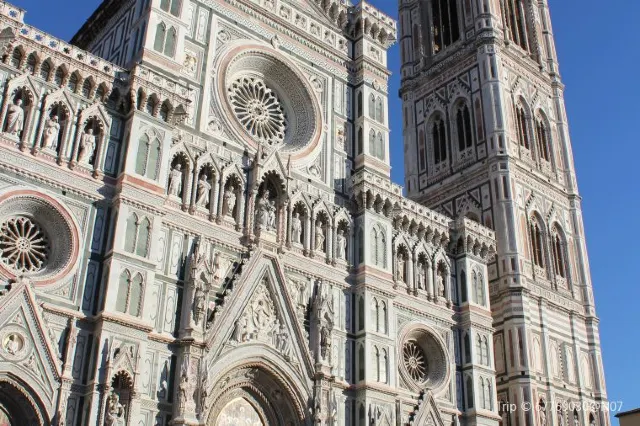
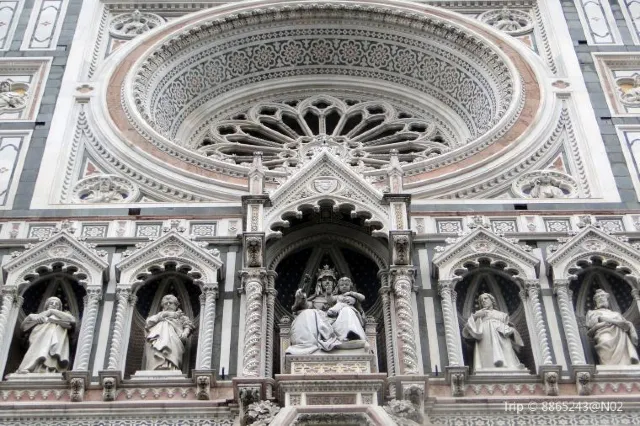
The construction of Florence Cathedral structure was finally finished in 1466 with the lantern designed by Brunelleschi and Michelozzo and the gilt copper ball and the cross by Verrocchio set in its present place and its consecration on march 25,1436 by pope Eugenius IV. However, the final moderation of the cathedral's facade in white, green, and pink marble was done between 1871 and 1887 based on designs by Emilio De Fabris. The new designs were dedicated to the Mother of Christ were similar to the old facades by Arnolfo di Cambio and carried the original neo-gothic style of the Belltower and the side portals of the cathedral. Above the central portal of the facade is a figure of Mary enthroned and holding a flower scepter; the mosaics over the middle door represents the Christ enthroned between Mary and Saint John the Baptist and other followers; over the viewers left door is Florentine artisans, merchants, and humanists paying homage to the faith; and above left door is representation of charity amongst the founder of Florentine philanthropic institutions.
Upon entering the Florence Cathedral, you'll find a contrast between the exterior and the interior. The view when entering from the middle facade is astonishing, the diversified characteristics of the gothic religious and the early renaissance are noticeable in every part. This church holds the testimony of the roman religion, great achievements of men, and the artist and the art. The interior of the church depicts a synergy between the men and the god, above the main door is a colossal clock face painted by Paolo Uccello with frescos of four Prophets or Evangelists at four corners, the clock shows the 24 hours of Italian time and was used until the 18th century. This is one of the few remaining clocks of the time that is still in a working condition. The mosaic created by Gaddo Gaddi on the opposite side of the central nave on the entrance and the stained-glass windows designed by Donatello placed high above the main altar, both depict The Coronation of Mary in Heaven. The aisles of the church honors achievements of men, including bust of Brunelleschi, Giotto, Marsilio Ficino, Emilio De Fabris, Arnolfo di Cambio, Antonio Squarcialupi; fresco depicting Niccolo da Tolentino by Andrea del Castagno and Sir John Hawkwood by Paolo Uccello, and Monument to Dante and the Divine Comedy, by Domenico di Michelino.
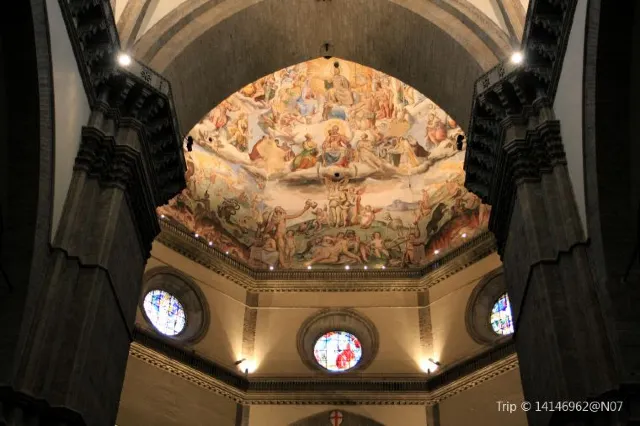
Moving toward the high alter you'll see the colorful nave and the floor and the Duomo above the high altar. The mesmerizing frescoes inside the cupola depict The Last Judgment, painted by Giorgio Vasari and Federico Zuccari, who worked on the fresco from 1572 to 1579. Passing the alter from left you'll see the Bronze doors by Luca Della Robbia and a relief showing the resurrection of the Christ, behind that is the Mass Sacristy with 15th-century Intarsias. whereas, on the right corner of the alter is a relief by Luca Della Robbia showing the Ascension of Christ. On the absolute end of the main entrance are the altar of Saint Zanobius and the Blessed Sacrament including the urn with Saint Zanobius’ relics, by Lorenzo Ghiberti and Last supper by Giovanni Balducci.
The Baptistery of San Giovanni contains elements of many cultures, it is considered to be a pagan temple built between the 4th and the 5th century. The floor seems borrowed from Islam, while the carpet between the north door and the hall carries Zodiac motifs, the wall decoration reminds of the Germanic era, and the mosaics on the dome represents the high influence of Byzantine art. The mosaics on the dome by Jacopo Torriti are spectacular, the eight-sector dome is divided horizontally into six tiers. Three segments of these domes show the scenes of the Final Judgment, the remaining five sectors are decorated horizontally telling the stories of Saint John the Baptist, Mary and the Christ, the Patriarch Joseph, stories from the book of Genesis, and the choirs of angels from bottom to highest top.
The three bronze doors of the Baptistery were the result of patronage from the wealthy Arte di Calimala, the Guild of Merchants, and the Finishers and Dyers of Foreign Cloth. The oldest being the south door cast by Andrea Pisano in between 1330-1336, the upper 20 panels depict the life of Saint John the Baptist, while the lower eight reminds the Christian virtues. The north door depicts the scene from the new testaments in 20 panels and the four Evangelists and four church fathers in the other four-panel executed by Lorenzo Ghiberti, a young sculptor who won a public competition to get the patronage. The east door contains only 10 panels and tells the stories from the old testaments. Executed by Lorenzo Ghiberti between 1425-1450, these doors were so captivating that Michelangelo called them the "Gates of Paradise", as the east doors open right in front of the Florence Cathedral.
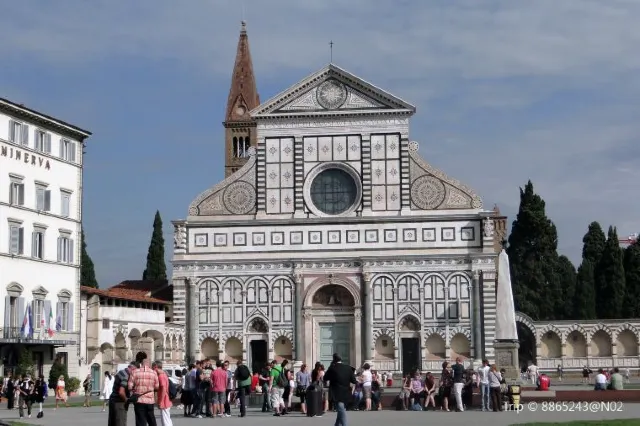
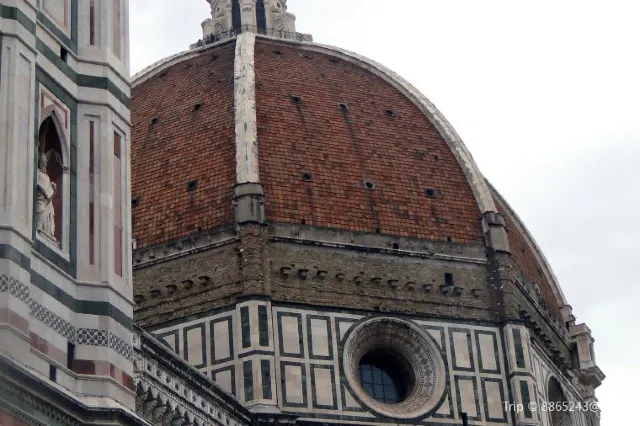
The Duomo is the main attraction of the Florence city, one of the largest masonry dome, it has a diameter of 150 feet and has 463 steps in narrow corridors reaching the top. On reaching the base of the dome you can walk along the walkway made for the construction of the dome to get an up-close glance at the amazing fresco on the inner shell of the Florence Dome depicting the Last Judgment. Step out on the terrace to have a panoramic view of the Florence city from the Florence Dome. The access to the dome is restricted and only people with advanced purchase tickets and registered time slots are allowed entry to the dome, you get an exclusive entrance into the private north terrace when you book a Little Peek on Florence guided tour ticket. The best time to make this climb is early in the morning when it opens or late before it is shut in the afternoon.
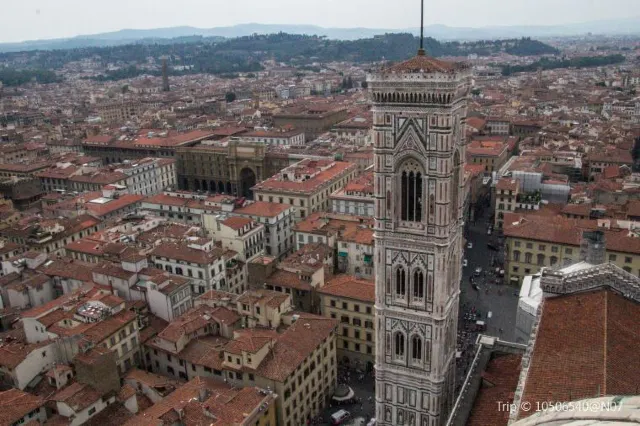
This 84.7 meters tall gothic style bell tower was designed by Giotto more for visual appeal than practical use. Following the plans of Giotto after his death in 1337, Andrea Pisano continued the construction up to two levels, and later after his death, Francesco Talenti finished the project with some moderation like the large windows in the upper level of the tower. Unlike the dome, the Campanile or the Bell Tower doesn't require a times slot reservation but it does require a cumulative ticket for entry. The Bell Tower or the Campanile has over 414 steps up a narrow passage, the climb is not recommended for a person with a heart condition, vertigo, and claustrophobia. The overlooking view of Florence and the countryside from the top of the tower can only be compared with the view from the dome terrace.
The museum of Opera di Duomo or Opera di Santa Maria Del Fiore was founded in 1871 to conserve the rich heritage of medieval monuments of Florence. Since then, many original masterpieces have been moved to this house for their preservation. The museum is spread in about 6000 square meters of exhibition space, over 750 works of art in 25 rooms on 3 levels, has over a thousand years of standing in Florence. On the ground floor of the museum you'll find the Corridoio dell' Opera presenting the name of a few 1000 people on a wall who contributed in constructing, decoration, and preservation of the Duomo, this includes architects, artists, musicians, artisans, and workman; the Sculpture Gallery (Galleria Delle sculpture) housing the gothic sculpture of the Florence Cathedral; Salone del Paradiso where the first facade of the Florence Cathedral is shown in a life-size model along with statues and the original Gates of Paradise from the Baptistery facing the Duomo; other attractions including Sala Della Maddalena and Tribuna di Michelangelo.
The first floor of the Museum provides a much deeper understanding of the men behind the Florence Cathedral. Galleria del campanile stores the original 16 statues and 42 reliefs from the Giotto's Bell Tower. Galleria del Cupola is dedicated to Brunelleschi and his innovations and creations for making the dome. In the Sala, Delle Cantorie is the two choir lofts, found in the church in late middle ages, made by Luca Della Robbia and Donatello. And a room dedicated to Sala del Coro Bandinelliano who made 86 marble reliefs to decorate the choir enclosure, 24 of which are displayed in the room. And on the second floor is the Galleria Dei Modelli preserving the seven proposed designs for the Florence Cathedral facade after the original demolished in 1587. And Belvedere Della Cupola, from where you can have an up-close view of the dome.
The ticket price for a non guided tour is € 18 including a presale fee for € 2 for booking online, for a guided tour of the Florence Cathedral called the "Little Peek on Florence" the fee is € 33. This € 18 non guided tour and € 33 guided tour ticket can be purchased online from the official website of the Opera di Santa Maria del Fiore. You can book your ticket online or at the ticket office. The validity of the ticket is 72 hours from the selected date on the ticket. Visiting Cathedral is free for everyone and one can visit it many times, however, to visit the Duomo and other monuments you'll need to buy a ticket. The Museum is closed on the first Tuesday of every month, and opening and closing time of all the monuments are different.
Popular recommendations

Top 19 Hippest Mid-Size US Cities
TripBlog
Top European Bucket List Foods and the Best Places to Try Them
TripBlog
LEGOLAND® Malaysia Resort from 21 to 23 Sept 2018
 Trip.com
Latest Trip.com Promo Codes, Black Friday Deals, Flight Discounts & Hotel Savings (Weekly Update)
 Trip.com Official
Trending Travelogues
Popular Trip Moments
Popular Attractions
Popular Ranked Lists
Popular Destinations
Recommended Attractions at Popular Destinations


About






of the year 2025



Site Operator: Trip.com Travel Singapore Pte. Ltd.