Mount Huashan Plank Walk 2026: Hiking Routes, Tickets & Tips

Contents
- Where Is Mount Hua?
- The Five Peaks
- What the Scenic Area Includes
- Why the Mountain Feels Different
- How to Get to Mount Hua from Xi'an
- Xi'an North to Huashan North by Train
- From Huashan North Station to the Visitor Centre
- By Bus or Car from Xi'an
- The Walking Gate at Yuquan Temple
- Mount Hua Tickets, Cable Cars and Shuttle Prices
- Peak Season and Off-Season Dates
- Discounts and Free Entry
- How to Book with a Foreign Passport
- What a Route Actually Costs
- Opening Hours and the Best Time to Hike
- Best Season
- Best Time of Day
- Night Hiking
- Weather and What to Wear
- The Plank Walk in the Sky
- How the Plank Walk Works
- Is It Safe?
- The Hawk Turning Over
- If You Skip the Plank Walk
- Hiking Routes: Which Cable Car to Take
- West Up, North Down: The Classic Route
- North Up, North Down: The Budget Route
- West Up, West Down: The Easy Route
- The All-Walking Route from Yuquan Temple
- The Five Peaks, One by One
- West Peak: Lotus Peak
- South Peak: The Highest Point
- East Peak: Sunrise and the Hawk
- Central Peak: Jade Maiden
- North Peak: Cloud Terrace
- One-Day Itinerary from Xi'an
- If You Have Two Days
- Combining Mount Hua with the Terracotta Army
- Where to Stay Near Mount Hua
- Huashan Xifeng Hotel
- Shaanxi Dijian Nanshan Hot Spring Hotel
- Mount Hua East Peak Hotel
- Staying in Huayin or Xi'an
- Food, Gear and Practical Tips
- What to Eat
- What to Bring
- Toilets, Water and Cash
- Crowds and Holidays
- Fitness and Altitude
- More China Mountain and Xi'an Guides
Show more
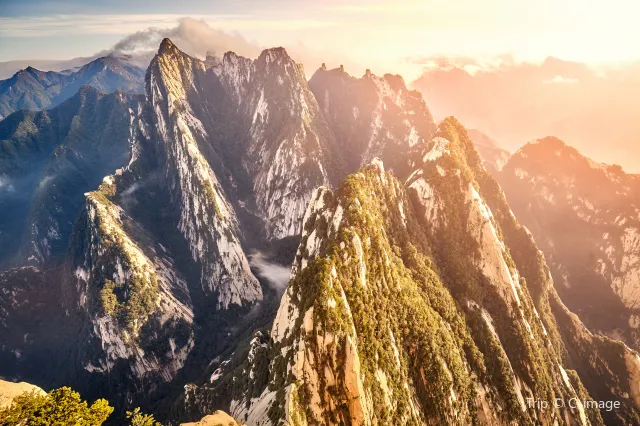
The granite spires of Mount Hua at sunrise. The South Peak, at 2,154.9 m, is the highest of the five. Photo: Trip.com
Mount Hua is the granite mountain 120 km east of Xi'an that everyone calls the most precipitous in China, and the plank walk in the sky is the reason most people come. The scenic area has five peaks, two cable cars and one 24-hour hiking gate, so the trip can be a four-hour cable car circuit or a 12 km stair climb that starts at midnight. This guide covers ticket and cable car prices, opening hours, the train from Xi'an, the plank walk, every route up, and where to sleep if you want the sunrise.
Mount Hua stands in Huayin, a small city in Weinan prefecture at the eastern edge of Shaanxi, roughly 120 km east of Xi'an. It is the western member of China's Five Great Mountains and the highest of the five, a massif of white granite that rises straight out of the Wei River plain in cliffs rather than slopes. The name is written Mount Hua, Hua Shan or Huashan; all three mean the same place.
| Address | Mount Hua Scenic Area, Huayin, Weinan, Shaanxi |
| Distance | 120 km east of Xi'an; 15 km from Huashan North railway station |
| Highest point | 2,154.9 m at South Peak |
| Entry ticket | 160 CNY peak season (1 Mar - 30 Nov); 100 CNY off-season |
| Cable cars | West Peak 140 CNY, North Peak 80 CNY, one way in peak season |
| Opening hours | Cable car check-in 07:00-16:00 peak; hiking gate open 24 hours |
| Time needed | 4-6 hours by cable car; 10-12 hours on foot |
| Status | National 5A scenic area, UNESCO Global Geopark |
The scenic area is a cluster of five summits arranged like a hand, with the visitor centre and both cable car stations far below. Almost every route ends up on the same ridge, so the order you visit them depends on which cable car you take.
| Peak | Height | What it is known for |
| East Peak | 2,096 m | Sunrise, the Hawk Turning Over cliff ladder, best spot to sleep for dawn |
| South Peak | 2,154.9 m | Highest point, the Plank Walk in the Sky, views over the whole massif |
| West Peak | 2,083 m | Lotus Peak, sunset, the upper station of the long Taihua cableway |
| Central Peak | 2,038 m | Jade Maiden Peak, the gentle crossing point between the other summits |
| North Peak | 1,615 m | Cloud Terrace Peak, the end of the walking route, upper station of the short cableway |
Everything starts at the visitor centre east of Huayin, where you buy the shuttle bus and cable car tickets and board the bus for one of the two valleys. The West line runs 30-40 minutes up the Wengyu valley to the Taihua cableway; the North line runs about 20 minutes up the Huangpu valley to the North Peak cableway. Both shuttle rides are compulsory if you are using a cable car, because the roads are closed to walkers. The separate walking entrance is at Yuquan Temple on the west side of the mountain, and it is the only gate that stays open all night.
Mount Hua is not a forest walk. The rock is bare granite, the paths are cut into vertical faces, and the chains bolted to the cliffs are there because you need them. That is also why the mountain has kept its reputation for 2,000 years: emperors sacrificed here, Taoist hermits built temples on ledges, and the phrase "since ancient times, one road up Mount Hua" still describes the main hiking valley almost exactly.
The high-speed train is the default option and the reason a day trip works. Trains run from Xi'an North to Huashan North in 28-40 minutes, roughly every 20-30 minutes from early morning until late evening, and a second-class seat costs 54-65 CNY. On a typical weekday there are more than 50 departures, so you do not need to plan around a single service.
Book with your passport number and keep the passport in your pocket; station gates and the scenic area both check it. The first trains leave around 07:50 and the last ones after 22:00, which makes a night climb from Xi'an possible if you take an evening service and start walking at Yuquan Temple. For station layouts and how to change between Xi'an's stations, see our guide to Xi'an's railway stations.
The station is about 15 km from the visitor centre, on the plain below the mountain. Local city buses 1 and 2 connect the two and are free or a few yuan; a dedicated scenic-area shuttle charges 10 CNY. Taxis wait outside the exit and cost 20-30 CNY for the 15-20 minute ride. If you are heading straight to Yuquan Temple for the walking route, the taxi is a little shorter and costs about the same.
Coach services leave Xi'an Railway Station in the morning for Huayin and take about two hours; they are the cheapest option but arrive after the first cable car crowds. Driving from central Xi'an takes 1.5-2 hours on the Lianhuo expressway, and the visitor centre car park fills by mid-morning on sunny weekends. Most travellers find the train faster than either.
Yuquan Temple sits at the western foot of the mountain, 5 km from Huayin town and about 20 minutes by taxi from Huashan North station. This is where the historic climbing route begins and where night hikers start, usually between 22:00 and midnight to reach East Peak before dawn. There is no cable car here and no shuttle: from the gate it is 12.5 km of stone stairs to North Peak.
Three separate tickets get you up the mountain, and first-timers routinely assume one covers everything. You buy the entry ticket, then a shuttle bus ticket for one of the two valleys, then a cable car ticket. All three are priced per person and per ride, and none of them includes the other.
| Ticket | Peak season | Off-season |
| Entry ticket, adult | 160 CNY | 100 CNY |
| West Peak cableway, one way | 140 CNY | 120 CNY |
| North Peak cableway, one way | 80 CNY | 45 CNY |
| West line shuttle bus, one way | 40 CNY | 40 CNY |
| North line shuttle bus, one way | 20 CNY | 20 CNY |
| Plank walk safety harness | 30 CNY | 30 CNY |

 One of the top mountains to see in China. Seeing the granite mountains and walking up the peaks was such a great experience. You get to see the magnificent view and the experience on walking on the stone ridges is just amazing.
Peak season runs from 1 March to 30 November, when the entry ticket is 160 CNY, the West Peak cableway 140 CNY and the North Peak cableway 80 CNY. Off-season starts on 1 December and ends at the end of February, dropping the entry ticket to 100 CNY, the West cableway to 120 CNY and the North cableway to 45 CNY. Shuttle buses stay at 40 and 20 CNY all year.
Children 6 and under, or 1.2 m and under, enter free; visitors aged 65 and over enter free with ID. Children between 1.2 m and 1.5 m, teenagers from 6 to 18, and full-time university students pay half price for the entry ticket with a student card or ID. On the cableways, students get 10 percent off, visitors aged 60 and over get 20 percent off, and military personnel, firefighters and disabled visitors get 20 percent off with the relevant Chinese certificate. Foreign passports do not automatically qualify for the Chinese senior or student discounts unless the age or student status is on the document, so budget the full fare if you are unsure.
The scenic area runs a real-name, timed-entry system and releases tickets up to 10 days ahead; daily caps apply and holiday dates sell out. Foreign visitors can book online with a passport number, including through Trip.com, and the e-ticket is linked to that number at the gate. If the scanner will not read your passport, the staffed ticket office at the visitor centre can print a paper ticket. Cable car and shuttle tickets are bought separately and are tied to the same date.
Add the entry ticket, both shuttle legs and both cable car rides and the totals are easy to compare. In peak season, West up and West down comes to 520 CNY; West up and North down is 440 CNY; North up and North down is 360 CNY. Off-season the same routes cost 420, 325 and 230 CNY. The all-walking route costs only the 160 CNY entry ticket, plus whatever you spend on gloves and noodles.
The mountain has two different clocks: the cable cars keep office hours, and the walking gate never closes. Getting the two confused is how people end up at the visitor centre at 16:30 with no way up.
| Facility | Peak season | Off-season |
| Cable car check-in | 07:00-16:00 | 08:00-16:00 |
| Cable car operation | 07:00-19:00 | 08:00-18:00 |
| Walking gate, Yuquan Temple | 24 hours | 24 hours |
| Visitor centre ticket office | 07:00-16:00 | 08:00-16:00 |
April to June and September to October are the best windows: mild temperatures, clear air and a reasonable chance of the cloud sea that forms below the ridge after rain. Autumn turns the lower slopes red and gold while the granite stays white. Summer is hot on the plain but 8-10 C cooler on the summit, and afternoon thunderstorms are common in July and August. Winter is the quietest and cheapest season, with snow on the peaks and ice on the stairs; the plank walk and the Hawk Turning Over close whenever the rock is wet or frozen.
Be at the visitor centre when it opens at 07:00. The first shuttle and cable car load reaches West Peak before the tour groups, and the ridge between the peaks is still empty for the first hour. The worst window is 10:00-14:00, when day-trippers from Xi'an arrive in waves and the queue for the plank walk can run an hour. If you are staying overnight, sunset from West Peak and sunrise from East Peak are the two set pieces.
Climbing through the night to catch sunrise is a Chinese tradition here, and the 24-hour gate makes it possible. Most night hikers start at Yuquan Temple between 22:00 and midnight, reach North Peak in four to six hours, and continue along the ridge to East Peak by 05:00. The route is stone stairs all the way, with chains on the steep sections, and the only light is your headlamp. Do not attempt it in winter without experience, and do not expect to ride a cable car down before 07:00.
The summit is 600 m above the valleys and exposed to wind from every direction. Bring a windproof layer even in July, and add a fleece or down jacket for sunrise. Stone steps stay wet for hours after rain, and the chains are cold enough to need gloves. Check the forecast the night before: cloud can hide the entire ridge, and lightning closes the upper paths without much warning.
The Plank Walk in the Sky, Changkong Zhandao in Chinese, is a line of wooden boards bolted to a vertical cliff on the south side of South Peak, about 2,100 m above sea level. There is no handrail and no widening: you clip a harness to a steel cable, turn sideways, and shuffle along the rock with the valley floor a very long way below. It is the single most famous thing on the mountain and the reason many visitors come at all.
The walk is optional and costs 30 CNY for the safety harness, paid at the entrance to the section. Staff fit the harness and explain the clip sequence; you move in one direction along the boards, holding the cable with one hand and the harness line with the other. Bags, selfie sticks and loose items are not allowed on the boards, and there is a small locker area at the start. The whole detour takes 30-60 minutes including the queue, and the return is along the same boards.
The harness is a continuous double-clip system, the cable is anchored into the cliff, and the section is supervised. Accidents are rare, but this is not a theme park: people freeze halfway, the boards flex, and the exposure is real. If you are afraid of heights, do not force it; the viewing platform at the top of South Peak looks straight down the same cliff and requires no harness. The walk closes in rain, snow, high wind and after dark.
East Peak has its own adrenaline set piece, the Hawk Turning Over or Yaozi Fanshen: a near-vertical ladder of cut steps over a drop, also protected by a 30 CNY harness. It is shorter than the plank walk and, for many people, scarier, because you climb rather than shuffle. Both attractions are staffed and both can be skipped without missing the peaks themselves.
South Peak's summit terrace gives you the highest view in the massif and a clear sightline down to the plank walk and the chess pavilion on its rock pinnacle. East Peak has the sunrise terrace and the cliff edge above the Hawk Turning Over. Neither needs a ticket beyond entry, and both are reachable on any cable car route.
There is no single "best" route, only a trade between money, time and stairs. The table below assumes you use the cable cars and shuttles; the all-walking option is described further down.
| Route | Time | What you see | Peak-season cost |
| West up, West down | 4-5 hours | West Peak, South Peak, East Peak, back the same way | 520 CNY |
| West up, North down | 5-6 hours | All five peaks, Canglong Ridge, one-way traverse | 440 CNY |
| North up, North down | 6-7 hours | North Peak, Canglong Ridge, the central peaks | 360 CNY |
| All walking from Yuquan | 10-12 hours | The historic stair route, Thousand-Foot Precipice, all peaks | 160 CNY |
This is the route most guides recommend, and it is the one that shows you the whole mountain without repeating a step. The West shuttle climbs 30-40 minutes up the Wengyu valley, the Taihua cableway lifts you to West Peak in about 20 minutes, and from there you walk the ridge to South, Central, East and finally North Peak before taking the short cableway and the 20-minute shuttle down. Budget five to six hours on the mountain, more if you queue for the plank walk.
The North cableway is shorter, cheaper and much closer to the visitor centre. It drops you at 1,615 m, below the famous Canglong Ridge, and you climb the ridge to reach the central peaks. The saving is real, but the climb is steep and you retrace it on the way down. Fit hikers who want the classic stair experience without the all-day walk often choose this route.
For families, older visitors and anyone with a tight schedule, going up and down the same cableway is the least demanding option. You still reach South Peak and the plank walk, but you skip the long traverse and the descent to North Peak. Four hours is enough, and the cableway runs until 19:00 in peak season.
The historic route starts at Yuquan Temple and climbs the Huashan valley for 12.5 km and roughly 9,500 steps to North Peak, passing the Thousand-Foot Precipice and the Hundred-Foot Gorge, two near-vertical staircases where you pull yourself up by chains. Fit walkers take four to six hours to North Peak; most people take longer. From North Peak the ridge route continues to the other four peaks, and getting down means either the North cableway or another three hours of stairs. This is the route for people who want the mountain as a climb rather than a viewpoint, and the only one that starts at night.
Once you are on the ridge, the five summits are linked by stone paths and staircases, and the walking between them is the best part of the day. The order below follows the classic West-to-North traverse.
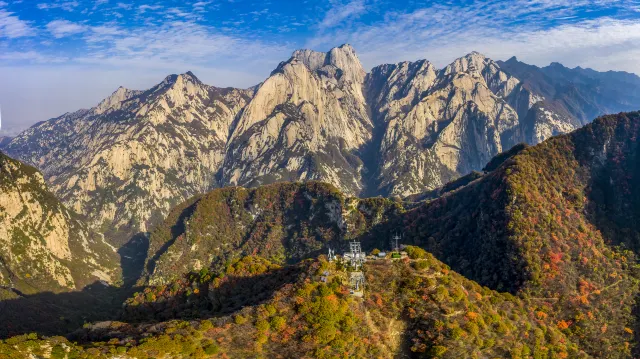
The West Peak cableway station sits on a forested spur below the granite ridge. Photo: Trip.com
West Peak is where the long cableway arrives, and its flat summit terrace is the easiest place on the mountain to get your bearings. The rock splits into a lotus shape, the cliff drops away on three sides, and the sunset light turns the granite orange. The legend of Chenxiang splitting the mountain to free his mother is set here, which is why you will see the cleft in the rock pointed out by every guide.
South Peak, at 2,154.9 m, is the highest summit of the Five Great Mountains. The top is a broad terrace with a small temple and a view that runs to the Wei River plain on clear days. The plank walk hangs off its southern cliff, and the queue forms on the path below the summit.
East Peak is the official sunrise spot, with a terrace that faces the eastern horizon and a small guesthouse for people who sleep up here. The Hawk Turning Over ladder is on its flank, and the cliff edge behind the terrace is one of the most photographed spots on the mountain.
The Central Peak is the lowest of the four central summits and the quietest, a wooded rise named for a Taoist goddess. Most people pass through it on the way between East and West without stopping, which makes it a good place to sit down when the ridge gets busy.
North Peak is the gateway for walkers and the end of the North cableway, with the stone tablet commemorating Jin Yong's Mount Hua sword debate and the start of the climb up Canglong Ridge. The ridge itself, a narrow spine of rock with a staircase along its top, is the most dramatic section of the traverse and the place where queues form in both directions.
This is the version that works for most visitors: an early train, the West-up and North-down traverse, and a late train back to Xi'an. It leaves room for the plank walk without turning the day into a race.
| Time | Where | What happens |
| 06:30 | Xi'an North station | Breakfast, passport check, board the 07:00 train |
| 07:40 | Huashan North station | Bus or taxi 15-20 minutes to the visitor centre |
| 08:10 | Visitor centre | Buy shuttle and cable car tickets, board the West line |
| 09:00 | West Peak | Taihua cableway up, walk the summit terrace |
| 10:30 | South Peak | Highest point, then the plank walk if the queue is short |
| 12:30 | East Peak | Hawk Turning Over, lunch from a stall or your pack |
| 14:00 | Central Peak to North Peak | Canglong Ridge, the long staircase down |
| 16:00 | North cableway | Shuttle back to the visitor centre by 16:40 |
| 17:30 | Huashan North station | Train to Xi'an, dinner in the city by 19:30 |
If you would rather not manage three separate tickets and two transfers, a guided day tour from Xi'an bundles the train or coach, the entry ticket, both cable cars and the shuttle, and adds a guide who knows where the queues form.
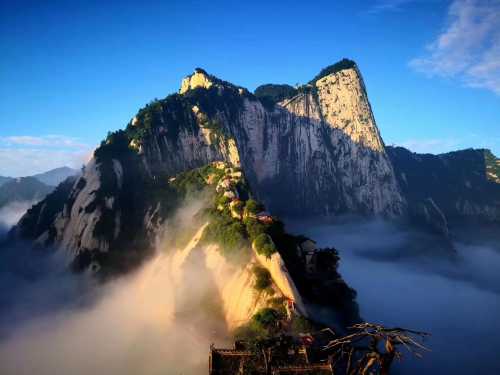
Stay on the mountain and do the sunrise properly. Take an afternoon train, ride up the West cableway, sleep at East Peak or West Peak, and be on the sunrise terrace at 05:30. The second day is a slow traverse of the remaining peaks, with time for the plank walk and the Hawk Turning Over before the last cable car down.
The two sights sit on opposite sides of Xi'an, so they do not fit into one day without a car and a very early start. The practical version is Mount Hua on day one and the Terracotta Army on day two, both by high-speed train or tour. If your time in Xi'an is short, choose one; each needs a full day.
Sleeping at the foot of the mountain buys you the 07:00 start without a 06:00 train from Xi'an. The options run from a simple hotel beside the visitor centre to a hot spring resort and a guesthouse on the summit itself.
The most practical base for a cable car day: a mid-range hotel a short walk from the visitor centre, with clean rooms, hot water and a restaurant that opens early enough for breakfast before the first shuttle. Ask for a room on the mountain side and you can watch the ridge light up while you eat.
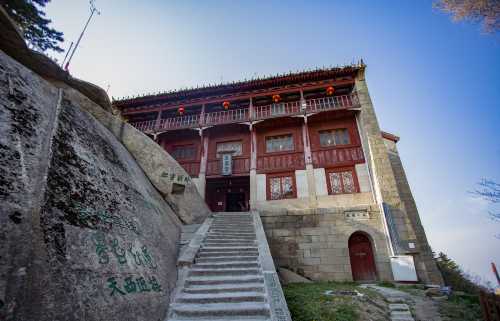
Huashan Xifeng Hotel
The splurge option, a hot spring resort at the foot of the mountain with outdoor pools fed by mineral water, spacious rooms and a proper restaurant. It is the place to soak your legs after the all-walking route, and it works well for couples or families who want one comfortable night between two days of hiking.
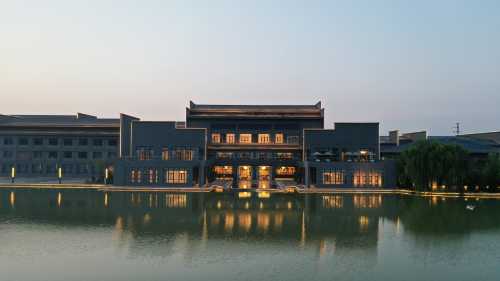
Shaanxi Dijian Nanshan (Huashan) Hot Spring Hotel
 No. 1 of Hot Spring Hotels in Mount Hua
A basic guesthouse on East Peak, steps from the sunrise terrace. Rooms are small and shared bathrooms are normal, bedding is limited and everything costs more than it would in town, because supplies come up by cable car. Book well ahead for weekends and holidays, and bring earplugs; the corridors are busy from 04:00.
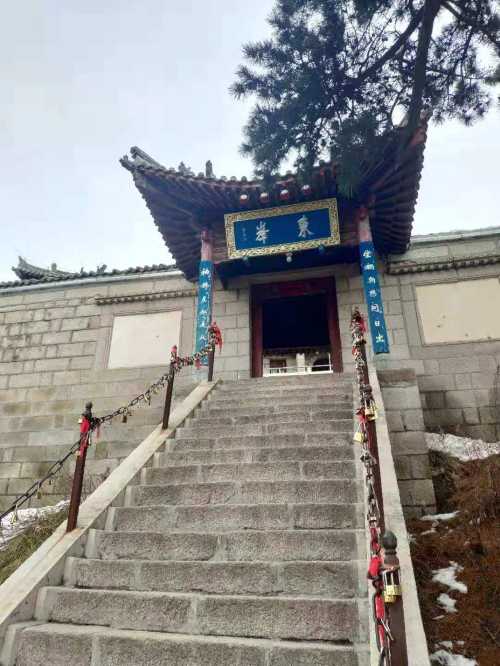
Mount Hua East Peak Hotel
Huayin town has the widest choice of ordinary hotels and the cheapest food, 15 minutes by taxi from the visitor centre. Staying in Xi'an works if you take the first train, but you will be leaving before the city wakes up and getting back after dark. For more city options, see our two-week China itinerary for how Xi'an fits into a longer route.
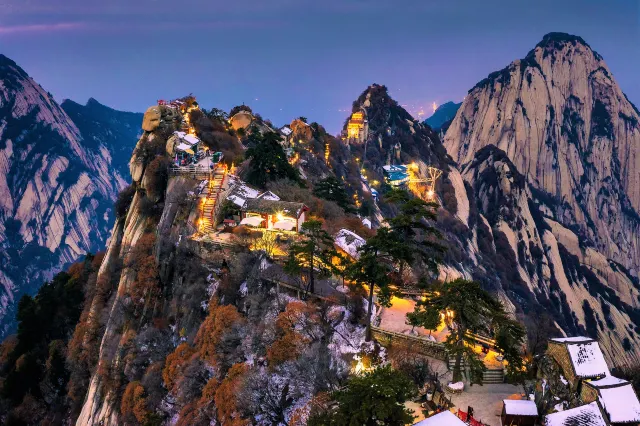
Summit temples and guesthouses light up at dusk; this is where sunrise guests sleep. Photo: Trip.com
Mount Hua is a full-day mountain with limited services above the cable car stations, so a little preparation changes the day. The food is simple, the water is heavy, and the stairs punish bad shoes.
At the visitor centre and in Huayin town you will find Shaanxi noodles, dumplings, roujiamo and bowls of hot soup for 15-30 CNY. On the mountain, stalls near the cable car stations sell instant noodles, sausages, tea eggs and bottled water at three or four times city prices; the summit guesthouses serve simple set meals. Bring nuts, chocolate or bread for the ridge, where there is nothing between peaks. For a proper Xi'an food day before or after, see our Xi'an street food guide.
A headlamp if you are climbing at night, thin gloves for the chains, a windproof shell, one warm layer, 1.5-2 litres of water, cash for stalls and harness fees, and a power bank. Trekking poles are useful on the descent but a nuisance on the chain sections, where you need both hands. Wear shoes with real grip; trainers are fine in dry weather, trail shoes are better after rain.
Toilets are available at the visitor centre, both cable car stations and the main peak areas, and they range from basic to primitive. Tap water is not drinkable; buy bottled water or carry a filter. Mobile payment works at most stalls, but the harness fee and some small vendors prefer cash, and the signal on the ridge is patchy.
Avoid the first week of October, the Lunar New Year week and the May Day holiday, when the cable car queue can exceed two hours and the plank walk queue closes early. Weekday mornings outside holidays are the quietest. If you must come on a holiday, book the timed entry slot the moment it opens and take the first shuttle.
The summit is 2,155 m, low enough that altitude sickness is not a concern, but the stairs are relentless: the traverse between peaks includes thousands of steps, many of them steep and uneven. Anyone with knee problems should take the cable car both ways and keep to the summit terraces. Children from about eight cope well with the West-up, North-down route; the plank walk and the Hawk Turning Over have their own height and age limits at the gate.
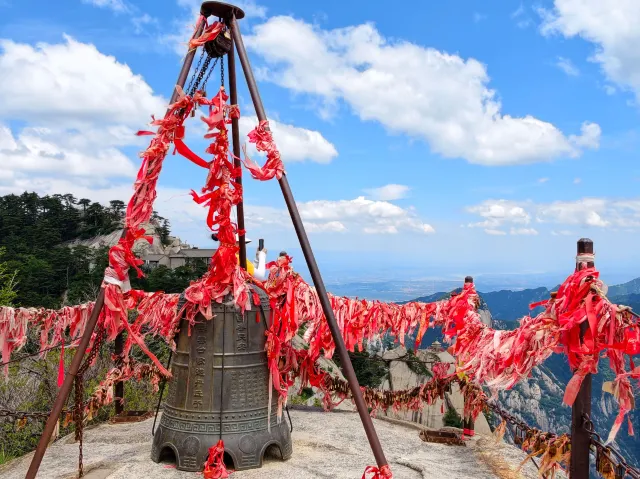
Red ribbons on the summit bell, where hikers leave a wish before the descent. Photo: Trip.com
Popular recommendations
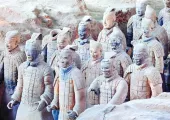
Terracotta Army Tickets 2026: Prices & How to Book
 OneVoyager

Xi'an Railway Station vs Xi'an North Railway Station 2026
OneVoyager
2026 Guide to Shanghai Pudong Airport: Transit Visa & PVG Airport Shuttle
 _TS***4m

Latest Trip.com Promo Codes, Flight Discounts & Hotel Savings (Weekly Update)
 Trip.com Official
Popular Picks

Pinnacle Hotel Vancouver Harbourfront
4.3/5(125)
£265.00£300.00
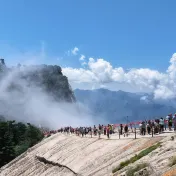
Xi'an Mount Huashan One-Day Tour | Tickets & Round-Trip Cable Car & Shuttle Bus Included | Breakfast/Coffee & Hiking Pole Provided
4.8/5(147)
£43.41

Four Queens Hotel and Casino
4.4/5(322)
£44.00£71.00

AmericInn by Wyndham Madison West
4.6/5(45)
£72.00

Mainland China 5G eSIM | Day Pass/Total Data Package | ChatGPT Available | 24-Hour Billing | 1-365 Days | QR Code
4.6/5(77,857)
£0.07£0.14