[Trip Planner in Lhasa] How to travel in Lhasa for 4 days and 3 nights, a comprehensive guide to itinerary planning!

Contents
- Trip Planner
- Overview of Lhasa Itinerary Planning
- Lhasa Day 1
- Potala Palace
- Norbulingka
- Tibet Museum
- Lhasa Day 2
- Jokhang Temple
- Jokhang Temple
- Sera Monastery
- Lhasa Day 3
- Namtso
- Lhasa Day 4
- Zhaji Temple
- Lhasa River
Show more
[Planning a new trip but don't know where to start? Let Trip.com's AI Itinerary Assistant generate custom itineraries with one click!]
✅ Copy a travel blog link to generate the same itinerary with one click
✅ Featured popular itineraries for the most authentic experience
✅ Import your favorite destinations and automatically arrange the best itinerary
✅ Check opening hours and recommended visit durations at attractions to ensure that every stop meets your expectations
This guide carefully plans a perfect 4-day and 3-night trip to Lhasa for you. Covering local attractions, authentic food and popular shopping areas, you can easily travel around Lhasa and enjoy a worry-free holiday. Whether it is an in-depth exploration of history and culture or a fashionable check-in in a modern metropolis, this guide can meet your needs. Come and start your wonderful trip to Lhasa!
The Potala Palace overlooks the whole city, you can turn the prayer wheels at the Jokhang Temple to pray, and you can see the prayer flags at the holy lake of Namtso, making a pilgrimage to both the holy city and the holy lake.
Admire the garden cultural relics in Norbulingka, worship the God of Wealth with fireworks at Zhaxi Monastery, watch the Buddhist debate at Sera Monastery, and take in the life of Tibetans in Lhasa River.
| Date | Journey |
| Day 1 | Potala Palace->Norbulingka->Tibet Museum |
| Day 2 | Jokhang Temple->Ramchho Temple->Sera Monastery |
| Day 3 | Namtso |
| Day 4 | Zhaji Temple->Lhasa River |
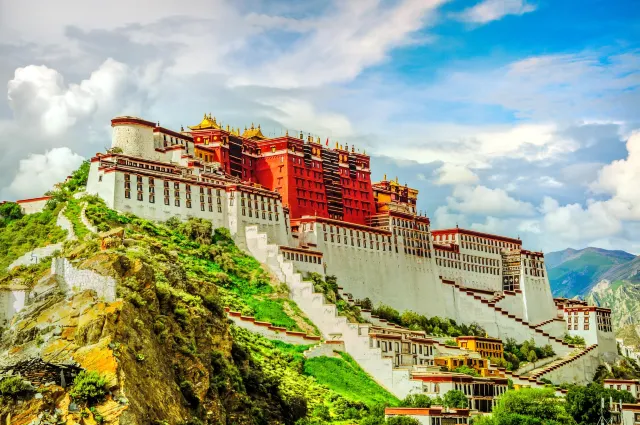
The Potala Palace is the symbol of Tibet and a sacred place in the hearts of all pilgrims! "Potala" is a Sanskrit word, also translated as "Putuo", which originally refers to the residence of Guanyin Bodhisattva. When you come here, you can not only view the large number of historical relics collected in the palace and appreciate the wonderful architectural art of the Tibetan people, but also have a baptism of the soul in that holy atmosphere. The origin of the Potala Palace. According to historical records, In the 1930s of the 7th century AD, the 33rd Tibetan king Songtsen Gampo moved the capital to Lhasa and built the Potala Palace. Since then, major religious and political ceremonies have been held here, making it the theocratic ruling center of Tibet. The White Palace and the Red Palace, Potala Palace, have distinct Tibetan style and are majestic. They are the only complete palace-style building complexes still existing in Tibet and are known as one of the top ten earthen buildings in the world. Its main buildings are divided into two parts: the White Palace and the Red Palace. The White House is named after its white exterior walls and is where the President lives and conducts political activities. Because the sun shines here all day long, they are called East and West Sunlight Halls. The Red Palace is located at the top center of the Potala Palace. Its outer walls are red, and it consists of numerous pagodas and Buddhist halls. Historical Relics The Potala Palace collects and preserves a large number of historical relics, including pagodas, statues, murals, thangkas, scriptures, as well as gold books, jade books, gold seals bestowed by emperors of the Ming and Qing dynasties, as well as gold and silver wares, jade wares, porcelain, enamel and handicrafts that indicate the historical relationship between the Tibetan local government and the central government. Among them, the eight pagodas built over the past five generations are eye-catching. They are all magnificent and adorned with a variety of gems, and can be called a palace of art.
Address: No. 35, Beijing Middle Road, Chengguan District, Lhasa, Tibet Autonomous Region
Business hours: Open from 09:00 to 17:30 tomorrow (no admission at 15:40)
evaluate:
| The Potala Palace is a must-visit place for everyone who goes to Lhasa. It combines palaces, castles, and temples in one. It contains countless rare treasures and has a profound historical and cultural background. It integrates the essence of Tibetan and Han architectural art and is worth a visit. |
Norbulingka, meaning "treasure garden", is the summer palace where successive lamas worked in the summer. It houses a large number of relics and treasures. The park is divided into three areas: the front garden area with the entrance attic on the east side, the core palace area in the middle, and the Golden Linka area dominated by a plant jungle in the west. Norbulingka has a beautiful environment, with a large variety and quantity of plants and flowers, and shade from the trees, making it like a "paradise" in Lhasa.
Address: No. 1 Minzu South Road, Chengguan District, Lhasa, Tibet Autonomous Region
Business hours: Open from 09:30 to 19:00 tomorrow (no admission at 17:20)
evaluate:
| Norbulingka is located in the western suburbs of Lhasa, right next to the Tibet Museum. If you want to visit, you can go to the museum first, and then go to Norbulingka in the afternoon. It is a small park and it takes two hours to visit the entire venue. The scenery is beautiful and you can take a rest inside, which is very comfortable. |
The Tibet Museum is located across the road from the eastern part of the Norbulingka in Lhasa. It is a museum with modern functions. The museum's exhibition hall consists of four parts: prehistoric culture, inseparable history, culture and art, and folk culture. It houses many precious cultural relics, showing the unique and charming splendid culture and long history of the Tibetan people.
Address: No. 19 Norbulingka Road, Chengguan District, Lhasa, Tibet Autonomous Region
Business hours: Open from 09:30 to 18:30 tomorrow (no admission at 17:30)
evaluate:
| The Tibet Museum is located in the southeast corner of Norbulingka in Lhasa. It is the first modern comprehensive museum in Tibet. Construction began in 1994, was completed and opened in 1999, and will reopen in 2022 after the new museum is expanded. The museum has a rich collection, totalling more than 520,000 pieces, including more than 40,000 precious cultural relics. The exhibition consists of permanent exhibitions and special exhibitions, such as "Song of the Snowland", "The Man Closest to the Sun", "Monument of the Snowland", etc. It is a national AAAA-level tourist attraction and a national first-class museum. |
Jokhang Temple, called "Jokhang" in Tibetan, also known as "Zulakang", is the end point of the pilgrimage for Tibetan Buddhists. In their hearts, the sacredness of Jokhang Temple is no less than that of the Potala Palace. Whether from a geographical location or in the minds of Tibetan Buddhist believers, the Jokhang Temple is a veritable holy place and center of Tibetan Buddhism, and it holds an extremely lofty and holy position in the history of Tibetan Buddhism. The Jokhang Temple was first built in the middle of the seventh century. It was built by the Tibetan King Songtsen Gampo to house the life-size statue of Sakyamuni at the age of 8, which was brought from his hometown of Kathmandu by his wife, Princess Bhrikuti of Nepal. In 1409, Tsongkhapa, the founder of the Gelug Sect, promoted Buddhism in the Jokhang Temple and held a grand ceremony to spread the Dharma, thus establishing its important position in the history of Tibetan Buddhism. In the 8th century AD, Princess Wencheng of the Tang Dynasty brought a life-size statue of Sakyamuni at the age of 12 from Chang'an when she entered Tibet. It was enshrined in the Jokhang Temple and has become the treasure of the temple. It is one of the attractions that tourists and pilgrims must not miss.

In addition, there are nearly a thousand-meter-long Tibetan murals, "Princess Wencheng's Journey to Tibet" and "Construction of the Jokhang Temple", as well as two Ming Dynasty embroidered thangkas of guardian gods, which are rare art treasures. There are three prayer paths in Lhasa, namely the inner, middle and outer ones, all of which revolve around the Jokhang Temple. Among them, the circle around the Thousand Buddha Hall and the Jokhang Hall in the temple is the inner circle, called "Nangkhor"; the circle around the outer periphery of the Jokhang Temple is the middle circle, called "Bakhor"; the circle around the Potala Palace, Yaowang Mountain, the Ramoche Temple and the Jokhang Temple is the outer circle, called "Lingkhor". After entering the Jokhang Temple through the main gate, there is a patio-style courtyard. On the east side of the courtyard, there are several rows of butter lamps. Because believers add butter every day, they are never extinguished all year round. Behind the butter lamps is the main entrance to the Jokhang Temple. On the left side of the entrance is Guru Padmasambhava, the founder of the Red Sect, and on the right side is Jampa Buddha, also known as Maitreya Buddha, also known as the Future Buddha. On the right wall is a mural depicting the story of the Jokhang Temple's construction. The main content is the appearance of the Potala Palace in the 7th century and the scene of filling the lake to build the Jokhang Temple. Going clockwise, you will find the Buddhist temple dedicated to Tsongkhapa, the founder of the Yellow Sect, and his eight major disciples. Continue to circle right, passing through the Yaksha Hall and Dragon King Hall on both sides, and behind hundreds of ghee lamps is the famous "Jokhang" Hall. It is both the main body and the essence of the Jokhang Temple. In the center of the Jokhang Hall is the Great Sutra Hall, where lamas chant sutras and practice on weekdays. There are many small sutra halls around it. One that cannot be missed is the Sakyamuni Hall in the center, which houses a life-size golden statue of Sakyamuni at the age of twelve brought by Princess Wencheng. This is the center of the Jokhang Temple and a holy place longed for by devout pilgrims who come here. There are stairs next to the courtyard leading to the second and third floors. On the second floor, there is the Dharma King Hall, which enshrines the Tibetan King Songtsen Gampo, Princess Wencheng, and Princess Bhrikuti, and the Bandan Lhamo Guardian Hall, which enshrines the Goddess of Good Fortune. Standing on the wide terrace on the second floor, you can overlook the Potala Palace, which is a great place to take photos. The golden roof on the third floor is also one of the attractions of the Jokhang Temple, but the third floor is not open to the public most of the time. If by chance you can climb to the third floor, the four magnificent golden roofs will be breathtaking.

Address: No. 2 Barkhor West Street, Chengguan District, Lhasa
Business hours: Open from 08:30 to 18:30 tomorrow (no admission after 18:30)
evaluate:
| Jokhang Temple, also known as "Zulakang" and "Jokhang" (meaning "Temple of Sakyamuni Buddha" in Tibetan), is a temple that houses a life-size statue of Sakyamuni Buddha at the age of twelve. It was built by the Tibetan King Songtsen Gampo. The reason why Lhasa is known as a "holy land"[1] is related to this statue. The temple was originally called "Resa", and later, Resa became the name of the city and evolved into the current "Lhasa". After the Jokhang Temple was built, it was repeatedly modified and expanded during the Yuan, Ming and Qing dynasties until it reached its current size. [2][3] The Jokhang Temple has a history of more than 1,300 years and holds a supreme position in Tibetan Buddhism. Jokhang Temple is the most splendid Tubo-period building still existing in Tibet. It is also the earliest civil engineering structure in Tibet and pioneered the Tibetan plain-style temple layout. The circle surrounding the Sakyamuni Buddha Hall in the center of the Jokhang Temple is called "Nangkhor", the circle surrounding the outer wall of the Jokhang Temple is called "Bakhor", and the street radiating from the Jokhang Temple is called "Bakhor Street" or Bajiao Street. The large circle with Jokhang Temple as the center, including the Potala Palace, Yaowang Mountain and Ramoche Temple, is called "Lingkor". The three circles, from the inside to the outside, are the routes that Tibetans take for their prayer circumambulation rituals. |
The Jokhang Temple is located on the Jokhang Temple Road, north of Beijing Road in Lhasa. It was first built in 641 AD by Princess Wencheng. The temple was named "Jyada Remuqi Zu Lakang", which means "Hanhu Shenbian Temple". Although the Jokhang Temple is not as big or as famous as the Jokhang Temple, it has its unique flavor. The architectural style of Jokhang Temple combines the characteristics of Han and Tibetan architecture. It was built by Han craftsmen brought by Princess Wencheng when she entered Tibet, so the early Jokhang Temple has obvious Han and Tang styles.
Address: 500 meters north of Jokhang Temple, Chengguan District, Lhasa, Tibet Autonomous Region
Business hours: Open from 08:30 to 16:00 tomorrow
evaluate:
| After visiting the Jokhang Temple, come to the Ramoche Temple, which is within walking distance. No reservation is required; just buy tickets at the door. The place is smaller than the Jokhang Temple, but there are still many places worth appreciating. I love to slowly look at the murals and imagine the stories inside; the architecture is also beautiful. You can worship and take photos inside. |
Sera Monastery, whose full name is Sera Mahayana Monastery, is located at the foot of Sera Uze Mountain in the northern suburbs of Lhasa. It was built during the Yongle period of the Ming Dynasty by Jiangqin Chogyal, a disciple of Tsongkhapa. Sera Monastery is large in scale, with numerous temple buildings built against the mountain and a towering golden roof that sparkles in the sun. It is one of the three largest monasteries in Lhasa and one of the six major monasteries of the Gelugpa (Yellow Sect).
Address: No. 1 Sela Road, Chengguan District, Lhasa
Business hours: Open from 09:00 to 16:00 tomorrow
evaluate:
| Overall structure of the building and layout: The building complex is built against the mountain and is staggered. It is mainly composed of the Coqen (large scripture hall), three major Zhasangs (colleges), monks' quarters and a debate field. Characteristic buildings: Coqen Hall: The largest building in the temple, it enshrines statues of Master Tsongkhapa and other Buddhas, and houses a large number of precious Buddhist scriptures and cultural relics. Maiba Dratsang, Gyi Dratsang and Aba Dratsang: The three major Dratsangs respectively studied exoteric Buddhism, esoteric Buddhism and medicine, etc. Hall of Hayagriva: The black thangka dedicated to the guardian deity Hayagriva is one of the treasures of Sera Monastery. |
Namtso Lake is 240 kilometers away from Lhasa. It is one of the three sacred lakes in Tibet and a famous holy place of Tibetan Buddhism. The endless snow-capped mountains beside the lake are the Nyainqentanglha Mountains. When the weather is fine, the towering snow-capped mountains are reflected in the lake, appearing tranquil and peaceful. During the Saga Dawa Festival on the 15th day of the fourth month of the Tibetan calendar every year, many monks and lay believers come to Namtso to circumambulate the lake.
Address: Namtso National Park, Damxiong County, Lhasa
Business hours: Open from 08:00 to 20:00 tomorrow (ticket sales stop at 18:00; admission stops at 20:00)
evaluate:
| It takes about two and a half hours to drive from Lhasa to Namtso. The itinerary was purchased based on the consideration that the direct bus to the scenic area did not provide oxygen and lunch services. However, the driver set off at around 7:30 and arrived in Dangxiong before 10:00. Although he asked everyone to have lunch, seven out of the 14 people did not eat, which delayed at least 20 to 30 minutes. The oxygen would be delayed for 20 to 30 minutes before getting on the highway, a full hour. After arriving at the scenic area, it took a total of two and a half hours. However, the round-trip bus to the scenic area only takes one and a half hours, so the actual time was only more than an hour. The time was very tight, but the driver was quite responsible. I don't know if all the itineraries are arranged in this way. This one hour can be fully spent in the scenic area. |
Zhaxi Temple is located on Zhaxi Road in the northern suburbs of Lhasa. It is a temple dedicated to the God of Wealth in Tibet. Although the temple is small, it is very popular. The accomplished monks bless the guests by wiping their heads and praying for their precious gifts. Many Tibetans and Han people come here to worship Buddha. The main deity of Zhaxi Temple loves wine, so people who come to Zhaxi Temple to worship will bring white wine or barley wine in addition to Hada.
Address: Opposite to Zhaji Retirement Community, Department of Justice, Zhaji East Road, Chengguan District, Lhasa, Tibet Autonomous Region
Business hours: Open from 09:00 to 16:30 tomorrow
evaluate:
| Zhaji Temple is worth visiting once in Lhasa. Mondays, Wednesdays and Fridays are crowded with people. It is a temple of the God of Wealth. You can buy a set of three offerings for the Zhaji Goddess outside the temple. There are many people inside. |
The Lhasa River originates from the southern foot of the Nyainqentanglha Mountains. Its lower reaches have a relatively open valley and are the main farming area in Tibet. The Lhasa River is the mother river of Lhasa City and has a great influence on the development of Lhasa. After the Tubo monarch Songtsen Gampo unified the Tibetan tribes, he moved the capital to the Lhasa River Valley. The Lhasa River basin developed accordingly and gradually became the political, economic, cultural and religious center of the Tibetan Plateau.
Address: Chengguan District, Lhasa
Opening hours: 24 hours a day, all year round
evaluate:
| The Lhasa River, called Jiqu in Tibetan, which means "Happy River" and "Happy River", originates from Lob Rula on the north side of the middle section of the Nyainqentanglha Mountains, flows through Medog County, Dagze District, and finally passes through Lhasa City and merges into the Yarlung Zangbo River in Qushui County of Lhasa City. The sunset that day was beautiful. |
Popular recommendations

Paris Museum Virtual Tours For You on the Couch
 TripBlog
Top 4 World's Most Walkable Cities: Locals' Guide
TripBlog
Food Matters: Top 6 Staycations with Delectable Breakfasts
Trip.com
Latest Trip.com Promo Codes, Black Friday Deals, Flight Discounts & Hotel Savings (Weekly Update)
 Trip.com Official
Q&A
What's the most popular attractions in Lhasa?
How to get to Lhasa from Shanghai?
How to get to Lhasa from Ningbo?
How to get to Namtso from Lhasa?
How to get to Ali from Lhasa?
What's the best food in Lhasa?
Trending Travelogues
Popular Trip Moments
Popular Attractions
Popular Ranked Lists
Popular Destinations
Recommended Attractions at Popular Destinations


About






of the year 2025



Site Operator: Trip.com Travel Singapore Pte. Ltd.