[Free Travel in Lhasa] How to travel in Lhasa for 3 days and 2 nights, a comprehensive guide to itinerary planning!

Contents
- Trip Planner
- Overview of Lhasa itinerary planning
- Lhasa Day 1
- Sera Monastery
- Zongjiaolukang Park
- Potala Palace
- Barkhor Street
- Lhasa Day 2
- Namtso
- Lhasa Day 3
- Norbulingka
- Tibet Museum
- Yaowang Mountain
Show more
[Planning a new trip but don't know where to start? Let Trip.com's AI Itinerary Assistant generate custom itineraries with one click!]
✅ Copy a travel blog link to generate the same itinerary with one click
✅ Featured popular itineraries for the most authentic experience
✅ Import your favorite destinations and automatically arrange the best itinerary
✅ Check opening hours and recommended visit durations at attractions to ensure that every stop meets your expectations
This guide carefully plans a perfect 3-day and 2-night trip to Lhasa for you. Covering local attractions, authentic food and popular shopping areas, you can easily travel around Lhasa and enjoy a worry-free holiday. Whether it is an in-depth exploration of history and culture or a fashionable check-in in a modern metropolis, this guide can meet your needs. Come and start your wonderful trip to Lhasa!
See the Buddhist debate at Sera Monastery, photograph the Potala Palace's reflection at Zongjiao Lukhang, sip sweet tea on Barkhor Street, and discover the mysteries of the Potala Palace, a simplified representation of Lhasa's philosophy and way of life.
See the holy lake and history in one day by taking a stroll around Namtso Lake and admiring the snow-capped mountains, reading the Tibet Museum's thousand-year-old treasures, and checking in at Yaowang Mountain using the same RMB.
| date | journey |
| Day 1 | Sera Monastery->Zongjiaolukhang Park->Potala Palace->Barkhor Street |
| Day 2 | Namtso |
| Day 3 | Norbulingka->Tibet Museum->Yaowang Mountain |
In the northern suburbs of Lhasa, at the base of Sera Uze Mountain, sits Sera Monastery, also known as Sera Mahayana Monastery. Jiangqin Chogyal, a follower of Tsongkhapa, constructed it during the Yongle era of the Ming Dynasty. The Sera Monastery is enormous, with a tall golden roof that gleams in the sunlight and other temple structures set against the mountain. It is one of the six main Gelugpa (Yellow Sect) monasteries and one of the three biggest in Lhasa.
Address: No. 1 Sela Road, Chengguan District, Lhasa
Business hours: Open from 09:00 to 16:00 tomorrow
evaluate:
| Overall structure of the building and layout: The building complex is built against the mountain and is staggered. It is mainly composed of the Coqen (large scripture hall), three major Zhasangs (colleges), monks' quarters and a debate field. Characteristic buildings: Coqen Hall: The largest building in the temple, it enshrines statues of Master Tsongkhapa and other Buddhas, and houses a large number of precious Buddhist scriptures and cultural relics. Maiba Dratsang, Gyi Dratsang and Aba Dratsang: The three major Dratsangs respectively study exoteric Buddhism, esoteric Buddhism and medicine, etc. Hall of Hayagriva: The black thangka dedicated to the guardian deity Hayagriva is one of the treasures of Sera Monastery. |
Zongjiaolukhang Park, sometimes called Longwangtan Park, is situated behind the Potala Palace. Folk activity area, ecological water scenic region, Longtan scenic area, water-friendly activity area, and cultural activity area are its five scenic areas. The park is open and features lawns, fountains, stone tables and chairs, gravel roads, and other landscaping features. Zongjiaolukhang Park is now a popular spot for Lhasa residents to unwind and work out in the morning. It is also a place to go around the prayer wheels that are comparatively close to the Potala Palace.
Address: No. 9, Niangre South Road, Chengguan District, Lhasa
Opening hours: 24 hours a day, all year round
evaluate:
| [Scenery] Zongjiao Lukang Park is also very beautiful at night. With the Apple original camera, all photos look good. [Fun] There are ducks in the water and the lights are beautiful. [Cost-effectiveness] It's free and very cost-effective! |
The Potala Palace holds a special place in the hearts of all pilgrims and is the representation of Tibet! In Sanskrit, "Potala" (sometimes rendered as "Putuo") originally denoted the Guanyin Bodhisattva's home. In addition to admiring the magnificent architectural art of the Tibetan people and the numerous historical artifacts gathered in the palace, visitors can experience a spiritual immersion in this hallowed setting. The Potala Palace's history Historical accounts state that Songtsen Gampo, the 33rd Tibetan ruler, constructed the Potala Palace and relocated the capital to Lhasa in the 1930s of the 7th century AD. Since then, it has been the site of significant political and religious events, making it Tibet's theocratic capital. Both the White Palace and the Red Palace Potala Palace are magnificent and have a distinctly Tibetan design. They rank among the top ten earthen structures in the world and are the only entire palace-style architectural complexes still standing in Tibet. The White Palace and the Red Palace are the two sections that comprise its principal structures. The lamas reside and carry out their political activities at the White House, which gets its name from its white outside walls. They are known as East and West Sunlight Halls because the sun shines here throughout the day. In the uppermost part of the Potala Palace stands the Red Palace.Its outer walls are red and it consists of numerous pagodas and Buddhist halls. Historical Relics The Potala Palace collects and preserves a large number of historical relics, including pagodas, statues, murals, thangkas, scriptures, as well as gold books, jade books, gold seals bestowed by emperors of the Ming and Qing dynasties, as well as gold and silver wares, jade wares, porcelain, enamel and handicrafts that indicate the historical relationship between the Tibetan local government and the central government. Among them, the eight pagodas built over the past five generations are eye-catching. They are all magnificent and adorned with a variety of gems, and can be called a palace of art.
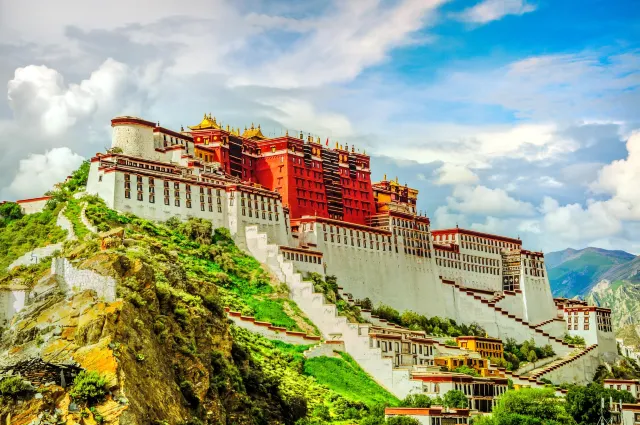
Address: No. 35, Beijing Middle Road, Chengguan District, Lhasa, Tibet Autonomous Region
Business hours: Open from 09:00 to 17:30 tomorrow (no admission at 15:40)
evaluate:
| The Potala Palace is a must-visit place for everyone who goes to Lhasa. It combines palaces, castles, and temples into one. It contains countless rare treasures and has a profound historical and cultural background. It integrates the essence of Tibetan and Han architectural art and is worth a visit. |
In Lhasa, Tibet, Barkhor Street—also called Bajiao Street—is situated. It is a thousand-year-old roadway that symbolizes Tibetan folklore. The historic street has a lengthy history and a modest cultural legacy. This street combines the selling of regional Tibetan dishes, sightseeing, traditional folk practices, and historic structures with Tibetan features. It is one of Lhasa's must-see tourist destinations.
Address: Chengguan District, Lhasa, Tibet Autonomous Region
Opening hours: 24 hours a day, all year round
evaluate:
| The history of Barkhor Street can be traced back to the 7th century AD, and it was originally developed for the construction of the Jokhang Temple. As time goes by, this place has gradually become a multifunctional area integrating culture, commerce, religion, and residence. Today, Barkhor Street is not only an important religious site that attracts pilgrims from all over the world, but also a bustling commercial center with many shops selling traditional Tibetan items and tourist souvenirs. This place has a history of more than 1,300 years, witnessing the interaction, exchange and integration between the Tibetan and Han peoples. Barkhor Street was selected as the first "Famous Historical and Cultural Street in China" and was named as the third batch of national-level tourist and leisure districts in 2023. |
Lhasa is 240 kilometers from Namtso Lake. It is a well-known holy site in Tibetan Buddhism and one of the three sacred lakes in Tibet. The Nyainqentanglha Mountains are the infinite snow-capped mountains that border the lake. In good weather, the lake reflects the majestic snow-capped mountains, which seem serene and calm. Every year on the fifteenth day of the fourth month in the Tibetan calendar, a large number of lay believers and monks travel to Namtso to walk around the lake during the Saga Dawa Festival.
Address: Namtso National Park, Damxiong County, Lhasa
Business hours: Open from 08:00 to 20:00 tomorrow (ticket sales stop at 18:00; admission stops at 20:00)
evaluate:
| It takes about two and a half hours to drive from Lhasa to Namtso. The itinerary was purchased based on the consideration that the direct bus to the scenic area did not provide oxygen and lunch services. However, the driver set off at around 7:30 and arrived in Dangxiong before 10:00. Although he asked everyone to have lunch, seven out of the 14 people did not eat, which delayed at least 20 to 30 minutes. The oxygen would be delayed for 20 to 30 minutes before getting on the highway, a full hour. After arriving at the scenic area, it took a total of two and a half hours. However, the round-trip bus to the scenic area only takes one and a half hours, so the actual time was only more than an hour. The time was very tight but the driver was quite responsible. I don't know if all the itineraries are arranged in this way. In fact, this one hour can be fully used to spend in the scenic area. |
The term "treasure garden" refers to Norbulingka, the summer palace where succeeding lamas worked throughout the summer. Numerous antiquities and treasures are kept there. The park is separated into three sections: the core palace region in the center, the Golden Linka area, which is dominated by plant jungle in the west, and the front garden area with the entrance staircase on the east side. Norbulingka is a "paradise" in Lhasa because of its lovely surroundings, which include a wide variety and abundance of flora and flowers as well as shade from the trees.
Address: No. 1 Minzu South Road, Chengguan District, Lhasa, Tibet Autonomous Region
Business hours: Open from 09:30 to 19:00 tomorrow (no admission at 17:20)
evaluate:
| Norbulingka is located in the western suburbs of Lhasa, right next to the Tibet Museum. If you want to visit, you can go to the museum first, and then go to Norbulingka in the afternoon. It is a small park and it takes two hours to visit the entire venue. The scenery is beautiful and you can take a rest inside, which is very comfortable. |
The Tibet Museum is located across the road from the eastern part of the Norbulingka in Lhasa. It is a museum with modern functions. The museum's exhibition hall consists of four parts: prehistoric culture, inseparable history, culture and art, and folk culture. It houses many precious cultural relics, showing the unique and charming splendid culture and long history of the Tibetan people.
Address: No. 19 Norbulingka Road, Chengguan District, Lhasa, Tibet Autonomous Region
Business hours: Open from 09:30 to 18:30 tomorrow (no admission at 17:30)
evaluate:
| The Tibet Museum is located in the southeast corner of Norbulingka in Lhasa. It is the first modern comprehensive museum in Tibet. Construction began in 1994, was completed and opened in 1999, and will reopen in 2022 after the new museum is expanded. The museum has a rich collection, totaling more than 520,000 pieces, including more than 40,000 precious cultural relics. The exhibition consists of permanent exhibitions and special exhibitions, such as "Song of the Snowland", "The Man Closest to the Sun", "Monument of the Snowland", etc. It is a national AAAA-level tourist attraction and a national first-class museum. |
Beijing Road runs between the Red Mountain and Yaowang Mountain, which are situated on the southwest side of the Potala Palace and directly across from each other. One of the best places to take pictures of the Potala Palace is from the observation deck located halfway up the mountain. The pattern on the reverse of the 50-yuan RMB note was also taken there. Photographers congregate here every morning to capture the sunrise over the Potala Palace for their photographs.
Address: Near No. 41, Beijing Middle Road, Chengguan District, Lhasa
Business hours: Open from 7:00 to 19:00 tomorrow (no admission at 19:00)
evaluate:
| Family, Yaowang Mountain is really worth a visit! It’s a must-go place for a 50-yuan check-in. As soon as you step into Yaowang Mountain, the fresh air hits you in the face, making you feel refreshed instantly. The mountain is covered with lush vegetation and full of green, as if you are in a green ocean, which greatly relaxes your body and mind. The cultural landscape of Yaowang Mountain is even more shocking. Along the way, you can see many ancient temples and inscriptions, each of which carries a profound historical and cultural heritage, making people marvel at the wisdom and skills of the ancients. These ancient monuments have gone through the baptism of time and still exude a unique charm, as if telling stories of the past. Moreover, the process of climbing is also very interesting. The mountain road is well planned and not too steep. There are various scenery along the way, so it will not feel boring at all. The moment you reach the top of the mountain and overlook the beautiful scenery around you, you will feel a sense of accomplishment. |
Popular recommendations

Paris Museum Virtual Tours For You on the Couch
 TripBlog
Top European Bucket List Foods and the Best Places to Try Them
TripBlog
Food Matters: Top 6 Staycations with Delectable Breakfasts
Trip.com
Latest Trip.com Promo Codes, Black Friday Deals, Flight Discounts & Hotel Savings (Weekly Update)
 Trip.com Official
Q&A
What's the most popular attractions in Lhasa?
How to get to Lhasa from Shanghai?
How to get to Lhasa from Ningbo?
How to get to Namtso from Lhasa?
How to get to Ali from Lhasa?
What's the best food in Lhasa?
Trending Travelogues
Popular Trip Moments
Popular Attractions
Popular Ranked Lists
Popular Destinations
Recommended Attractions at Popular Destinations


About






of the year 2025



Site Operator: Trip.com Travel Singapore Pte. Ltd.