[Luoyang Free Travel] How to enjoy Luoyang travel in 3 days and 2 nights, a comprehensive itinerary planning package!

Contents
- Trip Planner
- Luoyang itinerary planning overview
- Luoyang Day 1
- Luoyang Museum
- Longmen Grottoes
- Luoyang Day 2
- Luoyang Ancient Tomb Museum
- Emperor's Chariot Museum
- Tiantang Mingtang Scenic Area of Sui and Tang Luoyang City National Heritage Park
- Ruins of Yingtian Gate of Luoyang City in Sui and Tang Dynasties
- Lijingmen Scenic Area
- Luoyang Day 3
- White Horse Temple
- Heluo Ancient City
Show more
[Planning a new trip but don't know where to start? Let Trip.com's AI Itinerary Assistant generate custom itineraries with one click!]
✅ Copy a travel blog link to generate the same itinerary with one click
✅ Featured popular itineraries for the most authentic experience
✅ Import your favorite destinations and automatically arrange the best itinerary
✅ Check opening hours and recommended visit durations at attractions to ensure that every stop meets your expectations
This guide carefully plans a perfect 3-day and 2-night trip in Luoyang for you. Covering local attractions, authentic food and popular shopping areas, you can easily travel around Luoyang and enjoy a worry-free holiday. Whether it is an in-depth exploration of history and culture or a fashionable check-in in a modern metropolis, this guide can meet your needs. Come and start your wonderful trip to Luoyang!
Admire treasures in museums, see the Giant Buddha at Longmen Grottoes, and take in the cultural heritage of this ancient capital of 13 dynasties in one day.
Explore the underground palace in the ancient tomb, climb to the Tianmen in the Mingtang, and enjoy the soup at the Lijingmen, connecting the royal family and fireworks of the imperial capital.
| date | journey |
| Day 1 | Luoyang Museum->Longmen Grottoes |
| Day 2 | Luoyang Ancient Tomb Museum->Emperor's Six-horse Chariot Museum->Tiantang Mingtang Scenic Area of Sui and Tang Luoyang City National Heritage Park->Yingtianmen Ruins of Sui and Tang Luoyang City->Lijingmen Scenic Area |
| Day 3 | White Horse Temple->Heluo Ancient City |
Luoyang Museum is located on the south bank of Luo River and on the north side of the Sui and Tang City Ruins Botanical Garden. Although Luoyang Museum is a museum in a prefecture-level city, the quantity and quality of its collections are comparable to many provincial museums. You can come here to fully experience the long history and culture of the ancient capital of Luoyang.
The museum is currently open to the public free of charge. After collecting the ticket at the ticket counter at the gate, you can enter the museum for a visit. The museum consists of a main building and an auxiliary building. There is an electronic browsing machine at the entrance on the first floor of the main building, which introduces some of the museum's treasures. You can browse it first to get a general idea.
The main building of the museum has two floors. The first floor is generally a general exhibition, and the second floor is the museum's boutique exhibition. The museum's special palace culture exhibition is also located on the second floor. Although the first floor is a general exhibition, the cultural relics on display will also amaze you. As the ancient capital of 13 dynasties, Luoyang has a unique status, so there is naturally no shortage of rare treasures in the collection of cultural relics. When you enter the main building for a tour, you can start from the basic display "Heluo Civilization" on the first floor, and look back on the process of civilization changes in Luoyang, the thousand-year-old capital, and then go to the second floor to visit special exhibitions such as the "Boutique Display Exhibition" and the Palace Culture Exhibition.
In the Luoyang Museum, you can see the "Nipple-patterned Bronze Jue" from the Xia Dynasty; the "Inlaid Gold and Silver Bronze Tripod" from the Warring States Period, which is decorated with gold and silver using gilding, inlaid gold and silver and other techniques. The inlaid gold and silver are symmetrical and harmonious, and the decoration is gorgeous; as well as the "Clay Human Face Statue" from the Northern Wei Dynasty. Although the original color painting of this Buddha statue was lost due to a fire, it did not affect its beauty at all; and the three-color lanterns and three-color horses from the Tang Dynasty are brightly colored and uniquely shaped. The appearance of the three-color lanterns absorbs the connotation of Buddhist art, and the shape of the three-color horses follows the traditional composition rule of "circle square circle", reflecting the unrestrained and upward style of the Tang Empire.
In addition to local unearthed cultural relics, Luoyang Museum has also accepted a number of treasures allocated by the Palace Museum, so you can also see collections from the Palace Museum here, such as: the Nepalese-style "Gilded Bronze Guanyin", this Buddha statue is more than 1 meter high, large in size and has a rare sitting posture; there is also the "Silver Gilded Tsongkhapa Statue", the casting, gilding, engraving, inlaying and other craftsmanship of the statue are very exquisite, and the materials are made of precious gold and silver. It is a Buddha statue offered by the royal family of the Qing Dynasty.
The display locations of museum collections may sometimes be adjusted. Please consult the staff on site for the specific locations. Visitors can also rent audio guides or hire tour guides on the first floor of the museum.
Address: Northwest corner of the intersection of Nietai Road and Wenbo Road, Luolong District, Luoyang City, Henan Province
Business hours: Open from 09:00 to 17:00 tomorrow (no admission at 16:30)
evaluate:
| I booked a guided tour of Luoyang Museum on Ctrip during the May Day holiday and was fortunate to meet Teacher Li. This "high-priced" tour was totally worth the money! Teacher Li’s explanations are humorous and vivid. Different from the conventional introductions of cultural relics and allusions, he is good at guiding children to think deeply and let them understand the significance of visiting a museum and the connection between history and current life. Inspired by him, the children have a new understanding of history. This thought-provoking visiting experience is great! Highly recommended! |
Longmen Grottoes is one of the four major grottoes in China. It is listed as a World Cultural Heritage and is a treasure house of Buddhist art that has lasted for thousands of years. With the Yi River as the boundary, the grottoes are divided into two parts, West Mountain and East Mountain. Most of the East Mountain Grottoes are works from the Tang Dynasty, while the West Mountain Grottoes were excavated in the Northern Dynasties and the Sui and Tang Dynasties and are the essence of the grottoes. The Buddha and Bodhisattva sculptures in the Longmen Grottoes are compassionate and kind, with various graceful postures. The cold grottoes are solemn and dignified. These sculptures can be regarded as precious relics of Buddhist art.
Address: No. 13, Longmen Middle Street, Luolong District, Luoyang City, Henan Province
Business hours: Open from 08:00 to 21:00 tomorrow (ticket sales stop at 19:30; admission stops at 20:00)
evaluate:
| The Giant Buddha in Longmen Grottoes is so stunning, a symbol of the ancients’ craftsmanship and wisdom, and their respect for Buddhism. It only costs 8 yuan to take a taxi from Longmen High-speed Railway Station to Longmen Grottoes. It is indeed a great tourist attraction that will make you linger. |
Luoyang Ancient Art Museum is located in Mangshan Town, Luoyang City. It is divided into the tomb area of successive dynasties, the tomb of the Northern Wei emperors and the mural museum exhibition area. Tombs from various periods in ancient my country are stored here, all of which have been moved from their original sites and restored in their original tomb forms in the underground exhibition area. Visitors can get close to the interior environment of the ancient tomb, including the tomb architecture, unearthed cultural relics, brick carving art, etc.
Address: No. 6 Airport Road, Laocheng District, Luoyang City, Henan Province
Business hours: Open from 09:00 to 17:00 tomorrow (admission ends at 16:00)
evaluate:
| The Lulong tour guide was very detailed and knowledgeable, and his introduction to the national treasures of the museum was comprehensive and in-depth, which was very rewarding. During the explanation, he often interacted with the audience and actively responded to questions, which enhanced the sense of participation. Worth a thumbs up! |
The Emperor's Chariot Museum is a museum that displays artifacts on their original site. It is divided into two exhibition areas, where you can see the historical introduction of Luoyang City as the royal capital of the Zhou emperor during the Eastern Zhou Dynasty, as well as exhibition areas for bronze ware and large chariot and horse pits. The remains of a "six-horse chariot" in the No. 5 chariot pit are quite shocking. This was the chariot ridden by the Zhou emperor at that time.
Address: No. 226, Zhongzhou Middle Road
Business hours: Open from 08:30 to 18:30 tomorrow (ticket sales stop at 18:00)
evaluate:
| The entire museum is not big. You can see the burial pit after going up the stairs on the left hand side of the entrance. The first floor is an introduction to the tomb pit and unearthed cultural relics. It is only two minutes away on the left hand side after exiting Zhouwangcheng subway station. You have to go down the stairs to enter the main gate. |
The Sui and Tang Luoyang City National Heritage Park was once the core area of the palace ruins of the Sui, Tang, Five Dynasties and Song Dynasties. Among them, the famous ones are the Mingtang and Tiantang during the Wu Zetian period. Mingtang is located on the central axis of Luoyang City in Sui and Tang Dynasties. It is the main hall of the palace city and an important place for Emperor Gaozong of Tang and Empress Wu Zetian to unify the country and govern the country. The prototype of the Tower of Heaven in the 2013 film Detective Dee and the Mystery of the Phantom Flame directed by Tsui Hark is here.
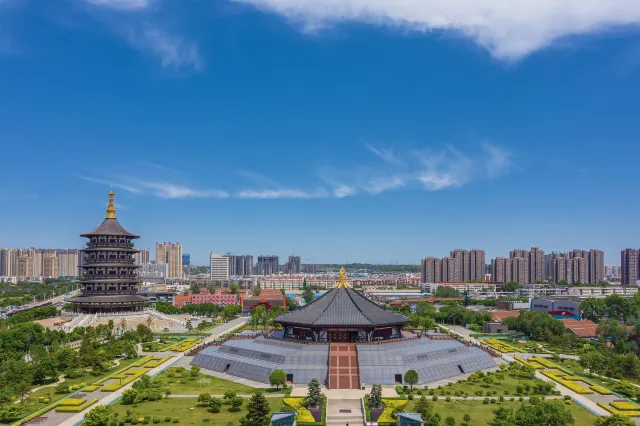
The building of heaven has five floors on the outside and nine floors on the inside, symbolizing the supreme status of the emperor. Visitors can take the elevator directly to the ninth floor to overlook the panoramic view of Luoyang, and the night view is not to be missed. There are also large and small Buddha statues and murals on other floors, where you can learn about the profound Buddhist culture.
Address: Northwest corner of the intersection of Zhongzhou Road and Dingding Road in the old city of Luoyang
Opening hours: 09:00-22:30 (no admission after 22:30)
evaluate:
| Fortunately, you can go and take a look! The service attitude is very good! ! ! ! ! ! ! ! ! ! ! ! ! ! ! ! ! ! ! ! ! ! ! ! ! ! ! ! ! ! ! ! ! ! ! ! ! ! ! ! ! ! ! ! ! ! ! ! ! |
Yingtian Gate was the south gate of the palace city of Luoyang City during the Sui and Tang Dynasties. It was first built in the first year of the Sui Dynasty, which was 605 AD. It went through four periods, namely the Sui, Tang, Five Dynasties and Northern Song Dynasty. It was burned down by the Jin army in 1128, the second year of Jianyan in the Southern Song Dynasty. It had been in use for 523 years. Yingtian Gate was an important venue for major state celebrations and diplomatic activities at that time. The emperor would go up to the gate to hold court on important occasions such as the New Year's Day, the Winter Solstice, music performances, banquets, pardons, the old year and the new, when envoys from all nations came to pay tribute, and when guests from all over the world came to visit. Its function was similar to that of the current Wumen Gate in Beijing. This city gate witnessed the prosperous era when Emperor Yang Guang of the Sui Dynasty entered the Eastern Capital, Emperor Gaozong of the Tang Dynasty released the King of Buyeo of Baekje, the empress ascended the throne, and Emperor Xuanzong of the Tang Dynasty received the eighth Japanese envoy to the Tang Dynasty. During every Lantern Festival, a grand performance of various operas is held at Yingtianmen Square. During grand occasions, the performance team will stretch from here all the way to the south gate of Guocheng, 4 kilometers away. The name of Yingtian Gate has been different in different periods: when it was first built in the Sui Dynasty, it was called "Zetian Gate" because of the meaning of "taking Heaven as a rule" in "The Analects of Confucius"; in the first year of Tang Shenlong (705), during the reign of Emperor Zhongzong Li Xian, it was renamed Yingtian Gate to avoid Empress Wu's title "Zetian the Great Emperor". During the Kaiyuan period of Emperor Xuanzong of Tang Dynasty, the tower was renamed Wufeng Tower and was used until the Five Dynasties and Northern Song Dynasty. In the late Northern Song Dynasty, the Jin army invaded the Central Plains and Luoyang became a battlefield and suffered severe damage. The Jin army burned down the prosperous Luoyang City of Sui and Tang Dynasties that had existed for more than 530 years, and Yingtian Gate gradually faded out of people's sight. Yingtian Gate is magnificent in scale and grand in appearance. It is one of the buildings in Chinese ritual system that can demonstrate identity and status. "Yuan Dynasty Henan Chronicles" records: The main gate of the palace is called Zetian Gate. There are two pavilions in the gate. The upper one is called Ziwei Pavilion, with gates on the left and right, and the gates are 120 feet high. According to the Tang Dynasty's 29.4 cm per foot, which is equivalent to about 36 meters today, this magnificent city tower is about as high as a twelve or thirteen-story building today. Bai Juyi, a poet in the Tang Dynasty, once gazed south from Yingtian Gate and composed a poem: "Longmen is like green eyebrows facing each other, and Yishui is like a golden line." From Yingtian Gate, you can see Longmen Yique, 15 kilometers away, showing the magnificence of Yingtian Gate.
Address: No. 23 Dingding South Road, Laocheng District, Luoyang City, Henan Province
Opening hours: 09:00-22:30 (no admission after 22:30)
evaluate:
| 🏮The full name of the scenic spot is the Ruins of Yingtian Gate of Luoyang City in Sui and Tang Dynasties. It is the original site of Luoyang City built during the Wu Zetian period. It was rebuilt on the original site based on the location of the archaeological foundation and the architectural drawings unearthed from the mausoleum. The only thing that was not restored was the Heaven Tower, which was the tallest building in the world at that time, with a height of 150 meters. However, in order to protect the foundation ruins, Luoyang only rebuilt it to a height of 88 meters. |
The Lijingmen Scenic Area was first built in the Sui Dynasty. According to the "Research on the City Streets of the Two Capitals of the Tang Dynasty", there were two gates on the west side of the Eastern Capital Imperial City, the Lijing Gate in the south and the Xuanhui Gate in the north. Today, after development and renovation, Lijingmen has become a comprehensive scenic spot integrating historical sites, folk customs, catering, entertainment and accommodation. Among them, ancient temples such as Tianhou Palace, Jiudi Palace, Three Gods Temple, City God Temple, and Guanyin Temple are listed and have been rated as one of the new eight scenic spots in Luoyang.
Address: Intersection of Ximenkou Street and Jinye Road, Old Town, Luoyang City, Henan Province
Opening hours: 08:30-22:00
evaluate:
| As a landmark of the old city, Luoyang Lijing Gate is generally a tourist attraction that is worth a visit. With its rebuilt city tower and old street atmosphere, it provides tourists with a convenient window to experience the charm of the ancient capital. However, if measured by the standards of historical authenticity or deep cultural immersion, there is still room for improvement. |
The White Horse Temple was first built in 68 AD. It was the first temple built by the government after Buddhism was introduced into my country. There are five major halls in the temple, located on a central axis. The main hall is the second-level Great Buddha Hall, which is also the main place for rituals. Now a new "World Buddhist Temple Expo Area" has been built next to the White Horse Temple to display Buddhist temples in the styles of countries such as India, Thailand, Sri Lanka, Nepal, Myanmar, Japan, and South Korea.
Address: No. 6 Luobai Road, Baimasi Town, Chanhe District, Luoyang City, Henan Province
Business hours: Open from 07:40 to 18:40 tomorrow (no admission at 18:00)
evaluate:
| You must do these three things when you come to the White Horse Temple: 1️⃣ Burn incense and pray for blessings 2️⃣ Drink tea in the Silent Teahouse 3️⃣ Visit the International Buddha Hall 🔴 There is a thousand-year-old wishing well in the Jieying Hall, and burning incense is particularly effective 🔴 Pray for good health in the Great Buddha Hall, usually light five incense sticks and bow three times towards the main hall 🟡 The Thai Buddha Hall enshrines the relics of Sakyamuni Buddha 🟢 The Silent Teahouse is hidden in a bamboo forest, with Chinese tea inside. It is a place for visiting tourists to provide tea and rest. There are signposts on the road, and you cannot talk 😉🟤 The Qiyun Pagoda Courtyard next to the White Horse Temple contains the tomb of Di Renjie and the first nunnery in China, as well as the first stupa in China. It is the most worthwhile monument to see. The only international temple that integrates Buddhist temples from China, India, Myanmar and Thailand. Take photos 📷 |
The design concept of the "Heluo Ancient City" project is to use Heluo culture as the background, Ming and Qing architecture as the main carrier, and supplemented by the architectural style of the Sui and Tang Dynasties, to showcase Luoyang's humanistic culture and traditional architectural culture for thousands of years. As an urban cultural tourism complex, "Heluo Ancient City" integrates food, accommodation, transportation, travel, shopping and entertainment. After completion, it will be a relatively large tourist distribution center and secondary consumption place in Luoyang City.
Address: East of the intersection of Zhongzhou East Road and Erguang Expressway, Luolong District, Luoyang City
Business hours: Open from 09:00 to 18:00 tomorrow
evaluate:
| It used to be pretty good, but now the developer has withdrawn its investment because the housing prices are too high and it has gone bankrupt. But the scenery is still good and worth a visit. |
Popular recommendations
Top 19 Hippest Mid-Size US Cities
 TripBlog
Latest Trip.com Promo Codes, Black Friday Deals, Flight Discounts & Hotel Savings (Weekly Update)
 Trip.com Official
6 Things to know before Exploring the Montmorency Falls, Quebec
TripBlog
2025 Guide to Shanghai Pudong Airport: Transit Visa & PVG Airport Shuttle
TripBlogQ&A
What's the most popular attractions in Luoyang?
Any recommended attractions about nature scenery in Luoyang?
How to get to Shaolinsi from Luoyang?
How to get to Luoyang from Zhengzhou?
In which area should I book my hotel in Luoyang?
Any advice on where to stay in Luoyang?
Trending Travelogues
Popular Trip Moments
Popular Attractions
Popular Ranked Lists
Popular Destinations
Recommended Attractions at Popular Destinations


About






of the year 2025



Site Operator: Trip.com Travel Singapore Pte. Ltd.