[Luoyang Free Travel] How to enjoy Luoyang travel in 2 days and 1 night, a comprehensive itinerary planning package!

Contents
- Trip Planner
- Luoyang itinerary planning overview
- Luoyang Day 1
- Longmen Grottoes
- Luoyang Museum
- Luoyang Day 2
- China National Flower Garden
- Ruins of Yingtian Gate of Luoyang City in Sui and Tang Dynasties
- Tiantang Mingtang Scenic Area of Sui and Tang Luoyang City National Heritage Park
- Jiuzhou Pond in Luoyang City of Sui and Tang Dynasties
Show more
[Planning a new trip but don't know where to start? Let Trip.com's AI Itinerary Assistant generate custom itineraries with one click!]
✅ Copy a travel blog link to generate the same itinerary with one click
✅ Featured popular itineraries for the most authentic experience
✅ Import your favorite destinations and automatically arrange the best itinerary
✅ Check opening hours and recommended visit durations at attractions to ensure that every stop meets your expectations
This guide carefully plans a perfect 2-day and 1-night trip in Luoyang for you. Covering local attractions, authentic food and popular shopping areas, you can easily travel around Luoyang and enjoy a worry-free holiday. Whether it is an in-depth exploration of history and culture or a fashionable check-in in a modern metropolis, this guide can meet your needs. Come and start your wonderful trip to Luoyang!
Visit the Longmen Grottoes to see the Giant Buddha, admire the precious cultural relics in the museum, and explore the two wonders of Luoyang in one day.
Stroll through the sea of peonies in the National Flower Garden, tour the ruins of Yingtianmen at night, and enjoy the night view of the royal gardens at Jiuzhou Pond.
| date | journey |
| Day 1 | Longmen Grottoes->Luoyang Museum |
| Day 2 | China National Flower Garden->Yingtian Gate Site of Luoyang City in Sui and Tang Dynasties->Tiantang Mingtang Scenic Area of Luoyang City in Sui and Tang Dynasties National Heritage Park->Jiuzhou Pond of Luoyang City in Sui and Tang Dynasties |
Longmen Grottoes is one of the four major grottoes in China. It is listed as a World Cultural Heritage and is a treasure house of Buddhist art that has lasted for thousands of years. With the Yi River as the boundary, the grottoes are divided into two parts, West Mountain and East Mountain. Most of the East Mountain Grottoes are works from the Tang Dynasty, while the West Mountain Grottoes were excavated in the Northern Dynasties and the Sui and Tang Dynasties and are the essence of the grottoes. The Buddha and Bodhisattva sculptures in the Longmen Grottoes are compassionate and kind, with various graceful postures. The cold grottoes are solemn and dignified. These sculptures can be regarded as precious relics of Buddhist art.
Address: No. 13, Longmen Middle Street, Luolong District, Luoyang City, Henan Province
Business hours: Open from 08:00 to 21:00 tomorrow (ticket sales stop at 19:30; admission stops at 20:00)
evaluate:
| The Giant Buddha in Longmen Grottoes is so stunning, a symbol of the ancients’ craftsmanship and wisdom, and their respect for Buddhism. It only costs 8 yuan to take a taxi from Longmen High-speed Railway Station to Longmen Grottoes. It is indeed a great tourist attraction that will make you linger. |
Luoyang Museum is located on the south bank of Luo River and on the north side of the Sui and Tang City Ruins Botanical Garden. Although Luoyang Museum is a museum in a prefecture-level city, the quantity and quality of its collections are comparable to many provincial museums. You can come here to fully experience the long history and culture of the ancient capital of Luoyang.
The museum is currently open to the public free of charge. After collecting the ticket at the ticket counter at the gate, you can enter the museum for a visit. The museum consists of a main building and an auxiliary building. There is an electronic browsing machine at the entrance on the first floor of the main building, which introduces some of the museum's treasures. You can browse it first to get a general idea.
The main building of the museum has two floors. The first floor is generally a general exhibition, and the second floor is the museum's boutique exhibition. The museum's special palace culture exhibition is also located on the second floor. Although the first floor is a general exhibition, the cultural relics on display will also amaze you. As the ancient capital of 13 dynasties, Luoyang has a unique status, so there is naturally no shortage of rare treasures in the collection of cultural relics. When you enter the main building for a tour, you can start from the basic display "Heluo Civilization" on the first floor, and look back on the process of civilization changes in Luoyang, the thousand-year-old capital, and then go to the second floor to visit special exhibitions such as the "Boutique Display Exhibition" and the Palace Culture Exhibition.
In the Luoyang Museum, you can see the "Nipple-patterned Bronze Jue" from the Xia Dynasty; the "Inlaid Gold and Silver Bronze Tripod" from the Warring States Period, which is decorated with gold and silver using gilding, inlaid gold and silver and other techniques. The inlaid gold and silver are symmetrical and harmonious, and the decoration is gorgeous; as well as the "Clay Human Face Statue" from the Northern Wei Dynasty. Although the original color painting of this Buddha statue was lost due to a fire, it did not affect its beauty at all; and the three-color lanterns and three-color horses from the Tang Dynasty are brightly colored and uniquely shaped. The appearance of the three-color lanterns absorbs the connotation of Buddhist art, and the shape of the three-color horses follows the traditional composition rule of "circle square circle", reflecting the unrestrained and upward style of the Tang Empire.
In addition to local unearthed cultural relics, Luoyang Museum has also accepted a number of treasures allocated by the Palace Museum, so you can also see collections from the Palace Museum here, such as: the Nepalese-style "Gilded Bronze Guanyin", this Buddha statue is more than 1 meter high, large in size and has a rare sitting posture; there is also the "Silver Gilded Tsongkhapa Statue", the casting, gilding, engraving, inlaying and other craftsmanship of the statue are very exquisite, and the materials are made of precious gold and silver. It is a Buddha statue offered by the royal family of the Qing Dynasty.
The display locations of museum collections may sometimes be adjusted. Please consult the staff on site for the specific locations. Visitors can also rent audio guides or hire tour guides on the first floor of the museum.
Address: Northwest corner of the intersection of Nietai Road and Wenbo Road, Luolong District, Luoyang City, Henan Province
Business hours: Open from 09:00 to 17:00 tomorrow (no admission at 16:30)
evaluate:
| I booked a guided tour of Luoyang Museum on Ctrip during the May Day holiday and was fortunate to meet Teacher Li. This "high-priced" tour was totally worth the money! Teacher Li’s explanations are humorous and vivid. Different from the conventional introductions of cultural relics and allusions, he is good at guiding children to think deeply and let them understand the significance of visiting a museum and the connection between history and current life. Inspired by him, the children have a new understanding of history. This thought-provoking visiting experience is great! Highly recommended! |
The China National Flower Garden is based on the history and culture of the Sui and Tang dynasties, with peony culture as its main content, integrating historical culture, peony culture and garden landscape. The China National Flower Garden is not just a peony garden, but a multifunctional comprehensive park that integrates peony culture and garden landscape. While admiring the peonies, you can also appreciate the beauty of the garden.
Address: No. 2 Longmen Avenue, Luolong District, Luoyang City, Henan Province
Business hours: 03/21-04/10 07:00-22:00; 04/13-05/05 07:00-22:00; 04/11-04/12 07:00-19:00
evaluate:
| I had missed the best flowering season when I went to Luoyang. I had wanted to go to the International Peony Garden, but I decided to go to the National Flower Garden which has a greenhouse. It turned out to be a wise decision. I could appreciate the flowers slowly in the air-conditioned greenhouse. It was so beautiful. There were also many wonderful performances. It was great! |
Yingtian Gate was the south gate of the palace city of Luoyang City during the Sui and Tang Dynasties. It was first built in the first year of the Sui Dynasty, which was 605 AD. It went through four periods, namely the Sui, Tang, Five Dynasties and Northern Song Dynasty. It was burned down by the Jin army in 1128, the second year of Jianyan in the Southern Song Dynasty. It had been in use for 523 years. Yingtian Gate was an important venue for major state celebrations and diplomatic activities at that time. The emperor would go up to the gate to hold court on important occasions such as the New Year's Day, the Winter Solstice, music performances, banquets, pardons, the old year and the new, when envoys from all nations came to pay tribute, and when guests from all over the world came to visit. Its function was similar to that of the current Wumen Gate in Beijing. This city gate witnessed the prosperous era when Emperor Yang Guang of the Sui Dynasty entered the Eastern Capital, Emperor Gaozong of the Tang Dynasty released the King of Buyeo of Baekje, the empress ascended the throne, and Emperor Xuanzong of the Tang Dynasty received the eighth Japanese envoy to the Tang Dynasty. During every Lantern Festival, a grand performance of various operas is held at Yingtianmen Square. During grand occasions, the performance team will stretch from here all the way to the south gate of Guocheng, 4 kilometers away. The name of Yingtian Gate has been different in different periods: when it was first built in the Sui Dynasty, it was called "Zetian Gate" because of the meaning of "taking Heaven as a rule" in "The Analects of Confucius"; in the first year of Tang Shenlong (705), during the reign of Emperor Zhongzong Li Xian, it was renamed Yingtian Gate to avoid Empress Wu's title "Zetian the Great Emperor". During the Kaiyuan period of Emperor Xuanzong of Tang Dynasty, the tower was renamed Wufeng Tower and was used until the Five Dynasties and Northern Song Dynasty. In the late Northern Song Dynasty, the Jin army invaded the Central Plains and Luoyang became a battlefield and suffered severe damage. The Jin army burned down the prosperous Luoyang City of Sui and Tang Dynasties that had existed for more than 530 years, and Yingtian Gate gradually faded out of people's sight. Yingtian Gate is magnificent in scale and grand in appearance. It is one of the buildings in Chinese ritual system that can demonstrate identity and status. "Yuan Dynasty Henan Chronicles" records: The main gate of the palace is called Zetian Gate. There are two pavilions in the gate. The upper one is called Ziwei Pavilion, with gates on the left and right, and the gates are 120 feet high. According to the Tang Dynasty's 29.4 cm per foot, which is equivalent to about 36 meters today, this magnificent city tower is about as high as a twelve or thirteen-story building today. Bai Juyi, a poet in the Tang Dynasty, once gazed south from Yingtian Gate and composed a poem: "Longmen is like green eyebrows facing each other, and Yishui is like a golden line." From Yingtian Gate, you can see Longmen Yique, 15 kilometers away, showing the magnificence of Yingtian Gate.
Address: No. 23 Dingding South Road, Laocheng District, Luoyang City, Henan Province
Opening hours: 09:00-22:30 (no admission after 22:30)
evaluate:
| 🏮The full name of the scenic spot is the Ruins of Yingtian Gate of Luoyang City in Sui and Tang Dynasties. It is the original site of Luoyang City built during the Wu Zetian period. It was rebuilt on the original site based on the location of the archaeological foundation and the architectural drawings unearthed from the mausoleum. The only thing that was not restored was the Heaven Tower, which was the tallest building in the world at that time, with a height of 150 meters. However, in order to protect the foundation ruins, Luoyang only rebuilt it to a height of 88 meters. |
The Sui and Tang Luoyang City National Heritage Park was once the core area of the palace ruins of the Sui, Tang, Five Dynasties and Song Dynasties. Among them, the famous ones are the Mingtang and Tiantang during the Wu Zetian period. Mingtang is located on the central axis of Luoyang City in Sui and Tang Dynasties. It is the main hall of the palace city and an important place for Emperor Gaozong of Tang and Empress Wu Zetian to unify the country and govern the country. The prototype of the Tower of Heaven in the 2013 film Detective Dee and the Mystery of the Phantom Flame directed by Tsui Hark is here.
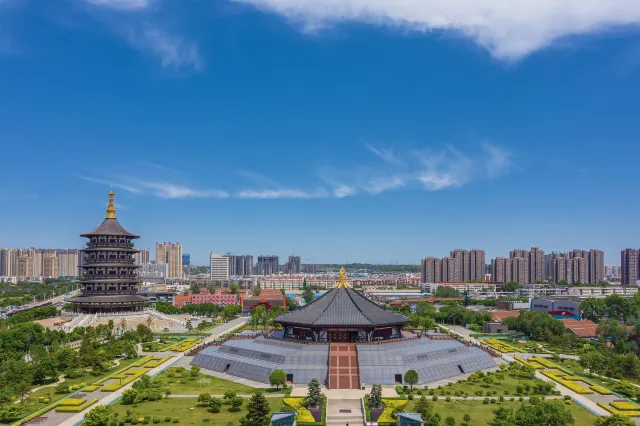
The building of heaven has five floors on the outside and nine floors on the inside, symbolizing the supreme status of the emperor. Visitors can take the elevator directly to the ninth floor to overlook the panoramic view of Luoyang, and the night view is not to be missed. There are also large and small Buddha statues and murals on other floors, where you can learn about the profound Buddhist culture.
Address: Northwest corner of the intersection of Zhongzhou Road and Dingding Road in the old city of Luoyang
Opening hours: 09:00-22:30 (no admission after 22:30)
evaluate:
| Fortunately, you can go and take a look! The service attitude is very good! ! ! ! ! ! ! ! ! ! ! ! ! ! ! ! ! ! ! ! ! ! ! ! ! ! ! ! ! ! ! ! ! ! ! ! ! ! ! ! ! ! ! ! ! ! ! ! ! |
Today's Jiuzhouchi Ruins Park covers an area of 288 acres, including the Ouchi Palace area in the northwest of the palace, part of the Taoguang Garden in the north of the palace, and the Jiuzhouchi Royal Garden in the north-central part of the city west of the palace. There are a total of 12 sites, which are protected and displayed through a variety of scientific means. We hope that more people will understand the appearance of royal gardens during the heyday of the Sui and Tang Dynasties through means and forms such as on-site displays of ancient ruins and ground simulations. Jiuzhou Pond, as the imperial garden of the palace in Luoyang City during the Sui and Tang Dynasties, actually existed in history. According to the "Research on the Cities and Streets of the Two Capitals of the Tang Dynasty", "Jiuzhou Pond is a winding pond with several islands in the middle, like the Jiuzhou in the East China Sea. It covers an area of ten hectares and the water is more than ten feet deep. Birds and fish swim in the pond and flowers grow everywhere." It was discovered by archaeologists in 1960 while excavating the Luoyang City of the Sui and Tang Dynasties. The palace area of Luoyang City in the Sui and Tang Dynasties consisted of the central core area, the Da Nei, and many small cities surrounding it. Kyushu Pond is located in the north-central part of the Nishige Castle on the west side of the Imperial Palace, occupying about two-fifths of the Nishige Castle. The scope of the "ten hectares of residential land" recorded in the records was based on the land measurement system of the Tang Dynasty. In the Tang Dynasty, one foot was about 29.5 centimeters, and ten hectares was about 520,000 square meters, which was larger than the entire Xigecheng. However, actual archaeological measurements show that the water area of Jiuzhou Pond is approximately 139,250 square meters. China's classical garden art occupies a pivotal position in traditional Chinese architecture. Chinese landscape gardens, represented by literati gardens and royal gardens, all aim to pursue the spiritual realm of nature, thus achieving the aesthetic pursuit of "although made by man, it seems created by nature" and embodying the cultural concept of "harmony between man and nature". This is completely consistent with the overall architectural concept of Luoyang City in the Sui and Tang Dynasties. As a royal garden, Jiuzhou Pond not only embodies the combination of nature and humanity and expresses the concept of harmonious unity between man and nature, but also highlights the "ritual system" in Chinese traditional culture.
Address: North side of the intersection of Tanggong Middle Road and Gongyu Road, Xigong District, Luoyang City
Opening hours: 09:00-22:30 (no admission at 22:00)
evaluate:
| The performance was average, the lighting was okay, and if it's your first time there, pay attention to the road signs (turn left after passing the pavilion with Jiuzhou Pond and follow the signs). The environment and sanitation are pretty good. You can see the scenery during the day, but the night view is better! |
Popular recommendations

Latest Trip.com Promo Codes, Black Friday Deals, Flight Discounts & Hotel Savings (Weekly Update)
 Trip.com Official
6 Things to know before Exploring the Montmorency Falls, Quebec
 TripBlog
2025 Guide to Shanghai Pudong Airport: Transit Visa & PVG Airport Shuttle
TripBlog
The World's Top-10 Best Nude Beaches
TripBlogQ&A
What's the most popular attractions in Luoyang?
Any recommended attractions about nature scenery in Luoyang?
How to get to Shaolinsi from Luoyang?
How to get to Luoyang from Zhengzhou?
In which area should I book my hotel in Luoyang?
Any advice on where to stay in Luoyang?
Trending Travelogues
Popular Trip Moments
Popular Attractions
Popular Ranked Lists
Popular Destinations
Recommended Attractions at Popular Destinations


About






of the year 2025



Site Operator: Trip.com Travel Singapore Pte. Ltd.