[Mount Hua Free Travel] Your Ultimate 3-Day, 2-Night Itinerary Guide to Exploring Mount Hua!

Contents
- Trip Planner
- Huashan itinerary overview
- Huashan Day 1
- Huayang Meadow
- Shaohuashan National Forest Park
- Huashan Day 2
- Dali County Folk Museum
- Tongguan Ancient City
- Huashan Day 3
- Huashan
Show more
[Planning a new trip but don't know where to start? Let Trip.com's AI Itinerary Assistant generate custom itineraries with one click!]
✅ Copy a travel blog link to generate the same itinerary with one click
✅ Featured popular itineraries for the most authentic experience
✅ Import your favorite destinations and automatically arrange the best itinerary
✅ Check opening hours and recommended visit durations at attractions to ensure that every stop meets your expectations
This guide thoughtfully curates a flawless 3-day, 2-night adventure to Mount Hua. From must-see local sights and authentic cuisine to bustling shopping hotspots, it ensures you experience Huashan with ease and peace of mind. Whether you're diving into rich historical and cultural landmarks or snapping stylish photos in a modern cityscape, this guide has you covered. Embark on your unforgettable Mount Hua journey today!
Forage for wild leeks in Huayang Meadow, stroll the wooden plank path nestled in the Shaohua Mountain valley, fish for Yellow River carp by the ancient walls of Tongguan, and savor a variety of mountain and river delicacies over three days.
Embark on a nighttime ascent of Mount Hua by gripping iron chains and scaling the Cloud Ladder, reaching the cliffside of East Peak just in time for sunrise. It’s a breathtaking journey from tranquil meadow to dramatic cliffside.
| date | journey |
| Day 1 | Huayang Meadow->Shaohuashan National Forest Park |
| Day 2 | Dali County Folk Museum->Tongguan Ancient City |
| Day 3 | Huashan |
Address: Next to Huayang Health Center, Huayang Township
Opening hours: 24 hours a day, all year round
Shaohua Mountain Forest Park, nestled in the southeastern part of Hua County in Weinan City, is named after the renowned Taoist landmark, Shaohua Mountain. The park features five main scenic spots: Shaohua Peak, Qianlong Temple, Hongya Lake, Shimen Gorge, and Milin Valley. It’s steeped in folklore, including tales of Shi Jin, the Nine-Striped Dragon from the classic novel Water Margin. Today, it serves as a popular destination for hiking, fitness, and reconnecting with nature.
Address: Yuanzhai Village, Lianhuasi Town, Huazhou District, Weinan City, Shaanxi Province
Opening Hours: 08:30–18:00 (Ticket sales and admission close at 16:00)
Address: No. 453, Nanqi Village
Opening Hours: Open tomorrow from 08:00 to 18:00 (last admission at 18:00)
The ancient city of Tongguan underwent two relocations and three fortifications from its founding through the Tang Dynasty, resulting in variations in city walls and infrastructure. In the early Eastern Han Dynasty, the Qin Dynasty fell, and Hangu Pass was built in Lingbao County, Henan. Emperors Wu and Xian subsequently relocated to Xin'an in Henan and the Hengshan Mountains in Hongnong. During the Jian’an era, Emperor Xian moved the capital just outside Tongguan’s south gate—today’s Yangjiazhuang and Chengbei Village in Gangkou Town. It was here the name "Tongguan" originated. Although there are no official historical records of its construction, ruins suggest the city spanned from the western edge of Yuanwanggou eastward through Chengbei Village to the eastern bank of Jingou, flanked by moats on both sides and set across a vast plain. A pivotal battle occurred here during the Northern and Southern Dynasties, where Yuwen Jue, Emperor Min of Northern Zhou, defeated Eastern Wei’s General Dou Tai. Following his victory, Emperor Min renamed the area "Tongguguan."
Address: 2 km north of the Port Expressway Exit, Tongguan County, Weinan City, Shaanxi Province
Opening Hours: Open 24 hours a day, year-round
Huashan, historically known as "Xiyue," is one of China's renowned Five Great Mountains, located in Huayin City, Shaanxi Province. Also referred to as "Mount Taihua," it is considered the cradle of Chinese civilization. In fact, the character "Hua" in words like "Zhonghua" and "Huaxia" originates from Mount Hua. Its landscape is defined by the words “strange” and “dangerous,” and the saying “Since ancient times, there's only been one path to Mount Huashan” speaks to its sheer steepness. The mountain is home to a number of adrenaline-pumping attractions, such as the Changkong Plank Road, Kitesurfing Cliff, Thousand-Foot Chuang, Baichi Gorge, and Laojun Ligou, all carved along precipitous cliffs that never fail to awe visitors.
The Huashan Scenic Area spans a wide region, comprising the Main Peak Area, Xiyue Temple Area, Xianyu Area, and more. The Main Peak Area is the heart of Huashan and features “Huashan One Road” as well as the five major peaks—East, West, South, North, and Central. For most visitors, this Main Peak Area embodies the essence of Mount Hua.
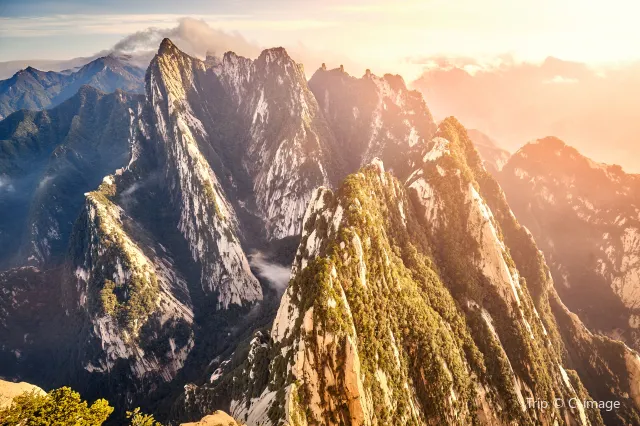
Five main peaks
East Peak
Rising about 2,100 meters above sea level, the East Peak is named for its location and is one of the best spots on Mount Huashan to catch the sunrise. At its summit is the famed Chaoyang Platform, where sweeping views and steep cliffs create a dramatic setting. The East Peak is also known as Chaoyang Peak and includes one main peak and three smaller ones—Yunu Peak to the west, Shilou Peak to the east, and Botai to the south. Among the many scenic highlights is the Huayue Fairy Palm, a giant natural stone pattern on a cliff that resembles a massive palm print. It’s recognized as the top of the Eight Scenic Spots in Guanzhong and is tied to legends of a celestial spirit shaping the mountains and rivers.
West Peak
Standing at around 2,000 meters, the West Peak is distinguished by a striking rock formation that resembles a lotus petal. This earned it the poetic names Lotus Peak and Hibiscus Peak among ancient scholars. Xu Xiake, a famous Chinese traveler, once described it in his travel diary as “a towering rock with stone layers like a lotus flower.” The peak is home to many famous sites, including Cuiyun Palace, Lotus Cave, Giant Spirit's Foot, Axe-Split Stone, and Sacrifice Cliff. It’s also steeped in mythology—most famously, the tale of Chenxiang splitting the mountain to rescue his mother.
South Peak
As the highest of Mount Huashan’s main peaks, the South Peak rises over 2,100 meters and is traditionally referred to as the “Head of Mount Hua.” One side features a sheer cliff that drops a thousand feet, dramatically dividing it from nearby peaks like Sangong and Sanfeng Mountains. The South Peak comprises one main summit and two additional ones—Songhui Peak to the east and Luoyan Peak to the west. Legend has it that wild geese used to rest on Luoyan Peak during migration, giving it its name.
North Peak
At about 1,600 meters, the North Peak—also known as Yuntai Peak or "Cloud Platform Peak"—is surrounded by steep cliffs and often shrouded in clouds. It stands tall and solitary, offering dramatic vistas. In the Tang Dynasty, poet Li Bai described its majesty in his work Song of Mount Hua from Yuntai, Xiyue, noting its towering peaks and mystical atmosphere. The North Peak is also the setting of the legendary tale “Taking Mount Hua by Strategy” and features famous spots such as Zhenwu Temple, Jiaogong Stone Chamber, Changchun Stone Chamber, and the legendary site where Laojun is said to have hung his plow.
Middle Peak
Located at the heart of the East, West, and South peaks, the Middle Peak acts as a natural crossroads and is the only path leading to the other summits. It is known for its tranquil beauty, with dense forests and a peaceful atmosphere. At its summit is Yunu Temple, a Taoist sanctuary believed to be where Nong Yu, daughter of Duke Mu of Qin, once lived and practiced self-cultivation during the Spring and Autumn Period. Because of this legend, it’s also known as Yunu Peak.
Main Highlights of Mount Huashan
Mount Huashan is home to over 210 famous scenic spots, many of which have inspired poets and scholars through the ages. Their verses have helped cement Huashan's reputation as one of China’s most culturally rich and awe-inspiring destinations.
Changkong Plank Road (Skywalk)
One of the most thrilling features of Huashan, the Changkong Plank Road clings to the cliffs on the eastern side of the South Peak. Originally built by Taoist master He Zhizhen during the Yuan Dynasty as a secluded place for spiritual cultivation, this daring path was constructed by embedding stone stakes into the cliff and laying 40-centimeter-wide wooden planks across them. Adventurers must press themselves tightly to the rock face, grasp iron chains, and carefully sidestep along the narrow boards. At the far end lies the He Zu Cave, where Master He once meditated—an incredible reward for the brave.
Xiyue Temple
Also known as Huayue Temple, Xiyue Temple is a sacred site where emperors once worshipped Shaohao, the Great Emperor of Xiyue. Originally built between 134 and 129 BC during the reign of Emperor Wu of the Han Dynasty, the temple was later relocated during the Eastern Han period and has been rebuilt and restored through the Tang, Song, Ming, and Qing dynasties. Today, it stands as a powerful symbol of Huashan’s spiritual legacy.
Canglong Ridge
This narrow ridge path is as dramatic as it is breathtaking. With only about two feet of walking space and steep drops on both sides, Canglong Ridge rises roughly 500 meters from the ground with a slope steeper than 45 degrees. From this high point, you can see sweeping views of green pine forests and drifting clouds—and hear the wind whistle through the valleys below.
Jinsuo Pass (Golden Lock Pass)
As one of Mount Huashan’s five key passes, Jinsuo Pass sits at the entrance to the mountain’s three main peaks and serves as the gateway to the East, West, South, and Middle peaks. Once this pass is closed, there is no way to proceed, which is why it is also called the "Tongtian Gate" or “Gate to Heaven.” According to Taoist beliefs, only after passing through this gate can one truly enter the realm of the immortals. As the local folk song goes, “After passing the Golden Lock Pass, there is another world.”
The Ancient Trail: “Only One Road to Mount Huashan Since Ancient Times”
This iconic phrase refers to the historic Huashan Valley trail, a time-honored climbing route that links together a series of famous scenic spots. When followed as a continuous path, it forms the legendary trail that has guided travelers up Mount Huashan for centuries.
Address: 1000 meters southeast of the intersection of Jiling Road and Huashan Road, Huashan Town, Huayin City, Weinan City, Shaanxi Province
Opening hours: 24 hours a day, all year round
Popular recommendations
Top 19 Hippest Mid-Size US Cities
 TripBlog
Latest Trip.com Promo Codes, Black Friday Deals, Flight Discounts & Hotel Savings (Weekly Update)
 Trip.com Official
6 Things to know before Exploring the Montmorency Falls, Quebec
TripBlog
2025 Guide to Shanghai Pudong Airport: Transit Visa & PVG Airport Shuttle
TripBlogTrending Travelogues
Popular Trip Moments
Popular Attractions
Popular Ranked Lists
Popular Destinations
Recommended Attractions at Popular Destinations


About






of the year 2025



Site Operator: Trip.com Travel Singapore Pte. Ltd.