To be honest, I was a bit disappointed with Shibui Luxury Collection Hotel. It used to be the former Nara Prefectural Governor's Office, but it's actually quite small. There's just the breakfast restaurant, the check-in reception hall, a tiny courtyard, and a tea house in the back—which I kept seeing recommended everywhere, but after staying for two days, I had aesthetic fatigue and didn't even bother going.
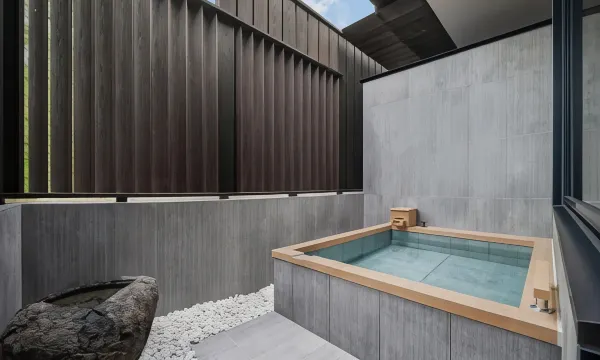
The rooms are in a newly built section designed by Kengo Kuma. They are quite pretty... but how should I put it? Compared to the feel of other Japanese-style hotels, it lacks subtlety. They placed decorations that scream "expensive," but it lacks elegance. Paired with large welcome mats everywhere emblazoned with the word "Luxury," it genuinely feels a bit... nouveau riche. Imagine staying at a hotel in a classical Suzhou garden, and everywhere you look, the floor mats are stamped with the words "EXTVAVAGANT" or "LUXURY" in characters the size of a human head. It's rather... tacky.
Only after arriving did I realize this is a Marriott Luxury Collection property. How can I put it? Having stayed at several top-notch Japanese hotels along the way, I've come to appreciate the "good side of Japanese hospitality's endless fussiness"—that thoughtful attentiveness. You know, vanity tables, little makeup mirrors, vanity stools, toners, moisturizers, and all that. At Shibui, all that thoughtfulness vanished, but the "endless fussiness" was out in full force.
During check-in, the young woman on duty at night spoke English in pure katakana-style, so I mostly had to rely on guessing. I told my husband to speak Japanese, but his Japanese is pretty rusty and he didn't understand much either, so we ended up with a barrier-ridden exchange of broken Japanese and English. Just checking in took forever with tons of questions... At that moment, I deeply missed the cold, efficient check-in machines at Hotel Respire Osaka.
To make matters worse, we also asked her to help us book two Michelin-rated restaurants across the street. Every time she confirmed a time, she’d make a phone call to ask us something, and then I forgot what other nonsense she asked. Realizing she was out of her depth, she brought over the assistant manager, whose English was much better and easy to understand. By this point, they must have already gone through three rounds of communication with the two restaurants. The assistant manager asked:
"What set menus would you like for these two places?"
- **Akordu**: Spanish cuisine featuring Nara specialty ingredients. There is an 11,000-yen set menu and a pricier Wagyu set menu (where the main course is swapped for Wagyu).
She emphasized that this place strictly enforces a dress code, followed by a detailed explanation of what you can and cannot wear. We were like: "Yeah, yeah, yeah (just make it end already)."
- **Musoan**: Japanese cuisine with four set menu options. We chose the third tier.
Then the assistant manager said, "So just to let you know, even if you don't show up, you'll still have to pay for the set menus" (they had recorded our credit card info earlier, so they can just charge us).
After a grueling battle of wits, 40 minutes had passed since we first arrived at the hotel. While waiting, they served two glasses of champagne. Drinking them on an empty stomach made us feel light-headed and floaty. Some reviews on Trip.com mentioned that other guests got cocktails while they didn't—well, we didn't either, haha, though we didn't really want to drink anyway.
The next day, we wanted to try Nara's specialty grass hot pot and asked them to help book it. This time, the assistant manager who spoke a little Chinese stepped up (actually, the daytime front desk girl's English was very good—I got my period unexpectedly and asked her for sanitary pads). Mr. Yoshimura was so hardworking and enthusiastic, rattling off a mix of Chinese and even Shanghainese. Both of us are introverts, so we were getting a bit exhausted... While lying in bed, Mr. Yoshimura called us four times to confirm various details. The restaurant is called *Toyo-no-Akari Suzunone*. When we first told him, we left off the suffix, but there are actually two *Toyo-no-Akari* locations—the other one is closed, about 50 meters away. "Okay, okay, okay, let's go with the one that's open!" A no-show fee of around 3,550 yen applies, but that's fine. "No home-style Kyoto dishes, is that okay?" "Yes, yes, yes!" (Who actually wants that stuff? Is it just a massive assortment of pickled vegetables?). "You can't share one drink between two people." "Okay, okay!" Booking this nearly killed us—the phone rang four times in 30 minutes.
***
### Summary: [TL;DR Guide: Shibui Booking Guide for the Michelin Restaurants Across the Street]
1. It's totally fine to just tell them you accept the no-show payment policy.
2. For **Akordu**, get the 11,000-yen set menu (the Wagyu is too greasy; not recommended for those with weak stomachs or who fear oily food).
3. Yes, the dress code is mandatory.
4. Book whatever time is available; no need to double-confirm.
For **Musoan**, get the 11,000-yen set menu (I felt it was just so-so; don't bother upgrading, the two of us were stuffed to bursting).
Anyway, it's just mediocre, classic Michelin-style goodness. It's not overly expensive, but I'm definitely never coming back. Nara's grass hot pot is way more delicious than both of those combined!!!! The raw chicken mixed with wasabi has an intensely pungent flavor, but it's super delicious—anyone who can handle the kick must order it. You should also order an order of fried chicken; their chicken is so tender and flavorful! We stuffed ourselves, and the bill for two was just 10,000 yen. Highly recommended!
### Booking Guide:
1. The name is *Toyo-no-Akari Suzunone*—make sure to emphasize the second part.
2. Order the chicken broth hot pot base. The 3,550-yen fee is fine. Each person ordering their own drink is required and allowed.
3. Book whatever time is available; no need to re-confirm.
***
I saw some reviews saying their service level is very low, but I thought the managers were okay... What's annoying is their rigid rules! Why not just make the phone calls right in front of me? If you need to ask something, ask it all at once! But no, even though you're right there at the front desk, they have to escort you into that pretty hall, pour you tea and wine, and then sneak away behind your back to make phone calls, coming back and forth to confirm everything. So noble, yet so inefficient. Meanwhile, the junior staff might as well be NPCs. On the first morning, three different people came up to me successively to ask whether I wanted a Western or Japanese breakfast for the next day. On the second day, a bellboy came over and still asked whether I wanted rice or rice porridge. When I said I wanted the Western breakfast, he made a facial expression as if he'd just woken up from a deep dream... Only when we were checking out did he suddenly remember my post-meal coffee hadn't been served.
They always look super busy, scribbling and jotting things down, staring at the computer screens, and then coming back to ask more questions... They work hard, but without using their brains. Is Nara really that short of staff? Places like Yakushima, tiny as it is, do a vastly better job.
We chose a garden-view room without an onsen. At 42 square meters, it was quite large—there was enough space in front of the TV for the two of us to dance. The view was alright, and in the morning, we actually saw deer from the room. But I still felt it wasn't worth the money—the only hotel on this trip that left me with that feeling. If you're curious, just stay for one night. Isn't the Hotel Nikko 600 yuan for 32 square meters a much better deal? Other than the faucet being a bit hard to turn, it has zero faults.
Original TextTranslation provided by AI