Things to do in Hezuo
Explore top experiences
Top 10 attractions in Hezuo

Milariba Buddha Pavilion
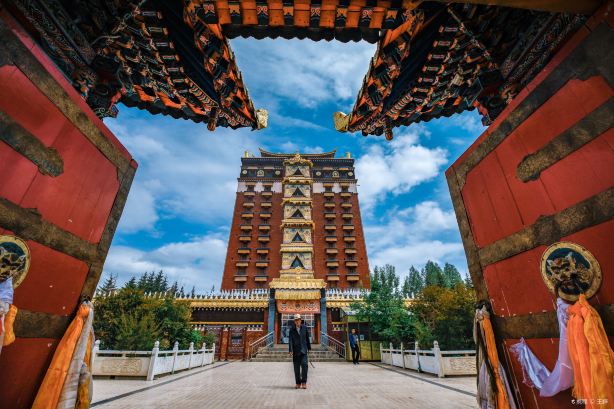
Milariba Buddha Pavilion is a nine-story Tibetan-style blockhouse pavilion built to commemorate the Tibetan Buddhist Kagyu school (commonly known as the White Sect) master Milarepa. It was first built in the 42nd year of the Qianlong reign of the Qing Dynasty (1777), and the existing structure was rebuilt in later generations. The pavilion is dark red throughout, which is relatively rare among monasteries in Tibetan areas. The hall enshrines over 1,000 statues, with the patriarchs of all major Tibetan Buddhist sects worshipped together in the same pavilion, along with numerous historical and cultural figures of Tibet. In the center of the first floor is a tall statue of Jampa Buddha (Maitreya Buddha), depicted in a solemn and dignified bodhisattva appearance. Flanking it are statues of Tibetan kings such as Songtsen Gampo and Princess Wencheng, as well as figures like Thonmi Sambhota, who created the Tibetan script, and Thang Tong Gyalpo, the founder of Tibetan opera. The second through fifth floors correspond to different sects. The fifth floor is dedicated to the White Sect, where the statues of Milarepa and his master Marpa are gaunt, and the murals on the walls depict the process of Milarepa's body changing from fat to thin during his ascetic practice. The sixth to eighth floors enshrine the Dharma kings, yidams, and protectors of Tibetan Buddhist Tantra, with statues of Hayagriva, Mahakala, and others often appearing in wrathful forms. The ninth floor is not an independent floor, but a mandala painting on the roof of the eighth floor. You can visit the interior by climbing the stairs floor by floor, or simply admire the exterior architecture. The Hezuo Monastery is located right next to the west side of the pavilion; if you have enough time, you can visit both.Hezuo · 756m from downtown

Meiren Grassland
Meiren Grassland has an altitude of over 3,000 m and is an alpine meadow grassland. Unlike common flat grasslands, the meadows here rise in mounds and stretch continuously, dotted with various small wildflowers. Herds of yaks and Tibetan sheep roam the grassland, which is also one of the main production areas for the local fine yak breed, the Meiren yak. Tents are often scattered across the grassy slopes, where you can see the daily scenes of herders grazing their livestock. The entire grassland stretches along the Heyi Highway from Hezuo to Yeliguan. You can slow down during your self-drive tour to view these rolling meadows, or easily connect to nearby scenic spots such as Kangduo Gorge and Lianhua Mountain.Hezuo · 29 km from downtown

Dangzhou Grassland
This is an ideal holiday destination, with green grass and trees, mountains, forests, grasslands and tents. Every midsummer, all kinds of wild flowers bloom on the green grass. Since the first Gannan Shambhala Tourism Art Festival was held in 2000, it has become the main venue of the previous Gannan Shambhala Tourism and Art Festivals, as well as the gathering place for ethnic mass cultural and sports activities and festival celebrations.Hezuo · 7.7 km from downtown

Gannan Tibetan Autonomous Prefecture Museum
The museumwas established in 1986,has an exhibition area of 601 m², houses 2,381 various artifacts, including 185 precious artifacts, with a focus onethnic and Red Army artifacts.Hezuo · 1.5 km from downtown

Jiuzhaigou National Park
Jiuzhaigou National Park is located in Jiuzhaigou County of Ngawa Prefecture. With its towering snow-capped peaks, dense forests, and vibrantly colored pools and shoals, crystal-clear streams meander through the forests and shallows. Combined with Tibetan wooden houses, prayer flags, and the unique traditional customs of the Tibetan and Qiang ethnic groups, Jiuzhaigou National Park is often referred to as a "beautiful fairyland". Jiuzhaigou National Park features a Y-shaped layout, consisting of three main valleys: Shuzheng Valley, Rize Valley, and Jiuzhaigou-Zechawa Valley, with a total length of over 50 km.The attraction is equipped with eco-friendly sightseeing vehicles that stop at designated stations. Visitors can wait at each station and conveniently tour various attractions within the site by taking the sightseeing vehicles.China · Jiuzhaigou

Prayer Wheel
The prayer wheel is located in Maqu County, Gannan Tibetan Autonomous Prefecture, and is one of the largest prayer wheels in the world. Its body has a total weight of 320 tons, a diameter of 12.43 m, and a height of approx. 42.38 m. This prayer wheel is not only massive in size but also deeply meaningful. The body is mainly made of titanium and is partly inlaid with relief Buddha images. Inside are about 110,000 sutra volumes, weighing more than 86 tons. The exterior is also carved with the 12 zodiac animals, attracting many visitors for pilgrimage and sightseeing.Hezuo · 7.9 km from downtown

Huanglong National Scenic Area
Huanglong National Scenic Area is a Attraction famous for its fantastic and beautiful calcified pools. The water in the numerous calcified pools in the Attraction is crystal clear and colorful and very beautiful. There are also many natural landscapes such as forests, canyons, snow-capped mountains and waterfalls in the Attraction. It is known as the "Fairyland on Earth". Huanglong National Scenic Area is mainly divided into two parts, Huanglong Headquarters and Munigou. Huanglong Main Gou in Huanglong Headquarters is the main Attraction of Huanglong National Scenic Area, and is also the place generally referred to when talking about Attraction. The Attraction is located in Songpan County. The best time to visit here is in summer and autumn, when the lake is in its flood season, with a large pool area and beautiful scenery. In winter and early spring, the water volume is smaller, but the scenery is still good.China · Songpan

Labrang Monastery
Located in Gannan District's Xiahe County, Labrang Monastery is one of the six great monasteries of the Gelug (Yellow) Sect of Tibetan Buddhism. The monastery is large in scale and high in status. A representative example of the monasteries and temples throughout Gannan, it is a must-see for visitors to the area. It is a majestic temple complex. It offers spectacular sights while walking through and also when taking in a panoramic bird's-eye view from its highest point. The monastery is full of giant Buddha statues and various exquisite sculptures, murals and countless musical instruments. Furthermore, the long corridor of the Labrang Monastery is a sight rarely seen anywhere else in the world. This is a place where pilgrims come to accumulate merit and to pray for friends and relatives.Xiahe · 42.4 km from Hezuo

Qinghai Tibetan Culture Museum
Qinghai Tibetan Culture MuseumIt is a comprehensive museum themed on Tibetan medicine culture and featuring Tibetan culture.Qinghai Tibetan Culture Museum(also known as Qinghai Tibetan Culture Museum) is located in Xining, the capital of Qinghai Province in the eastern part of the Qinghai-Tibet Plateau. It officially opened in September 2006. The museum has basically formed a "one museum with two halls" layout, featuring 16 exhibition halls including the Silk Road and Tibetan civilization, the grand view of Chinese Tibetan art painting, and the history of Tibetan medicine.Qinghai Tibetan Culture MuseumThe collection is rich, historic, and diverse, possessing high historical, scientific, and artistic value. The museum houses the Guinness World Record-holding thangka masterpiece, "The Grand Thangka of Tibetan Culture and Art," which is 618 m long. It was planned by renowned thangka master Zongzhe Lajie and completed by 400 painters over four years. Its content encompasses the Tibetan understanding of the universe, the formation of the Qinghai-Tibet Plateau, history, religion, medicine, culture, art, and folklore. With its intricate details and brilliant colors, it is a magnificent sight and can be called an encyclopedia of Tibetan culture, hailed as a "contemporary national treasure." Through four major series—ancient books and documents, Tibetan medical thangkas, ancient Tibetan medical instruments, and Tibetan material specimens—the museum comprehensively displays the long history, profound theoretical system, clinical practice, and unique preparation techniques of Tibetan medicine, with four ancient books included in the National Catalogue of Precious Ancient Books. The Silk Road and Qinghai-Tibet Civilization exhibition hall uses history as its temporal dimension and the vast plateau landscape as its geographical dimension. Through thousands of precious cultural relics such as silk, gold and silver ware, and coffin paintings, it highlights Tibetan cultural elements and showcases the origin, inheritance, rise, and prosperity of the Qinghai-Tibet Plateau civilization throughout the long river of history. The Tibetan carpet exhibition hall is one of the largest exhibitions of ancient carpets in China, displaying more than 400 Tibetan carpet artifacts from different periods and eras, featuring magnificent patterns, intense colors, and unique ethnic styles and local characteristics. At the same time, there are also Tibetan-style architectural exhibition halls, Tibetan calligraphy art exhibition halls, as well as temporary exhibition halls, multimedia screening rooms, academic lecture halls, and cultural relic storage rooms, providing strong capabilities for inheritance, protection, and research, as well as conditions for cultural exchange.Qinghai Tibetan Culture MuseumIt will continuously improve the level of cultural relic preservation, exhibition design, scientific research, and management operations, becoming a platform for promoting ethnic unity and social development, a broad stage for cultural dissemination and academic exchange, a research center for cultural relic protection and Tibetan studies, and an exhibition center for treasured literature and collections, showcasing the splendid civilization and culture of the Tibetan Plateau to the world.China · Xining

Kumbum Monastery
Kumbum Monastery is one of the important monasteries of the Gelug (Yellow Hat) sect of Tibetan Buddhism and the birthplace of Tsongkhapa, the founder of the Yellow Hat sect. The monastery features magnificent architecture, abundant treasures, and a strong religious atmosphere, making it one of the more popular travel destinations in Xining. Overview of the visit It has distinct differences in architectural layout compared to Han Chinese Buddhist temples in inland China: the complex here is not symmetrically arranged along a central axis. The monastery is an ancient architectural complex composed of numerous halls, scripture halls, stupas, and colleges, with each sutra hall, main hall, and stupa irregularly distributed on a small hill. Travelers can explore the site in a relatively free manner rather than following a straight path along a central axis. The Great Golden Roof Hall of Kumbum Monastery is the center of the entire architectural complex. It is said that Master Tsongkhapa was born here, and when he was born, his umbilical cord blood dripped on this spot, from which a bodhi tree grew. Later, a stupa was built around the tree, and a monastery was constructed, hence the name. Believers hold that this tree and stupa are the embodiment of the master. The three unique features of the attraction: butter sculptures, murals, and appliqué embroidery. Butter sculptures are made by mixing butter with various pigments to mold and carve into figures of Buddhas, people, flowers, birds, animals, and pavilions. Travelers can admire exquisite butter sculptures at the butter sculpture hall inside the temple (located far from the main gate). Vibrant centuries-old murals can be appreciated in the main halls, corridors, and front galleries of the temple. Appliqué embroidery involves cutting colored satin into desired shapes, such as Buddha figures or animals, stuffing them with wool or cotton, and embroidering them onto cloth hangings. In the temple's great sutra hall, two rare large appliqué embroidery pieces—"Sixteen Arhats Displaying Divine Powers" and "Eight Immortals Crossing the Sea"—hang on either side. The four major religious festivals (based on the lunar calendar): 1. Cham dance (14th day of the first month) and butter sculpture exhibition (15th day of the first month); 2. Cham dance (14th day of the fourth month), Buddha unveiling, and Cham dance (15th day of the fourth month); 3. Buddha unveiling, Cham dance (6th day of the sixth month), and golden Buddha procession (8th day of the sixth month); 4. Full-day Buddha unveiling (22nd day of the ninth month) and Cham dance (23rd day of the ninth month). During these festivals, activities like Buddha unveiling and ritual dances take place, attracting large crowds of devotees and travelers, creating a lively atmosphere.China · Xining
Experiences you can't miss in Hezuo
Featured Outdoor experiences in Hezuo
View all Outdoor experiences
5.0/5
· 2 reviewsFree cancellation
Instant confirmation
5% off
Limited-time sale
FromSGD 72.39SGD 76.2

Instant confirmation
FromSGD 208.77
Free cancellation
Instant confirmation
FromSGD 95.35

FromSGD 287.35
FromSGD 324.36
Free cancellation
Instant confirmation
FromSGD 119.73
More things to do
Free things to do in Hezuo


What travelers say about Hezuo

闻嘉流浪NoelAugust 13, 2026
4.0
This is a well-known Tibetan temple in Hezuo City, Gannan Prefecture. It's quite unique, with white stupas somewhat similar to those in Thai temples, and the red monastery exudes a solemn and dignified atmosphere. Taking photos against the backdrop of blue skies and white clouds would definitely be a great experience. Since I have no religious affiliation, I didn't buy a ticket to go inside; I just wandered around the outside. However, I absolutely respect the beliefs of the Tibetan people.
Milariba Buddha Pavilion

M10***51July 2, 2026
5.0
This high-altitude grassland, characterized by frost-covered hills and small grassy mounds, sits at an altitude of 3600m. In June, wildflowers such as the alpine meconopsis bloom across the grassland, creating a stunningly beautiful scene. Highly recommended!
Meiren Grassland

滇国剑客October 22, 2021
5.0
Because the grass on the grassland here grows well, it gives people a feeling of looking into the distance. This feeling of taking in endless scenery is so enjoyable. The world is so big that there are all kinds of wonders, and this is proven in this scenic spot.
Dangzhou Grassland

melindazDecember 28, 2022
4.0
The museum has stone tools, bone tools, pottery and bronze tools from the Neolithic Age and the Bronze Age; copper seals, bronze mirrors, inscriptions, bronze bells, bronze swords, and Persian silver coins from the Han and Tang dynasties; porcelain from the Wei and Jin dynasties; porcelain from the Song and Yuan dynasties; and porcelain from the Ming and Qing dynasties. Among the ethnic cultural relics are ethnic costumes, Buddhist statues, thangkas, ritual implements and other religious artworks.
Gannan Tibetan Autonomous Prefecture Museum

Anonymous userOctober 24, 2026
4.0
It's worth visiting, very beautiful, but it's quite crowded and uncomfortable. Even with good transportation, it's still not enough; everywhere is packed with people. We chose the off-season, which was a bit better; at least we were able to take some nice photos while enjoying the scenery.
Jiuzhaigou National Park

GeorgeLiOctober 24, 2026
5.0
The main scenic area is Huanglonggou, which is about 3.6 kilometers long. The valley is dotted with open-air travertine pools, which are layered like terraced fields and display blue, green and golden colors under the sunlight. You can also get a relatively close view of the snow-capped mountain scenery.
Huanglong National Scenic Area

Bolton ChenOctober 7, 2026
5.0
Labrang Monastery is truly a dream destination when the weather is perfect! The golden roofs gleam under the blue sky and white clouds, and the entire monastery appears exceptionally solemn and magnificent in the high-altitude sunshine. As a world-renowned center of Tibetan studies, its prayer wheel corridor stretches for 3.5 kilometers with over 2,000 prayer wheels. Walking clockwise with the pilgrims, the sunlight filters through the eaves, casting warm glow on the prayer wheels and red walls, creating an incredibly atmospheric experience. Climbing the Gongtang Pagoda offers a panoramic view of the golden roofs, white stupas, and brown-red monks' quarters layered upon each other, with rolling mountains and grasslands in the distance – a truly expansive vista. If you're lucky, you might even witness monks debating, their gestures and clapping adding to the captivating atmosphere.
Labrang Monastery

我要我疯我要我爱就是我要我疯我要我爱October 9, 2026
5.0
It's definitely worth a visit; it's truly breathtaking. Every detail is meticulously crafted, completely contrary to online claims of shoddy workmanship. The 600-meter-long mural is said to have taken 27 years to paint. I didn't spend the entire fourth-floor Tibetan cultural mural exhibition, but I saw the other exhibits. The guided tours all use headphones, but the volume is extremely low, making it difficult to hear the explanations.
If you're just rushing through, don't bother renting a guided tour. However, if you want to take your time and spend an afternoon at each exhibit, it's well worth it.
Qinghai Tibetan Culture Museum

M33***46October 22, 2026
5.0
As the birthplace and memorial monastery of Tsongkhapa, the founder of the Gelug school of Tibetan Buddhism, this historical and cultural site, over 600 years old, is a must-see. Photography of the stupa at the entrance is permitted, but not of the Buddha statues inside. The monastery currently houses over 1000 monks and more than a dozen Living Buddhas. While the throngs of worshippers are bustling, the atmosphere is peaceful and serene (perhaps the burning of large incense sticks is not part of the ritual). Many areas allow you to light lamps for blessings (20 yuan per person, depending on your conscience), and there are places to exchange change for prayers. Best of all, there are Chinese-language guided tours, and the guides are very professional; I learned more about Tibetan Buddhism than I did during my previous trip to Lhasa!
Kumbum Monastery


