
Things to do in Xingwen
Explore top experiences
Top 10 attractions in Xingwen


Xingwen Rock Sea
The Xingwen Sea of Rocks is located in Yibin City and there are many scenic spots in the area, including the rock forest, caves and Sea of Rocks. Here visitors can take in the towering stone forest, enormous cave and the stalactites inside it. It is a great place to witness the wonders of nature. Xingwen Sea of Rocks is famous for its caves. Visitors will stand in awe of the vastness of the caves and the amazing variety of stalactites within.Xingwen · 17.4 km from downtown

Bowang Mountain
Bowang Mountain is located in Xingwen County, Yibin City, Sichuan Province, and is a typical karst landform. In February 2005, UNESECO designated the Mount Bowangshan park area a global geopark. The vegetation on Bowang Mountain is lush, with waterfalls, deep pools, caves and strange stones all over the mountain. Its main districts are Feiwu Valley, Dao Cave, Heimao Peak and Shoushan Lake. Bowang Mountain has been home to the Duzhang people (the Bo nationality) since ancient times. Today there are well preserved remains of large and small village gates, city walls and castles built by the Bo people, as well as historic battle sites.Xingwen · 18 km from downtown

Tianquan Cave
Tianquan Cave, located in Xingwen County, Yibin City, is the main feature of the Shilin Town Scenic Area. A renowned karst cave within the Xingwen Shihai Cave complex, Tianquan Cave dates back 3 million years. Its spatial scale and systematic tour length are both among the largest in the world.Xingwen · 16 km from downtown

Southen Sichuan Bamboo Sea
Southen Sichuan Bamboo Sea is located in Yibin, southern Sichuan. Its continuous expanse of emerald bamboo covers more than twenty rugged ridges and over five hundred peaks. It is known as the "ocean of bamboo" and is listed alongside the dinosaur fossils, the Stone Forest, and the hanging coffins as one of the "four wonders of southern Sichuan." More than fifty types of bamboo grow in the forest; in addition to common varieties like moso bamboo, water bamboo, and ci bamboo, there are also rare species such as black bamboo, Buddha's belly bamboo, and mandarin duck bamboo. The bamboo forest scenes in the movie "Crouching Tiger, Hidden Dragon" were filmed here. Most travelers enter from the west gate of the attraction, first passing through the Southen Sichuan Bamboo Sea Museum, where finely crafted bamboo carvings and woven artworks are displayed and worth a closer look. Then take the cable car for a gradual ascent from the valley floor, with bamboo waves rolling beneath your feet. The upper cable car station is located near Guanhai Tower and Emerald Corridor. From Guanhai Tower, the view encompasses countless emerald ridges. Nearby, Emerald Corridor features a several-hundred-meter-long red sandstone path flanked by dense bamboo shade, with sunlight filtering through the leaves—a classic photo spot in the attraction. There are several farmhouse restaurants near Guanhai Tower where you can take a break. The signature "all-bamboo banquet" features dishes made with bamboo shoots and bamboo fungus, offering a fresh and light flavor that's perfect for savoring slowly after a tiring walk.Changning · 29.4 km from Xingwen

Big Funnel
Xingwen · 16.6 km from downtown

Xianfeng Mountain
Xingwen · 23.1 km from downtown

Huangguoshu Scenic Area
The Huangguoshu Scenic Area is located in Anshun, Guizhou, centered around the Huangguoshu Waterfall. Surrounded by deep gorges, dense vegetation, and dotted with limestone caves and stone forests, it is a typical karst landscape area. The waterfall's name originates from the locally abundant "Huangguoshu" (Ficus virens). Ming Dynasty traveler Xu Xiake visited and documented this site, contributing to its fame. The scenic area primarily consists of three main sections: the Great Waterfall, Tianxing Bridge, and Doupotang. Most travelers follow the sequence of Doupotang, Tianxing Bridge, and finally the Great Waterfall, saving the most spectacular view for last. The grand waterfall has a drop of nearly 80 m and a width of over 100 m. The Baishui River plunges from the cliff top into Rhinoceros Pool, creating a vast mist. Multiple viewing platforms around it allow visitors to experience its grandeur, wonder, steepness, and beauty from different angles—above, below, front, back, left, and right. A particularly unique experience lies behind the waterfall: a 100 m long Water Curtain Cave runs horizontally through its midsection, featuring cave windows and halls. Reaching through a window, one can touch the cascading water. The cave served as the filming location for the Water Curtain Cave in the 1986 TV series Journey to the West. Due to the heavy humidity inside, bringing a raincoat in advance is recommended. Tianxing Bridge is renowned for its harmonious blend of rocks, water, trees, and caves—where rocks rise from the water, caves hide within rocks, and trees stand beside caves. The stepping stones along the path are engraved with dates, allowing travelers to find their own "birthday stone." The attraction is divided into upper and lower sections. Many travelers turn back after completing the upper section, missing the Silver Chain Waterfall in the lower part—where water cascades like silver chains into a funnel-shaped pool, the highlight of Tianxing Bridge. The Doupotang waterfall is located approx. 1 km upstream from the grand waterfall. With a width of over 100 m at its crest, the water spreads out smoothly like a beaded curtain. During the high-water season, its deep roar earns it the nickname "roaring waterfall." The scene of the four pilgrims leading their horse across the river in the 1986 TV series Journey to the West was filmed here. In summer and fall, the waterfalls are full and powerful, while in winter and spring, the flow becomes gentler, offering different viewing experiences. Nearby, visitors can also enjoy local snacks like sticky rice, love tofu, and Anshun spring rolls.China · Zhenning

Chengdu Du Fu Thatched Cottage Museum
Du Fu Thatched Cottage is the former Chengdu residence of the famous Tang Dynasty poet Du Fu. Du Fu lived here for nearly four years. During his stay, he created hundreds of poems. This place is thus regarded as the “holy land” of Chinese literature. Today's Du Fu Thatched Cottage has survived multiple dynasties and been restored many times. The most important architecture of the place is his former residence, the thatched house. This former residence was built with the architectural characteristics of the western Sichuan civilian residences.China · Chengdu

Mount Emei
Mount Emei is one of the four famous mountains of Chinese Buddhism, and it is also the temple of Samantabhadra Bodhisattva. There are numerous Buddhist monasteries in the mountains that combine to give this place a holy and serene atmosphere. The scenery in the mountains are beautiful. The four seasons each have their own characteristics. If you are lucky, you can see the sunrise and sea of clouds. Do note that the monkeys in Mount Emei are notoriously naughty. They are not afraid of people, and even take the initiative to ask tourists for food.China · Emeishan City

Chengdu Wuhou Shrine Museum
The Chengdu Wuhou Shrine Museum is a temple dedicated to honoring Shu Han heroes such as Liu Bei and Zhuge Liang. Its origins date back to 221 AD during the first year of the Zhangwu era under Emperor Zhaolie of Shu Han, when Liu Bei's Hui Ling Mausoleum was constructed. The Han Zhaolie Temple was also built during the same period. Approx. around 500 AD during the Northern and Southern Dynasties period, the Wuhou Shrine was relocated from Chengdu's "Shaocheng" to the vicinity of Hui Ling Mausoleum and Han Zhaolie Temple, maintaining this layout until the Ming Dynasty. In 1390 during the 23rd year of the Hongwu era, Zhu Chun, the Ming Prince of Shu, visited the Chengdu Wuhou Shrine Museum for worship. Citing that "monarch and subject should be united as one," he merged Hui Ling Mausoleum, Han Zhaolie Temple, and Wuhou Shrine into a single complex. As Zhuge Liang's influence among the common people surpassed that of Liu Bei, the site became colloquially known as "Wuhou Shrine." The cultural relics area of the Chengdu Wuhou Shrine Museum mainly consists of the Hui Ling Mausoleum, Han Zhaolie Temple, Wuhou Shrine, and the Chengdu Wuhou Shrine Museum - Sanyi Temple, with the main structure being the Wuhou Shrine. The shrine is divided into the main gate, second gate, Liu Bei Hall, passage hall, Chengdu Wuhou Shrine Museum - Zhuge Liang Hall, and Chengdu Wuhou Shrine Museum - Sanyi Temple, all aligned along a central axis from south to north. The shrine houses 50 statues of Shu Han heroes including Liu Bei and Zhuge Liang, along with numerous stone inscriptions and plaques related to Zhuge Liang and Three Kingdoms culture. The famous "red wall and bamboo shadows" of Chengdu are located within the attraction. Don't forget to take photos. The garden area of Chengdu Wuhou Shrine Museum, located on the west side of the shrine, features architectural structures such as the stone archway gate, three-arched gate, square pavilion, Jiexin Hall, and burial chamber. It is the only northern-style mausoleum complex in southwest China. The shrine is adjacent to Jinli Ancient Street (Jinli Folk Custom Area), making it convenient to visit both sites together.China · Chengdu
Experiences you can't miss in Xingwen
Featured Food & drink in Xingwen
View all Food & drink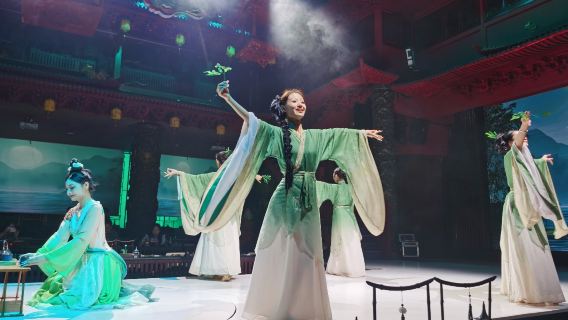
From€15.84

3.0/5
· 1 reviewFree cancellation
Book now for tomorrow
From€19.30
![[Yibin] ERSHISIYAN ‖ One banquet reveals twenty-four hours, one feast intoxicates three thousand years!](https://ak-d.tripcdn.com/images/0356812000phlimr146E6_C_568_320.jpg?_fr=wc)
![Twenty-Four Banquets in Yibin, Sichuan|Panoramic Immersive Ancient-Style Dining Show [Optional Lunch/Dinner + Optional Makeup & Styling Service + Imperial Chinese Feast]](https://ak-d.tripcdn.com/images/0350k12000q9s1bsn40A3_C_568_320.jpg?_fr=wc)
![[Yibin] 24 Banquets • Immersive Royal Banquet (Ancient-style song and dance performance + Imperial treatment + Optional ancient costume change experience + Chinese-style feast)](https://ak-d.tripcdn.com/images/0352s12000pf2svp40E5A_C_568_320.jpg?_fr=wc)
Free cancellation
Instant confirmation
Book now for tomorrow
From€19.30
Free things to do in Xingwen
Xingwen Rock Sea
Xingwen · 17.4 km from downtownBowang Mountain
Xingwen · 18 km from downtownTianquan Cave
Xingwen · 16 km from downtownSouthen Sichuan Bamboo Sea
Changning · 29.4 km from XingwenImmediate access, Book now for today, Cancel anytimeBig Funnel
Xingwen · 16.6 km from downtownXianfeng Mountain
Xingwen · 23.1 km from downtownHuangguoshu Scenic Area
China · ZhenningBook now for tomorrowChengdu Du Fu Thatched Cottage Museum
China · ChengduImmediate access, Book now for today, Cancel anytimeMount Emei
China · Emeishan CityImmediate access, Book now for today, Cancel anytimeChengdu Wuhou Shrine Museum
China · ChengduImmediate access, Book now for today
What travelers say about Xingwen

Anonymous userAugust 26, 2026
4.0
The scenic area might not be very popular, and it's actually quite short, mostly going up and down. The roads are slippery when it rains, which isn't ideal for the elderly. It's basically just walking around; there's not much to see. If you're going to the bamboo forest, I'd say it's optional. The sightseeing bus is just a large Coaster bus. Luckily, we didn't buy tickets and had our family pick us up by car.
Bowang Mountain

M43***18April 21, 2025
5.0
Tianquan Cave is a famous karst cave scenic spot in Xingwen County, Yibin City, Sichuan Province, China, and is also one of the core attractions of Xingwen World Geopark. The following is a comprehensive review analysis for reference:
Natural landscape features ★★★★☆
Large scale
Tianquan Cave is one of the longest karst caves discovered in China, with a total length of more than 10 kilometers. The cave has a wide space and the highest point can reach 100 meters, which is magnificent.
Geological wonders
Typical karst landforms, stalactites, stalagmites, stone pillars, stone curtains and other forms are rich, and with the lighting effects, they form fantastic scenes such as "Stone Forest Fairy" and "Sky River Waterfall".
Underground river
There is an underground river flowing in the cave, which can be experienced by boat (part of the area), which is cool and quiet, adding to the fun of adventure.
Play experience ★★★★
Mature tour route: the trail is flat, the lighting design is relatively reasonable, the whole journey is about 2-3 hours, and the physical exertion is moderate.
Cultural Fusion: The cave combines elements of Miao culture, and some areas have ethnic performances (seasonal).
Popular Science Value: The geological knowledge explanation signs are relatively complete, suitable for children to learn natural geography.
Summer Resort: The temperature in the cave is about 18℃ all year round, which is cool and comfortable in summer.
Precautions Dark Light: The lighting in some areas is dim, so you need to pay attention to your foot safety. It is recommended to wear non-slip shoes.
High Humidity: The cave is humid, and there is occasional water on the ground. You need to walk slowly with children or the elderly.
Commercialization: There is a shopping area at the exit, which some tourists think slightly affects the natural experience.
Transportation and Surroundings Location: It is about a 2-hour drive from Yibin City. It is recommended to drive by yourself or take a local one-day tour.
Joint Tour Recommendation: It can be combined with the surface stone forest of Xingwen Stone Sea, the hanging coffins of the Bo people and other attractions to form a one-day geological and cultural tour.
Summary
Tianquan Cave is suitable for tourists who like natural wonders and geological exploration, especially recommended for summer vacation or family travel. Photography enthusiasts can bring a tripod to shoot the light and shadow of the cave, and ordinary tourists are advised to travel light. The overall experience is worth the price, but you need to know the weather in advance (heavy rain may affect the underground river project).
Recommendation index: ★★★★ (out of 5 stars)
Suitable for people: nature lovers, family tourists, geological research
Best season: all seasons, especially recommended in summer
Tianquan Cave

某某公子October 17, 2026
5.0
I'd heard so much about this scenic spot, and finally made the long journey to see it during the National Day holiday. Even after the rainy season, the water volume was still considerable, especially when you got close, the deafening sound of the water was truly impressive. The panoramic view from Doupotang was also fantastic. It was definitely worth the trip.
Huangguoshu Scenic Area

WindskjOctober 16, 2026
4.0
This place is primarily for those seeking a refined, scholarly atmosphere. It's similar to a park; if you enjoy Du Fu's poetry, you can take your time to read and appreciate it, then stroll around. The snack stall near the north entrance is quite good, but unfortunately, time was too tight, so I didn't have time to go there for lunch.
Chengdu Du Fu Thatched Cottage Museum

Lawrence KSCOctober 17, 2026
5.0
A must-visit sightseeing destination near Chengdu! The entire area has a beautifully clean and nice environment with breathtakingly beautiful scenery as you walk up to the summit. It is an incredibly nice place to take photos, making it the perfect spot for a holiday that leaves you with nothing but good memories.
Mount Emei

道非非October 16, 2026
4.0
Overall, the explanation was good and very detailed, covering many historical anecdotes. Without the explanation, it would have been a rushed experience, and my impression of the Romance of the Three Kingdoms was far from reality 😅 I've really forgotten all my history. How can you come to Chengdu without visiting the Wuhou Shrine? And you definitely need to listen to a guided tour when you visit Wuhou Shrine. Because I was traveling with elderly people, I chose a private guided tour. What I didn't understand was that they never charged extra for the headsets, which was awkward and uncomfortable.
Chengdu Wuhou Shrine Museum


