Reed Flute Cave Guilin: Routes, Tickets and Guilin's Largest Cave

Contents
- Reed Flute Cave: Where It Is and How to Get There
- Where Reed Flute Cave Sits in Guilin
- Getting There from Guilin City Centre
- Bus, Taxi or DiDi: Which to Pick
- Reed Flute Cave Tickets and Discounts
- Ticket Prices at the Gate and Online
- Who Pays Less or Gets In Free
- How to Book Without a Chinese Payment App
- Reed Flute Cave Opening Hours and the Best Time to Visit
- Opening Hours by Season
- Quietest Hours and Peak Crowds
- What to Wear Inside the Cave
- Reed Flute Cave Highlights: What You See Inside
- Crystal Palace
- Lion Ridge at Dawn and the Red Silk Canopy
- Mushroom Hill and the Primeval Forest
- The Tang Dynasty Inscriptions
- Reed Flute Cave Facilities, Map and Light Show
- What Is at the Gate
- The 2026 Light and Sound Show
- Accessibility and Walking Conditions
- Reed Flute Cave Half-Day Plan and Where to Stay
- A Four-Hour Plan with the Taohua River
- Hotels Near Reed Flute Cave
- Where to Eat Near Reed Flute Cave
- At the Gate and Inside the Scenic Area
- Guilin Rice Noodles in the City Centre
- More Guilin Attractions to Pair with the Cave
Show more
Reed Flute Cave is the largest cave in Guilin open to visitors and the one that put Guilin's underground scenery on the map: a 240 m deep cave with a 500 m walking route, more than 70,000 stalactites and stalagmites, and a lighting rig that turns the chambers blue, green and gold. It sits 5 km northwest of the city centre on Ludi Road, which makes it the easiest cave to reach on a short stay.
This page covers what the cave costs in 2026, when it opens, how to get there without a tour, what you actually walk past inside, and where to eat and sleep afterwards. Allow half a day if you want the Taohua River walk as well.

Reed Flute Cave sits in Xiufeng District, on the northwest edge of Guilin, on the same side of the city as the airport road. Because it is inside the urban area rather than out in the county, you can see it on a half-day and still be back in the centre for dinner.
The address is No. 1 Ludi Road, Xiufeng District. The cave mouth opens onto a small lake and a karst hill called Guangming Hill, and the whole site is 5 km from the Zhengyang Pedestrian Street area, or about 20 minutes by road outside rush hour. The cave was opened to visitors in 1962 and has hosted a long list of foreign heads of state since, which is why locals call it the State Guest Cave.
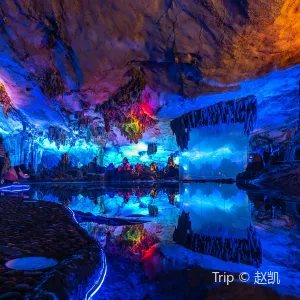
 Take taxi to cave area instead of ticket sale counter. You need to take a tram to the cave area for Rmb30. Which is only 500 meters away, waste of time and money. Cave itself is nice, and full of imagination stories, Come with guide to explain at every stops.
Bus 3 runs from the city centre to the Reed Flute Cave terminus, and bus 213 covers the same corridor from the Guilin North Railway Station side. The ride takes 30 to 40 minutes depending on traffic and costs CNY 2. Taxis and DiDi from the centre run CNY 25 to 35 and take 15 to 20 minutes.
If you arrive by high-speed train at Guilin North, the cave is roughly 9 km away, about 20 minutes and CNY 25 by car. From Guilin Liangjiang International Airport the drive is 30 to 40 minutes, which makes the cave a sensible first or last stop if your flight lands mid-morning.
Take the bus if you are travelling alone and have time: it is the cheapest option and drops you at the gate. Take a DiDi if you are two or more people, because the fare splits to roughly the bus fare per person and saves an hour of the day. Skip the sightseeing train inside the scenic area, which covers a few hundred metres that most people walk in five minutes.
| Option | Time from city centre | Cost | Notes |
| Bus 3 or 213 | 30 to 40 minutes | CNY 2 | Terminus at the gate, runs until early evening |
| DiDi or taxi | 15 to 20 minutes | CNY 25 to 35 | Metered, easiest with luggage |
| From Guilin North Station | 20 minutes | About CNY 25 | Useful for a same-day train transfer |
| From the airport | 30 to 40 minutes | CNY 80 to 110 | Cave is on the airport side of the city |
Tickets are cheap by cave standards and the price is the same all year, with no peak-season surcharge. The gap between the gate price and the online price is small, but booking ahead also skips the ticket window queue.
The adult ticket is CNY 90 at the gate and around CNY 82 when booked online before midnight on the day before your visit. Children under 1.2 m enter free, children between 1.2 m and 1.4 m pay half, and students and seniors in the concession band pay half with ID at the gate. The ticket includes the cave route and the guided group; there is no separate charge for the light show.
| Ticket | Price | How to buy |
| Adult, at the gate | CNY 90 | Ticket window or machine, ID or passport needed |
| Adult, online | About CNY 82 | Book by midnight the day before, scan the code at the gate |
| Child 1.2 m to 1.4 m | Half price | Measured at the gate |
| Child under 1.2 m | Free | Accompanied by an adult |
| Students and seniors | Half price | Valid student card or ID, gate only |
The concession is applied at the window, not online, so bring the physical card. Families with small children do well here: two adults and one child under 1.2 m pay CNY 164 online instead of CNY 270, which is the single biggest saving on the ticket page.
Trip.com sells the same ticket with a foreign card and sends a QR code by email, which is scanned at the gate with no exchange counter in between. Book at least one day ahead in the peak months of July, August and the October holiday, when morning slots fill and the gate stops selling walk-up tickets once the day's quota is reached.
The cave is open every day of the year, and the gate closes in the late afternoon rather than at night, so this is a morning or early-afternoon stop. Because the interior is lit and enclosed, rain does not ruin the visit, which makes the cave the reliable plan on a wet day in Guilin.
Opening runs from 07:30 to 18:00 in the warmer months and closes earlier, around 17:00 to 17:30, from November to March. Last entry is 30 to 45 minutes before closing. Always confirm the day's closing time at the gate or on the booking page in winter, because the winter schedule moves with the light and with maintenance closures.
| Period | Opening hours | Last entry |
| May to October | 07:30 to 18:00 | About 17:30 |
| November to April | 08:00 to 17:30 | About 17:00 |
| Public holidays | Same hours, longer queues | Book online and arrive at opening |
Arrive between 08:00 and 09:30 on a weekday. Tour groups land between 10:00 and 15:00, and the cave is a single one-way route, so a group in front of you sets your pace for the whole 40 minutes. In the afternoon after 15:30 the flow thins again and the light show is easier to watch.
Avoid the first three days of October Golden Week and the first three days of Chinese New Year. On those days the cave runs at capacity and the guided groups are nose to tail, which turns a 40-minute walk into an hour of queuing in a narrow passage.
The cave holds a steady 18 to 20 degrees Celsius with high humidity, which feels cool after a hot Guilin afternoon and cold in winter. Bring a light layer, and wear shoes with grip: the route has flights of steps and wet, polished stone. Water drips from the ceiling year-round, so a hood or a cap helps if you wear glasses.

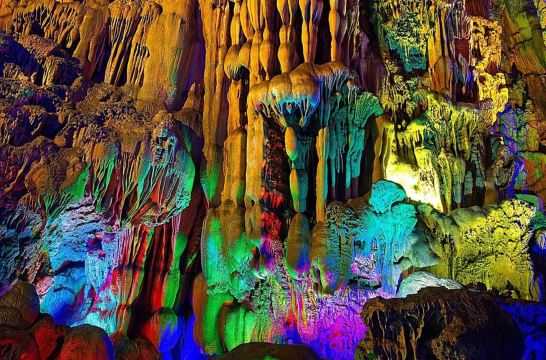
The route is 500 m of walkway through six named chambers, and the formations are lit in saturated colour rather than natural white light. Photography works best with a phone braced against a railing, because the exposure times are long.
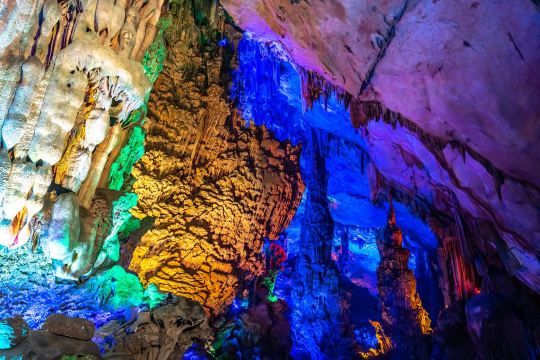
Crystal Palace is the largest chamber and the reason most people come: a hall roughly 20 m high with a still pool that doubles every stalactite in the water. The 2026 relight added projection and a sound-and-light sequence here, and the old film crew association is real: the 1986 television adaptation of Journey to the West shot its underwater palace scenes in this chamber.
Lion Ridge at Dawn is a cluster of stalactites that reads as a lion looking east when the amber light is on, and the Red Silk Canopy is a curtain-like sheet of flowstone behind it. Both sit in the first third of the route, so the group is still dense there; wait for the guide to move on and the light stays on for a minute or two longer.
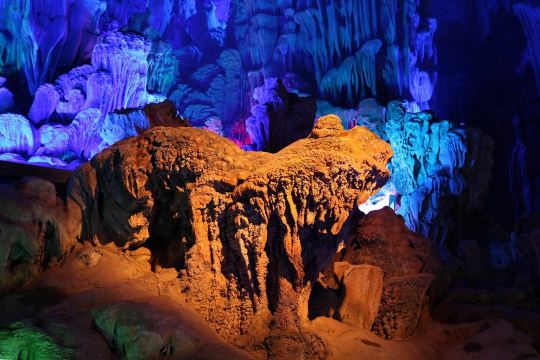
Mushroom Hill is a squat stalagmite column with a wide cap, and the Primeval Forest is the section where thin stalactites hang so densely that the chamber looks like a stand of trees. This is the best part of the cave for close-up shots, and the walkway here is wide enough to step aside.
More than 70 ink inscriptions survive on the cave walls, the oldest dated to 792 AD during the Tang dynasty. They are the reason the cave is treated as a heritage site rather than an attraction, and the guide will point out one or two with a torch if you ask.
Facilities are modest and clustered at the gate: ticket windows, toilets, a luggage counter, a small shop and a photo desk. Inside the scenic area there is a lake walk, a pavilion and the sightseeing train that most visitors skip.
Toilets sit on both sides of the entrance plaza, and there is a free cloakroom for bags, which matters because the cave route has low ceilings in two places. The photo desk sells a keychain print free of charge and larger prints for CNY 20 to 35; you can decline and take your own pictures instead. Cash is still useful for the shop, though WeChat and Alipay are accepted everywhere on site.
The relight completed in June 2026 added bare-eye 4D projection and a synchronised sound track in Crystal Palace, running on a loop through the day rather than on fixed showtimes. There is a daily pause around midday, so if the projection is the reason you are going, aim for the morning or after 14:00.
The route is one-way with roughly 200 steps in total, split into short flights, and it is not wheelchair accessible. Children walk it comfortably and there are handrails throughout, but the floor is wet and the passage narrows at two pinch points. The full walk takes 40 minutes with a guide and 60 to 90 minutes if you hang back and photograph.
The cave needs two hours including transport, so it pairs naturally with the Taohua River and the Lu Di ancient village next door, or with a late lunch back in the city. Below is the version that avoids the tour-group wave.
| Time | What to do |
| 08:00 | DiDi from the city centre to the cave gate, CNY 30 |
| 08:30 | Enter with the first guided group, 40 minutes inside |
| 09:30 | Walk the Taohua River bank and the lake at the cave mouth |
| 10:30 | DiDi back to the centre, or continue to Elephant Trunk Hill |
| 12:00 | Rice noodles and a walk on Zhengyang Pedestrian Street |
Most visitors sleep in the city centre and treat the cave as a morning trip, which is the right call unless you want the resort side of the Taohua River. The area around the cave has a cluster of resort hotels and garden guesthouses with river or hill views, usually cheaper than the centre on weekdays and much busier at weekends.
The city centre, around Zhengyang Pedestrian Street and the Two Rivers and Four Lakes, puts food and the Li River within walking distance and the cave 20 minutes away by car. Shangri-La Guilin sits on the Li River with a large garden and a mini zoo, and Sheraton Guilin is a 1988 building on Binjiang Road with river-view rooms, both about a 15 to 20 minute drive from the cave gate. The Taohua River side, near the cave gate, is quiet, green and aimed at families with cars.
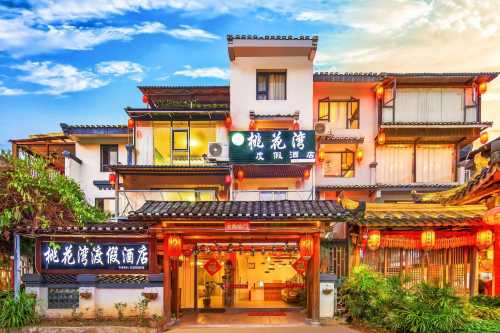
Peach Blossom Bay Resort (Guilin Ludiyan Scenic Area)
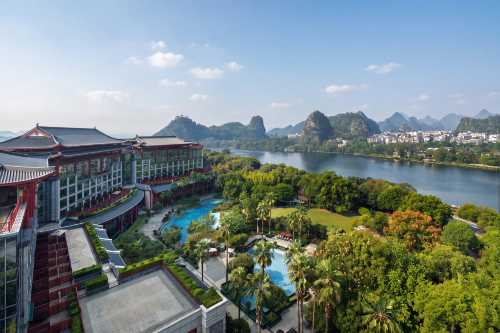
Shangri-La Guilin
 No. 5 of Family Hotels in Guilin
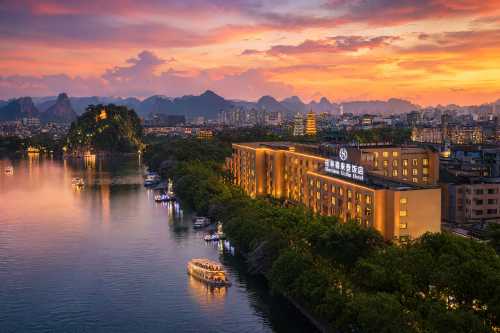
Sheraton Guilin Hotel
No. 6 of Premium Hotels in GuilinFood inside the scenic area is limited to snacks and a canteen, so plan lunch either back in the city or at one of the village restaurants on Ludi Road. Guilin rice noodles are the local default and cost CNY 8 to 12 a bowl within a 15-minute drive.
The gate area has a noodle counter and a convenience shop, useful for a quick bowl before the cave rather than a meal worth planning around. Prices are CNY 15 to 25, roughly double the city rate. If you want a proper lunch, eat after the cave instead.
The best bowls are 20 minutes away in the city centre, where the local price holds at CNY 8 to 12 for a two-liang bowl. If you are staying near the cave, the noodle counters on Ludi Road fill the gap at CNY 15 to 25. Look for a shop with a price board in Chinese and a queue of local customers at breakfast time; that combination is more reliable than any online rating.
For the full picture of what to order, how the brine works and which shops locals queue for, read our Guilin rice noodles guide.
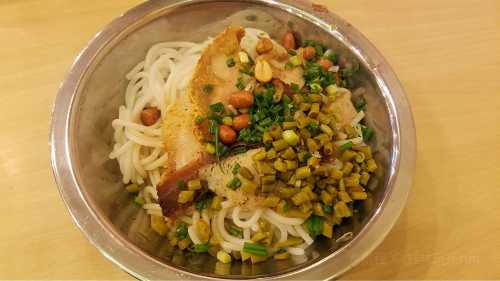
Chongshan Rice Noodles (Yiren Road Branch)
No. 16 of Global Traveller-Picked Restaurants in Guilin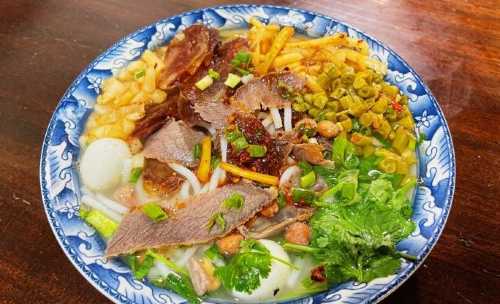
you yi xuan mi fen dian
The cave is a two-hour stop, so build the rest of the day around the river and the city. These are the pairings that work without a car and without long transfers.
The Li River cruise to Yangshuo is the headline half-day and sails in the morning, so put it on a separate day. If you are moving on to Yangshuo, our guide to the Guilin to Yangshuo high-speed train covers piers, stations and fares.
For a wider plan covering the river, the caves and the rice terraces, see the three-day Guangxi and Guilin itinerary. Travellers stitching Guilin into a longer route can use the two-week China itinerary as the frame.
If you have a spare afternoon in the city, Elephant Trunk Hill and the Two Rivers and Four Lakes walk are both free to view from the bank and 15 minutes from the pedestrian street.
Popular recommendations

Guilin+Huangyao Ancient Town 4-day, 3-night in-depth itinerary plan 2026: Explore Guilin+Huangyao Ancient Town's popular attractions (updated November)
 Trip.Planner
Guilin+Liuzhou+Yangshuo 3-day, 2-night travel guide 2026: Discover top activities with an easy itinerary planner (updated November)
Trip.PlannerGuilin+Beihai+Nanning 6-day, 5-night in-depth itinerary plan 2026: Explore Guilin+Beihai+Nanning's popular attractions (updated August)
Trip.PlannerGuilin 3-day, 2-night travel guide 2026: Discover top activities with an easy itinerary planner (updated August)
Trip.Planner