Jingshan Park Beijing 2026: Tickets, Hours & Forbidden City Views
Contents
- Where Is Jingshan Park in Beijing?
- Why Is It Also Called Coal Hill?
- How to Get to Jingshan Park
- From the Forbidden City
- By Metro
- By Bus
- Jingshan Park Tickets & Prices
- The Reservation Rule Foreign Visitors Need to Know
- Jingshan Park Opening Hours
- Hours for Shouhuang Hall and the Inner Halls
- Best Time to Visit Jingshan Park
- Jingshan Park by Season
- When to Avoid the Crowds
- Things to Do at Jingshan Park
- Wanchun Pavilion: The Forbidden City Panorama
- The Five Pavilions
- Shouhuang Hall
- The Chongzhen Emperor's Death Site
- Peony Garden
- Qiwang Tower and Local Life
- Jingshan Park Map & Facilities
- Facilities and Accessibility
- One-Day Itinerary: Forbidden City, Jingshan & Beyond
- Where to Eat Near Jingshan Park
- Where to Stay Near Jingshan Park
- City Point Hotel (Forbidden City)
- The PuXuan Hotel and Spa
- King Parkview Hotel
- More Beijing Guides
Show more
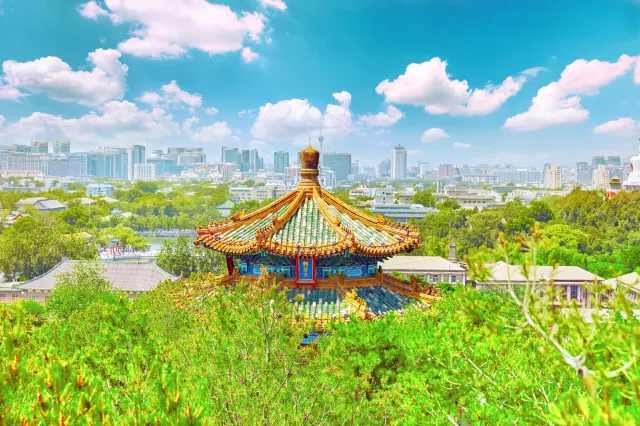
Wanchun Pavilion crowns Jingshan Hill, the highest point on Beijing's Central Axis. Photo: Trip.com
Jingshan Park is the wooded hill directly north of the Forbidden City, and for many visitors it is the single best view in Beijing. For ¥2 you climb to Wanchun Pavilion, the highest point on the city's Central Axis, and look straight down on the golden roofs of the imperial palace. This guide covers 2026 tickets, the reservation rule for foreign visitors, opening hours, which gate to use, the photo spots worth the climb and a simple one-day route that links the park with the Forbidden City.
Jingshan Park sits at No. 44 Jingshan West Street (景山西街44号) in Xicheng District, on the north–south axis of old Beijing. The Forbidden City is immediately to its south, Beihai Park to its west, and the Drum and Bell Towers to its north. The park covers about 230,000 square meters, and the hill rises to 94.2 meters above sea level, making it the highest point on the Central Axis.
This was the imperial rear garden of the Yuan, Ming and Qing dynasties and opened to the public in 1928. Today it is a national key cultural relic site and a 4A-level scenic area, but it still works like a neighborhood park: locals arrive at dawn to sing, dance and practise tai chi, then tourists take over the summit around mid-morning.
| Address | No. 44 Jingshan West Street, Xicheng District, Beijing |
| Tickets | ¥2 adult / ¥1 student; ¥10 / ¥5 during event periods |
| Opening hours | 6:00–21:00 (Apr–Oct); 6:30–20:00 (Nov–Mar) |
| Time needed | 1–3 hours |
| Nearest metro | Line 8, National Art Museum station, Exit A |
| Best for | Forbidden City panorama, sunsets, peonies, people-watching |
Jingshan has carried several names over the centuries, including Wansui Hill, Zhen Hill and Meishan, or Coal Hill. The hill is said to have been built from earth excavated while digging the moats around the Forbidden City in the Ming dynasty, and legend holds that coal was stored inside as a reserve for a siege. Whatever the truth, the artificial hill gave the palace the northern "mountain" that feng shui required — and gave later generations the best rooftop view of the palace.
The easiest approach is on foot from the Forbidden City. Leave through the Shenwumen (Gate of Divine Prowess), the palace's north exit, cross Jingshan Qianjie, and you are at the park's south gate in about two minutes. If you are coming from elsewhere in Beijing, the metro plus a short walk or bus ride is the most predictable option; taxis can drop you near the gates but cannot park in the narrow hutongs.
Walk north out of Shenwumen, cross the street and enter the south gate. This is the classic route and the reason Jingshan pairs so well with a palace visit: there is no backtracking, and the climb takes 15–20 minutes.
| South Gate | Trams 101, 103, 109, 124; bus 58; sightseeing lines 1–3 (Gugong stop) |
| East Gate | Trams 111, 124; bus 58 (Jingshan East Gate stop) |
| West Gate | Buses 5 and 58 (Xibanqiao stop) |
If you are arriving in Beijing by high-speed train, allow roughly 40–60 minutes from Beijing South Railway Station to the park by metro plus taxi, or longer at rush hour. Staying within the Second Ring Road makes the whole Forbidden City–Jingshan–Beihai circuit walkable.
Jingshan is one of the cheapest major sights in Beijing: a standard adult ticket costs ¥2, and a student ticket ¥1. During flower and cultural festivals the price rises to ¥10 for adults and ¥5 for students, so budget a little extra if you visit during the peony season or the summer cultural weeks.
| Ticket type | Price | Notes |
| Adult, regular period | ¥2 | Standard admission |
| Student, regular period | ¥1 | Valid student ID required |
| Adult, event period | ¥10 | Peony and cultural festivals |
| Student, event period | ¥5 | Valid student ID required |
| Children under 1.2 m | Free | Accompanied by an adult |
| Seniors aged 60+ | Free | Bring your passport or ID |
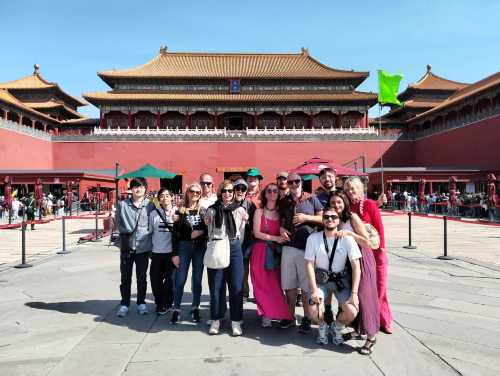
 Jade was our guide. @Jade thank you again for the awesome tour. What to expect: An organize meeting time/point with information sent to you via WeChat the day before. Jade spoke English very well, was happy to answer all questions and gave us many insights of the forbidden city. Do not expect to see every part - for this the city is just to large . Jade will show you the most important places. All in all 5/5 you get what you have booked.
Chinese visitors book through the official "Changyou Gongyuan" (畅游公园) WeChat account, but foreign passports often cannot complete that flow. The park's rule is explicit: foreign visitors must reserve by phone at least one day in advance, calling +86-10-64038098 between 9:00 and 16:00. You will be asked for your name, nationality and passport number. On the day, collect your paper ticket at the information desk by the south gate with the same passport. Without a reservation the park does not sell tickets on site.
Book before you leave your hotel, keep the passport you used for the reservation with you, and arrive at the south gate rather than the east or west gate. The desk is the only place that can issue the reserved ticket.
Domestic visitors and residents with Chinese ID can book same-day or next-day slots on WeChat and scan in at the gate. If you are travelling with a Chinese-speaking friend, asking them to book for you on the mini-program is usually faster than the phone line, but the passport holder still needs the passport at entry.
The park opens early and closes relatively late, which makes it practical to visit before the Forbidden City or after a full palace day. Hours switch on 1 April and 1 November each year.
| Period | Park hours | Last entry |
| 1 April – 31 October | 6:00–21:00 | 20:30 |
| 1 November – 31 March | 6:30–20:00 | 19:30 |
The courtyards inside the park keep much shorter hours than the gates. In peak season they open at 8:00 and close at 18:00, with last entry at 17:30; in winter they run 8:30–17:00 with last entry at 16:30. They are closed on Mondays except public holidays, so do not plan your whole visit around them on a Monday.
Sunset in Beijing falls between about 16:50 in December and 19:45 in June, and the park stays open well past sunset for most of the year. In winter, the 19:30 last entry still gives you time to climb for dusk, but the summit clears quickly once the light goes.
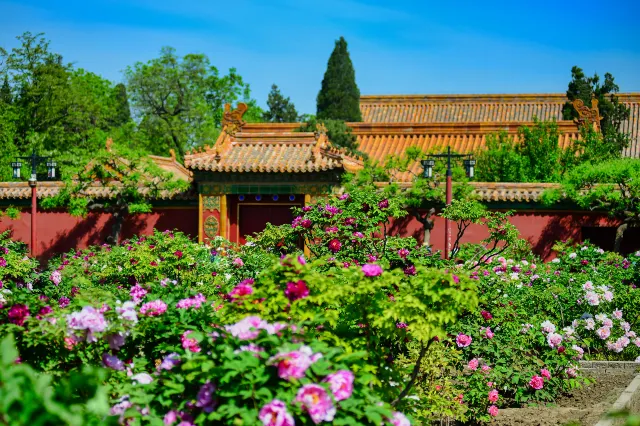
Jingshan's peony beds bloom from late April into May. Photo: Trip.com
Late afternoon is the best time to climb. An hour before sunset, the low light hits the Forbidden City's yellow roofs and the view turns from a map into the postcard everyone comes for. Early morning is the other sweet spot: gates open at 6:00 in summer, the hill is full of locals exercising, and you can photograph the palace without a wall of heads in the frame.
| Season | What you get | Watch out for |
| Spring (Mar–May) | Peonies in late April and May, fresh green, clear light | Event pricing and weekend crowds |
| Summer (Jun–Aug) | Long evenings, sunset after 19:00, lush trees | Heat, humidity and sudden storms |
| Autumn (Sep–Nov) | Ginkgo and maple colour, crisp air, best visibility | National Day crowds in early October |
| Winter (Dec–Feb) | Snow on the roofs, thin crowds, early sunsets | Cold wind on the summit, short daylight |
Weekday mornings and the last two hours before closing are the quietest. Chinese public holidays — especially the first week of October and the Spring Festival week — turn the summit into a queue, and the narrow stairs make the climb slow. If the air quality index is high, the panorama fades into haze; save the climb for a clear day and swap in Beihai Park or the hutongs instead.
The park is small enough to see in one loop, but the highlights are not all at the top. Give yourself 1.5–2.5 hours: 20 minutes to climb, 30–40 minutes on the summit, then the halls and gardens on the way down.
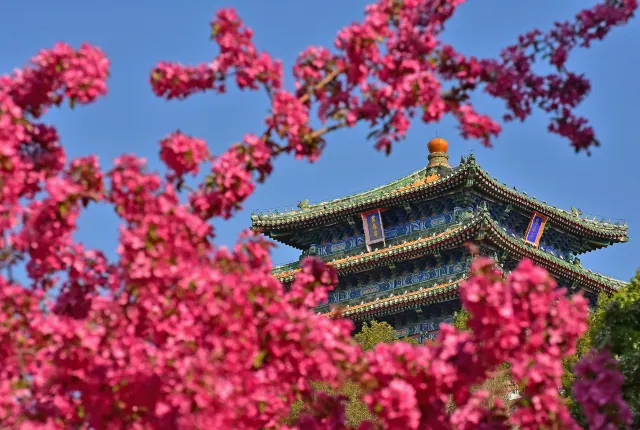
Wanchun Pavilion in spring; the summit terrace is a 15–20 minute climb from the south gate. Photo: Trip.com
Wanchun Pavilion (万春亭) was built in 1750 and stands at the very top of the hill, on the highest point of Beijing's Central Axis. From the terrace you look south over the full length of the Forbidden City, west to the white pagoda of Beihai Park, north to the Drum and Bell Towers, and east to the glass towers of the CBD. Go up the east stairs and come down the west side for a different angle; the summit terrace is narrow, so keep bags in front of you.
Five pavilions run across the ridge from east to west: Zhoushang, Guanmiao, Wanchun, Jifang and Fulan. Wanchun is the largest and busiest; the other four are quieter places to sit, catch your breath and look through the trees. Each has its own roof form and painted details, and the walk between them takes about 15 minutes.
On the north side of the hill, the Shouhuang Hall complex was where Qing emperors honoured their ancestors; it once held the portraits and memorial tablets of eight generations of emperors. The restored courtyards are large, red-walled and usually far quieter than the summit, which makes them the best place in the park for portraits. Check the Monday closure and the last-entry time before you count on going inside.
On the east slope, a stone marker and a replanted locust tree mark where the last Ming emperor, Chongzhen, is said to have hanged himself in 1644 as rebel forces entered Beijing. It is a two-minute stop on the way up, but it explains why the hill matters in Chinese history rather than just in photographs.
Jingshan has grown peonies since the Yuan dynasty, and the garden now holds more than 500 varieties. The beds below the halls bloom from late April into May, which is also when the park charges event pricing. Outside peony season the same area is a quiet, shaded walk with old cypresses and stonework.
Qiwang Tower sits at the foot of the hill facing the south gate and was built for students of the old Jingshan school to pay respect to Confucius. Nearby, the paths fill with dancers, card players and singers in the early morning — one of the few free, unscripted views of daily Beijing left in the old city.
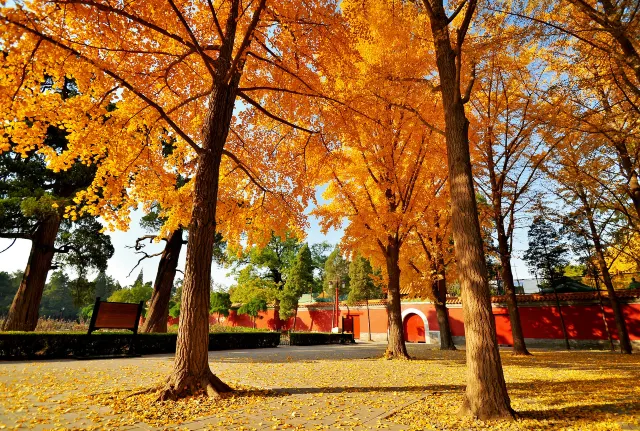
Autumn ginkgo along the park's red walls. Photo: Trip.com
The park has three gates — south, east and west — and a simple layout: a broad formal garden on the south side, the hill in the middle with five pavilions on the ridge, and the Shouhuang Hall complex on the north side. Most first-time visitors enter from the south and leave from the east, which puts them a short walk from Beihai Park and the Nanluoguxiang hutongs.
| Gate | Closest to | Best for |
| South Gate | Forbidden City's Shenwumen, ticket desk for foreigners | Classic climb, Qiwang Tower |
| East Gate | National Art Museum metro, Shatan North Street | Shouhuang Hall, exit toward Nanluoguxiang |
| West Gate | Beihai Park, Shichahai metro | Combining with Beihai and Houhai |
There are toilets near each gate and on the main paths, plus small kiosks selling water, ice cream and snacks; there is no full restaurant inside the park. The lower paths are paved and manageable with a stroller, but the summit stairs are steep and narrow, so leave the stroller at the bottom if you can. Benches are plentiful, and the halls have steps rather than ramps.
The most efficient day in central Beijing is palace first, hill second, hutongs last. The Forbidden City runs south to north, so you exit at the point closest to Jingshan and avoid retracing your steps.
| Time | Stop | Why |
| 08:30 | Enter the Forbidden City at Meridian Gate | Beat the tour groups and walk the central axis |
| 12:00 | Lunch near Jingshan Qianjie | Refuel before the climb |
| 13:00 | Exit Shenwumen, cross to Jingshan South Gate | Two-minute transfer |
| 13:20 | Climb to Wanchun Pavilion | Palace panorama in early afternoon light |
| 14:10 | Shouhuang Hall and peony garden | Quiet courtyards, best portraits |
| 15:15 | Exit east gate toward Nanluoguxiang or Beihai | Hutongs, cafés and the Drum Tower |
| 18:00 | Dinner in the hutongs | Finish within walking distance |
Book the Forbidden City separately: tickets are sold through the official mini-program, usually up to seven days ahead, and the palace is closed on Mondays. If you only have an afternoon, skip the palace, enter Jingshan at 16:00 and stay for sunset — the light is better and the crowds thinner.
Inside the park you will only find snack kiosks, so plan a proper meal before or after. The streets around the east and south gates have the best concentration of options, and the Nanluoguxiang area is a 15–20 minute walk north.
Lunch service in this area peaks between 11:30 and 13:30. Eating at 11:15 or after 13:30 gets you seated faster, and it keeps the Jingshan climb in the softer afternoon light.
Staying inside the Second Ring Road puts the Forbidden City, Jingshan, Beihai and the hutongs within walking distance, which saves a surprising amount of time in Beijing traffic. These three hotels are all close to the park and have different price points.
A comfortable mid-range option on Shatan North Street, about 460 meters from Jingshan and a 5–10 minute walk from the Forbidden City's east side. Rooms are compact but well kept, breakfast includes Beijing snacks, and the location is hard to beat for the price.
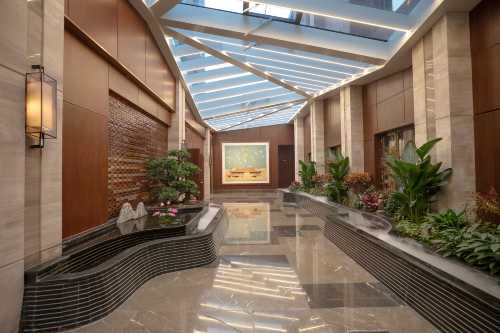
City point hotel(Forbidden city)
 No. 11 of 4-Star Select Hotels in Beijing
A luxury choice in Wangfujing with rooms facing west toward the Forbidden City and Jingshan. It is the option to pick if you want a skyline view from your room, a full spa and easy access to both the palace and Wangfujing dining.

The PuXuan Hotel and Spa

A characterful, mid-priced hotel about 320 meters from Jingshan's east gate, set around a courtyard with older university buildings in the grounds. It is quiet, close to local restaurants and a practical base for families who want to walk to the main sights.
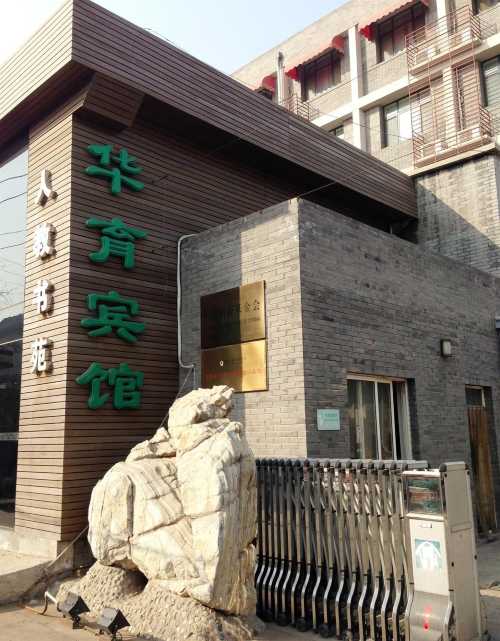
King Parkview Hotel
Popular recommendations
Forbidden City Beijing 2026: Map, Route & How to Get There
 OneVoyager
Mutianyu Great Wall 2026: Tickets, Toboggan & Transport
OneVoyager
Latest Trip.com Promo Codes, Flight Discounts & Hotel Savings (Weekly Update)
 Trip.com Official

6 Things to know before Exploring the Montmorency Falls, Quebec
 _TS***4m