
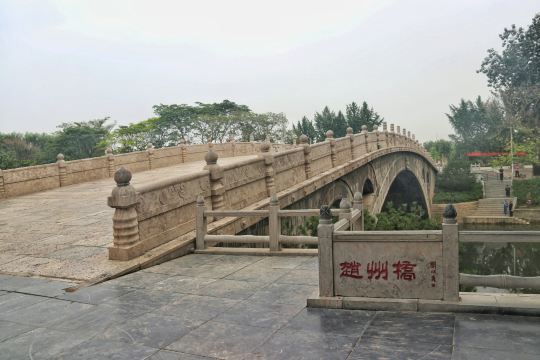
▲ Zhaozhou Bridge, also known as Anji Bridge and locally called the Great Stone Bridge, was built between 595 and 605 AD during the Sui Dynasty, with a history spanning over 1,400 years. Designed and constructed by master craftsman Li Chun of the Sui Dynasty, it was later named "Anji" by Emperor Zhezong during his northern inspection in the Northern Song Dynasty. As a large single-span open-spandrel stone arch bridge, Zhaozhou Bridge features a main arch composed of 28 parallel arch ribs arranged longitudinally. The bridge measures 64.4 meters in total length with a deck width of 9 meters, expanding to 9.6 meters at the arch abutments. The main arch has a clear span of 37.02 meters and a rise (vertical distance from the crown to the springing line) of 7.23 meters. Two smaller arches near each abutment have clear spans of 3.81 meters, while the two arches closer to the bridge center span 2.85 meters each.
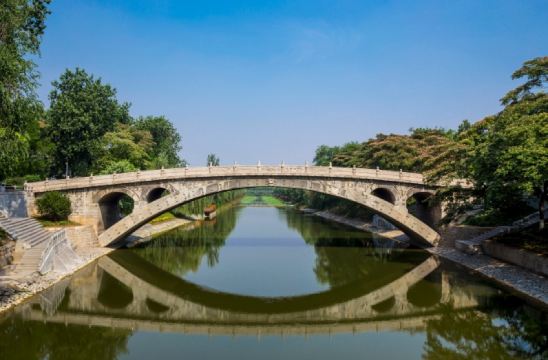
▲ Zhaozhou Bridge is an ancient stone arch bridge renowned for its long history, excellent preservation, advanced scientific design, and exquisite artistic form. It holds an extremely important position in the history of world architecture and has been celebrated since ancient times as "the most magnificent bridge under heaven." Today, it is honored as "the world's foremost bridge." In 1961, it was designated by the State Council as one of China's first batch of major historical and cultural sites under state protection. In September 1991, the American Society of Civil Engineers selected it as the 12th "International Historic Civil Engineering Landmark" and erected a commemorative plaque and monument in its honor.