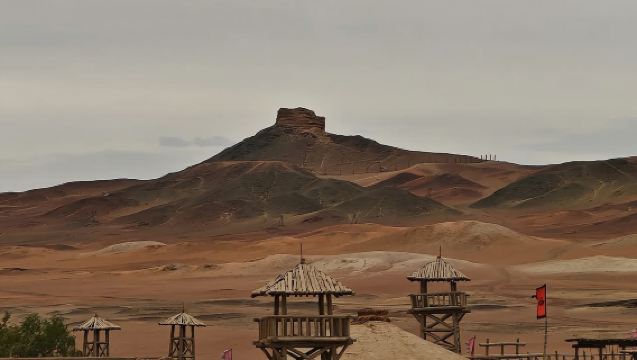
▲ Yang Guan, located 70 km southwest of Dunhuang City in Gansu Province at the ancient Antique Beach, was established during the Western Han Dynasty. Along with Yumen Pass, it served as a vital gateway to the Western Regions and was a key pass on the southern route of the Silk Road. Its name derives from its position south of Yumen Pass. The Yang Guan attraction preserves numerous historical relics from the Han Dynasty, including the ancient Yang Guan ruins, beacon towers, the ancient Yang Guan road, the Shouchang City ruins, sections of the Han Dynasty Great Wall, the Wowa Pool ruins, the Xitugou (Tang Dynasty Wulu Stream) ruins, ancient tombs, and pottery kilns.

▲ Yang Guan, located 70 km southwest of Dunhuang City in Gansu Province at the ancient Antique Beach, was established during the Western Han Dynasty. Along with Yumen Pass, it served as a vital gateway to the Western Regions and was a key pass on the southern route of the Silk Road. Its name derives from its position south of Yumen Pass. The Yang Guan attraction preserves numerous historical relics from the Han Dynasty, including the ancient Yang Guan ruins, beacon towers, the ancient Yang Guan road, the Shouchang City ruins, sections of the Han Dynasty Great Wall, the Wowa Pool ruins, the Xitugou (Tang Dynasty Wulu Stream) ruins, ancient tombs, and pottery kilns.

▲ The Dunhuang Yardang landform is part of the ancient Lop Nur. On this magical land of Dunhuang, nature has created numerous wonders. Located at the border of Xinjiang and Gansu provinces, about 80 km northwest of Yumen Pass, lies a typical Yardang landform cluster. With orderly arrangements and peculiar shapes, it forms a rare natural sculpture museum. Recognized as another wonder of Dunhuang, it showcases nature's extraordinary craftsmanship and infinite marvels.

▲ Yang Guan, located 70 km southwest of Dunhuang City in Gansu Province at the ancient Antique Beach, was established during the Western Han Dynasty. Along with Yumen Pass, it served as a vital gateway to the Western Regions and was a key pass on the southern route of the Silk Road. Its name derives from its position south of Yumen Pass. The Yang Guan attraction preserves numerous historical relics from the Han Dynasty, including the ancient Yang Guan ruins, beacon towers, the ancient Yang Guan road, the Shouchang City ruins, sections of the Han Dynasty Great Wall, the Wowa Pool ruins, the Xitugou (Tang Dynasty Wulu Stream) ruins, ancient tombs, and pottery kilns.

▲ Yang Guan, located 70 km southwest of Dunhuang City in Gansu Province at the ancient Antique Beach, was established during the Western Han Dynasty. Along with Yumen Pass, it served as a vital gateway to the Western Regions and was a key pass on the southern route of the Silk Road. Its name derives from its position south of Yumen Pass. The Yang Guan attraction preserves numerous historical relics from the Han Dynasty, including the ancient Yang Guan ruins, beacon towers, the ancient Yang Guan road, the Shouchang City ruins, sections of the Han Dynasty Great Wall, the Wowa Pool ruins, the Xitugou (Tang Dynasty Wulu Stream) ruins, ancient tombs, and pottery kilns.

▲ The Dunhuang Yardang landform is part of the ancient Lop Nur. On this magical land of Dunhuang, nature has created numerous wonders. Located at the border of Xinjiang and Gansu provinces, about 80 km northwest of Yumen Pass, lies a typical Yardang landform cluster. With orderly arrangements and peculiar shapes, it forms a rare natural sculpture museum. Recognized as another wonder of Dunhuang, it showcases nature's extraordinary craftsmanship and infinite marvels.

▲ The Dunhuang Yardang landform is part of the ancient Lop Nur. On this magical land of Dunhuang, nature has created numerous wonders. Located at the border of Xinjiang and Gansu provinces, about 80 km northwest of Yumen Pass, lies a typical Yardang landform cluster. With orderly arrangements and peculiar shapes, it forms a rare natural sculpture museum. Recognized as another wonder of Dunhuang, it showcases nature's extraordinary craftsmanship and infinite marvels.

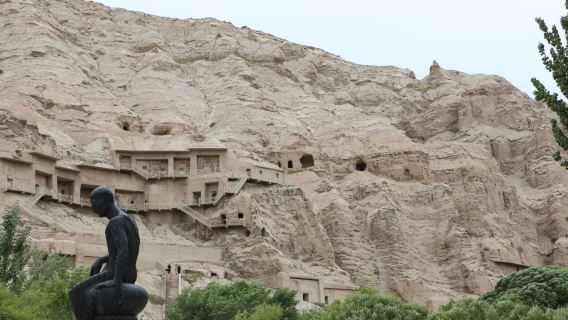
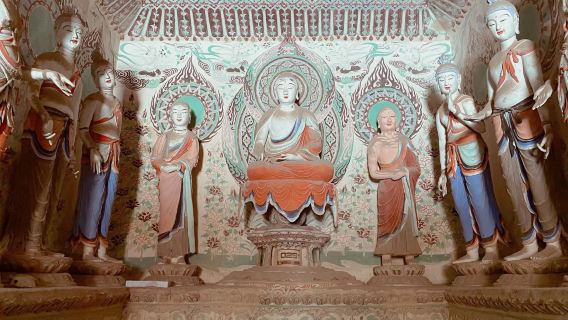
▲ The Western Thousands Buddha Grottoes is one of the Dunhuang cave complexes and an important component of Dunhuang cave art, often referred to as the "sister caves" of the Mogao Caves. Named for its location west of the Mogao Caves in Dunhuang, it is situated about 3 km east of the Danghe Reservoir in Dunhuang City, Gansu Province, on the north and south cliffs of the valley carved by the eastward-flowing Danghe River through the Gobi Desert. The cave area stretches 2.5 km from Nanhudian in the east to the current Danghe Reservoir in the west. The Western Thousands Buddha Grottoes currently preserves 34 painted sculptures and over 800 square meters of murals.

▲ The Western Thousands Buddha Grottoes is one of the Dunhuang cave complexes and an important component of Dunhuang cave art, often referred to as the "sister caves" of the Mogao Caves. Named for its location west of the Mogao Caves in Dunhuang, it is situated about 3 km east of the Danghe Reservoir in Dunhuang City, Gansu Province, on the north and south cliffs of the valley carved by the eastward-flowing Danghe River through the Gobi Desert. The cave area stretches 2.5 km from Nanhudian in the east to the current Danghe Reservoir in the west. The Western Thousands Buddha Grottoes currently preserves 34 painted sculptures and over 800 square meters of murals.

▲ The Dunhuang Yardang landform is part of the ancient Lop Nur. On this magical land of Dunhuang, nature has created numerous wonders. Located at the border of Xinjiang and Gansu provinces, about 80 km northwest of Yumen Pass, lies a typical Yardang landform cluster. With orderly arrangements and peculiar shapes, it forms a rare natural sculpture museum. Recognized as another wonder of Dunhuang, it showcases nature's extraordinary craftsmanship and infinite marvels.

▲ The Dunhuang Yardang landform is part of the ancient Lop Nur. On this magical land of Dunhuang, nature has created numerous wonders. Located at the border of Xinjiang and Gansu provinces, about 80 km northwest of Yumen Pass, lies a typical Yardang landform cluster. With orderly arrangements and peculiar shapes, it forms a rare natural sculpture museum. Recognized as another wonder of Dunhuang, it showcases nature's extraordinary craftsmanship and infinite marvels.

▲ Yang Guan, located 70 km southwest of Dunhuang City in Gansu Province at the ancient Antique Beach, was established during the Western Han Dynasty. Along with Yumen Pass, it served as a vital gateway to the Western Regions and was a key pass on the southern route of the Silk Road. Its name derives from its position south of Yumen Pass. The Yang Guan attraction preserves numerous historical relics from the Han Dynasty, including the ancient Yang Guan ruins, beacon towers, the ancient Yang Guan road, the Shouchang City ruins, sections of the Han Dynasty Great Wall, the Wowa Pool ruins, the Xitugou (Tang Dynasty Wulu Stream) ruins, ancient tombs, and pottery kilns.

▲ Dunhuang Ancient City is located 16 km west of Dunhuang City in Gansu Province. Built in 1987 as a film set for the Sino-Japanese co-production "Dunhuang," it was modeled after the Song Dynasty painting "Along the River During the Qingming Festival." Covering an area of 150,000 square meters with 15,000 square meters of construction, it is a national AAA-level tourist attraction. The city features five streets—Dunhuang, Gaochang, Ganzhou, Xingqing, and Bianliang—primarily showcasing Tang and Song architectural styles blended with Western Region folk elements. Facilities include Buddhist temples, taverns, and post stations, recreating the ambiance of an ancient Silk Road hub. This architectural complex fully represents the urban layout of Northwest China during the Tang and Song periods, earning it the title "Museum of Ancient Northwest Chinese Architecture." Today, it serves as a comprehensive film production base in Northwest China.

▲ The Dunhuang Yardang landform is part of the ancient Lop Nur. On this magical land of Dunhuang, nature has created numerous wonders. Located at the border of Xinjiang and Gansu provinces, about 80 km northwest of Yumen Pass, lies a typical Yardang landform cluster. With orderly arrangements and peculiar shapes, it forms a rare natural sculpture museum. Recognized as another wonder of Dunhuang, it showcases nature's extraordinary craftsmanship and infinite marvels.