Guangshui

Things to do in Guangshui

Search attractions or local attractions & tours
Search

Explore top experiences

Top 10 attractions in Guangshui

View all Attractions
The Three Gorges Dam Tourism Area
No. 1 of Best Things to Do in Hubei

The Three Gorges Dam Tourism Area

8.9
4.7/5
9k reviews

The Three Gorges Dam Tourism Area is located in the Xiling Gorge section of the Yangtze River in Yichang, Hubei. It is a scenic attraction built around the Three Gorges hydro project, covering over ten square kilometers. Currently, it offers travelers three viewing spots: Tanzi Ridge, the 185 viewing platform, and the river closure memorial park. The dam crest itself is not open to travelers, so visits primarily revolve around these three attractions. Tanzi Ridge is the highest accessible point in the dam area, named for its jar-shaped summit viewing platform resembling an overturned jar. It also served as the survey site for the dam's initial location selection. From the ridge top, visitors can overlook the Three Gorges Project in its entirety—the dam, power station, and twin five-level ship locks are all visible. The five lock chambers cascade down the mountainside, earning the nickname "Fourth Gorge of the Yangtze." The park displays engineering artifacts like ancient riverbed stones, river closure rocks, and foundation stones from the dam site, complemented by model exhibits that help visitors intuitively understand the origins and development of this mega-project. The 185 observation platform is located on the left bank of the dam. It gets its name from sharing the same elevation of 185 m as the dam crest. Standing on the platform feels like being atop the dam: on one side, the dam and vertical ship lift are within close reach, offering a chance to witness ships "riding the elevator" over the dam; on the other side lies the vast, tranquil reservoir upstream. The stark contrast between the stillness above and the dynamism below the dam is striking. The closure memorial park is situated on the right bank downstream of the dam, preserving artifacts like tetrahedral closure stones and large loading machinery used during the construction. It's an ideal spot to view the dam's full frontal grandeur. During flood seasons when the dam releases water, torrents rush out from the deep outlets, creating towering mist and thunderous echoes that reverberate through the valley—a truly awe-inspiring spectacle. The three attractions are far apart, and the scenic area provides shuttle buses for transportation. It is recommended to reserve half a day to visit them in order.

China · Yichang
Hubei Provincial Museum
2026 Asia 100 - Family-friendly Attractions

Hubei Provincial Museum

8.5
4.9/5
7.9k reviews

The Hubei Provincial Museum has ten treasures of the museum, including those unearthed from "Tomb of Marquis Yi of Zeng" the Hubei Provincial Museum's Zenghouyi chime bells; the Yue Wang Goujian sword, a masterpiece of the cold weapon era; the fossilized skull of the Yunxian Man dating back 1 million years; and a treasure of Yuan blue-and-white porcelain: the plum vase with the Four Loves design. The museum's regular exhibitions also feature distinctive characteristics of ancient Chu culture and ancient Yangtze River civilization. The Hubei Provincial Museum consists of the comprehensive exhibition hall,Chu culture hall,Chime bell hallIt is composed of multiple pseudo-classical buildings, and the layout reflects the high-platform architectural layout format of ancient Chu architecture, namely "one terrace, one hall" and "multiple terraces forming a group." Unearthed in 1978 at "Tomb of Marquis Yi of Zeng" in the Hubei Provincial Museum - the Zenghouyi chime bells have a wide range and their excavation rewrote the history of world music; the sword of Goujian, King of Yue, a masterpiece of the cold weapon era, is still incomparably sharp to this day, and displayed beside it is the "spear of Fuchai, King of Wu"; the geological age of the Yunxian human skull fossil is approx. 1 million years ago, earlier than the Peking Man skull fossil; the Yuan blue-and-white plum vase with four loves design is an extremely rare masterpiece among Yuan dynasty blue-and-white porcelain. Hubei is located in the middle reaches of the Yangtze River and belonged to the territory of the Chu state during the Spring and Autumn and Warring States periods. The permanent exhibitions at the Hubei Provincial Museum showcase ancient civilizations of southern China that differ from the Yellow River civilization of the north. The museum's current permanent exhibitions include "Yunxian Man: Prehistoric Humans in the Middle Reaches of the Yangtze River," "Qujialing: Prehistoric Culture in the Middle Reaches of the Yangtze River," and "Panlongcheng: Bronze Civilization in the Middle Reaches of the Yangtze River." In addition to viewing cultural relics at the Hubei Provincial Museum, you can also enjoy chime bell performances. In the museum's performance hall, chime bell performances are held from Tuesday to Sunday, and it is closed on Mondays.

China · Wuhan
Qingchuan Pavilion
No. 4 of Best Things to Do in Hubei

Qingchuan Pavilion

8.4
4.7/5
7.7k reviews

Qingchuan Pavilion stands on Yugong Rock at the eastern foot of Tortoise Hill in Hanyang, facing the Han River to the north and the Yangtze River to the east, gazing across the river at Yellow Crane Tower in Wuchang on the opposite bank. The pavilion's name is taken from the line "the clear river reflects the trees of Hanyang" by the Tang dynasty poet Cui Hao, and it was initiated for construction by Fan Zhizhen, the Ming dynasty prefect of Hanyang. First built during the Jiajing era of the Ming dynasty, it has a history of more than four hundred years. Throughout history, Qingchuan Pavilion was destroyed and rebuilt as many as six or seven times, the last destruction caused by a windstorm; the existing structure was rebuilt in the 1980s following the style of the Guangxu era of the Qing dynasty. Long known as one of the "finest sights of the Three Chu regions" and a "grand vista through the ages," Qingchuan Pavilion echoes Yellow Crane Tower across the river and stands out distinctly along the banks of the Yangtze. The attraction is composed of three main structures—Qingchuan Pavilion, Yuji Xinggong (Yu and Ji Ancestral Hall), and Tiemen Pass—along with auxiliary structures such as the ancient archway, Chubo Pavilion, Chaozong Pavilion, Yu Stele Pavilion, Jingchu Heroic Spirit Stele, and the poetry stele corridor, forming a complex of ancient and pseudo-classical buildings standing by the river. Among them, Yuji Xinggong was first built during the Shaoxing era of the Southern Song dynasty under the original name Yu Wang Temple; during the Tianqi era of the Ming dynasty, it was renamed "Yuji Xinggong" after its worship was changed to Houji and other former sages, and it has been an important site in Wuhan for successive generations to pay homage to Yu the Great. Tiemen Pass was first built during the Three Kingdoms period and has been a strategic location contested by military strategists since ancient times; it was restored in the 1990s. Ascending Qingchuan Pavilion offers a panoramic view of the expansive river scenery where the Yangtze River and the Han River converge. Inside the pavilion, permanent exhibitions such as "Traces of Yu Across the Nine Provinces" and "Historical Paintings of Qingchuan" present Yu the Great culture and the historical heritage of Qingchuan Pavilion from multiple perspectives, ranging from water-control culture to poetry and couplets. The attraction nestles between the hills and the river, with pavilions and terraces scattered in graceful arrangement. The poetry stele corridor preserves inscribed stones bearing verses by literati and poets of successive dynasties, and strolling through it allows visitors to feel the rich historical and cultural atmosphere.

China · Wuhan
Wudang Mountains
No. 5 of Best Things to Do in Hubei

Wudang Mountains

8.1
4.6/5
15.5k reviews

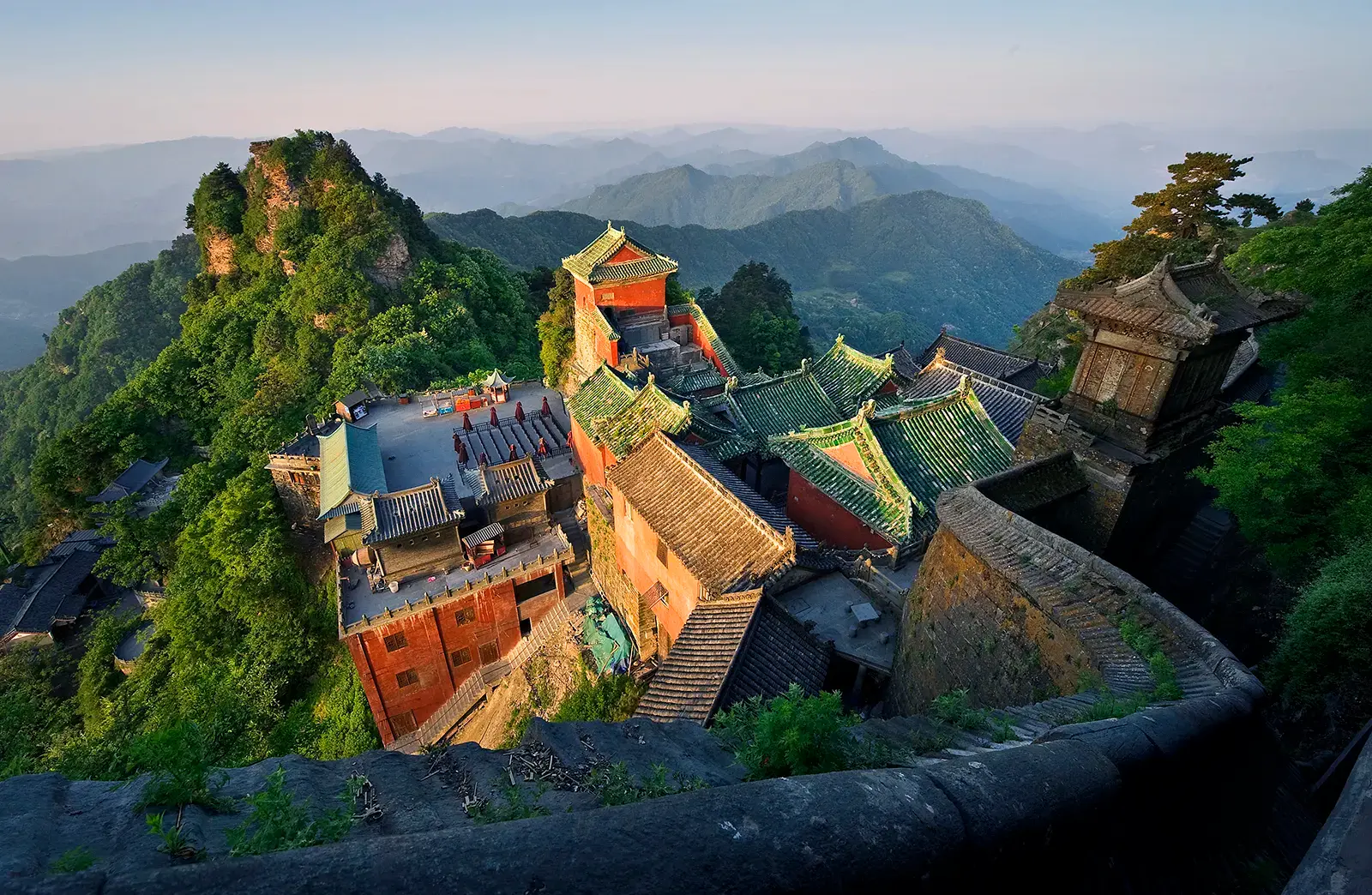
The Wudang Mountains are located in Shiyan, northwestern Hubei province. Its main peak, Tianzhu Peak, stands at an elevation of over 1,600 m. Legend has it that Emperor Zhenwu cultivated and ascended to immortality here, while Taoist Zhang Sanfeng further synthesized the essence of martial arts during the late Yuan and early Ming dynasties, making this the birthplace of Wudang martial arts. During the Yongle era of the Ming dynasty, the imperial court launched the monumental project of "constructing the Forbidden City in the north and building the Wudang Mountains in the south." The mountain temples were built according to royal standards, with their layout unfolding layer by layer following the mythological narrative of Zhenwu's spiritual cultivation. The palaces blend harmoniously with the peaks, cliffs, and streams, creating an ethereal and mystical atmosphere befitting a sacred mountain. The attractions unfold along the mountain terrain from the base to the summit, connecting key areas like Taizi Slope, Zixiao Palace, Nanyan Palace, and Taihe Palace. At Taizi Slope, the undulating Nine-bend Yellow River Wall follows the mountain contours, while Wuyun Tower's "one pillar supporting twelve beams" remains an architectural marvel. Zixiao Palace, a well-preserved imperial Taoist temple, features the stately Zixiao Hall with its double-eaved, nine-ridged roof. Nanyan Palace clings dramatically to a cliff face, offering vertiginous views of the valley below. Ascending the stone-paved ancient path to Tianzhu Peak's summit reveals the gilded bronze Golden Hall—the architectural masterpiece of the entire complex. As the birthplace of Wudang martial arts, this place attracts enthusiasts from home and abroad who come to seek masters and practice martial arts. The Taizi Slope on the mountain and the Xuantian Yuxu Palace at the foot serve as daily training grounds for practitioners. If you happen to encounter Taoist priests or students demonstrating Wudang boxing techniques, take a moment to quietly observe and appreciate the centuries-old martial arts heritage. A two-day visit is recommended: On the first day, enter from the mountain gate to visit Taizi slope and Zixiao palace, then stay overnight near Wuyaling. On the second morning, first visit Nanyan palace, then ascend to the golden summit before hiking down or taking the cableway at Qiongtai. After exiting the mountain gate, you may also visit Xuantian Yuxu palace. The attraction's shuttle buses connect all major core attractions, allowing flexible combinations of hiking and riding. Most dining and lodging options are concentrated around Nanyan, convenient for rest during the climb. From late October to November each year, when the forests are ablaze with color and red leaves cover the mountains, it's the perfect time to enjoy the fall scenery in the mountains.

China · Danjiangkou
Yue Yang Tower
No. 1 of Family-friendly Attractions in Hunan

Yue Yang Tower

8.1
4.6/5
11.5k reviews

"Be the first to worry about the world's worries and the last to enjoy its pleasures"—this line from Fan Zhongyan's Northern Song dynasty essay "Yueyang Tower chronicle" made Yue Yang Tower by Dongting Lake a household name. The main tower, Yueyang Tower, is said to have evolved from a naval review tower built by Lu Su of Eastern Wu during the Three Kingdoms period. Alongside Yellow Crane Tower in Hubei and Tengwang Pavilion in Jiangxi, it is hailed as one of the three great towers of southern China. Poets like Li Bai, Du Fu, Meng Haoran, and Bai Juyi once climbed it to compose verses. From the top floor, leaning on the railings, you can take in the vast expanse of Dongting Lake stretching hundreds of miles, with Junshan Island visible across the waters—where timeless verses and the lake's beauty converge in this moment. The tower itself is an architectural treasure: its three-story, triple-eave structure is built entirely of wood with mortise-and-tenon joints—no iron nails used—and four golden nanmu pillars run straight from the ground to the rooftop. The helmet-shaped roof, called "helmet crown," is supported by layered ruyi bracket sets, a rare design among surviving ancient towers in China. Inside, carved Qing-dynasty panels of "Yueyang Tower chronicle" are preserved—pause to admire them when ascending. The small attractions within the attraction each have their own highlights: near the gate, the "Five-dynasty towers" use bronze miniature models to recreate Yueyang Tower's different architectural styles from the Tang, Song, Yuan, Ming, and Qing dynasties, showcasing a millennium of changes at a glance. On the lakeshore in front of the main tower, ancient iron artifacts resembling shackles and weighing several tons are displayed—their casting era and purpose remain debated, forming a long-standing historical mystery. Additionally, there are the Shuanggong Shrine commemorating Fan Zhongyan and Teng Zijing, the stele corridor engraved with poems about the tower from various dynasties, and the Xiaoqiao Tomb—said to belong to the wife of Three Kingdoms general Zhou Yu—waiting to be explored. If you wish to extend your itinerary, you may also take a boat tour of Dongting Lake and visit Junshan Island on the opposite shore. The nearby Bianhe Street, a cobblestone-paved antique-style street, is lined with local snack stalls and souvenir shops, making it convenient to explore along with the nearby Baling Square.

China · Yueyang
Guangshui Today's weatherFoggy 8-19℃
Guangshui weather for the next 2 days11/15: 9-17℃, 11/16: 10-17℃

Free things to do in Guangshui

What travelers say about Guangshui

user-avatar
136***28March 29, 2022
5.0
[Scenery] Beautiful [Interest] Very good [Cost-effective] Very high

Santan Scenic Area

user-avatar
M53***48October 4, 2026
4.0
Unfortunately, we encountered heavy fog during our ascent, resulting in very poor visibility. Even the iconic Baoxiao Peak was obscured, significantly diminishing the natural beauty. The Republican-era villa complex is the main attraction, but overall development has been mediocre, with few highlights and unremarkable features. Hiking the mountain trails is physically demanding, and the various points of interest are scattered, with a lack of guided tours. The dining options are average, and the overall experience is highly dependent on the weather. A sunny day might allow you to experience the charm of one of the four major summer resorts, but a foggy day offers only a mediocre experience, suitable only for a leisurely stroll; expectations shouldn't be too high.

Kikungshan Scenic Area

user-avatar
M41***32June 28, 2025
5.0
Today is June 28th. The weather is cool. I took the kids to Mingyue Bay to feed the sika deer. The kids were so happy and the scenery was charming.

Mingyue Bay Resort Scenic Area

user-avatar
D17***33November 9, 2026
5.0
Booking tickets in advance was indeed convenient. There was no need to queue on-site; I could simply scan the code to board the scenic area bus and transfer to a sightseeing bus, saving a lot of time and allowing me to appreciate the magnificence of the Three Gorges Dam!

The Three Gorges Dam Tourism Area

user-avatar
duyanpeng1984November 11, 2026
5.0
A must-see when visiting Wuhan. This is a newly built building with elevators, suitable for seniors. The ruins of the old Yellow Crane Tower are located below the Wuhan Yangtze River Bridge. Standing on the new building, the view is unobstructed and quite nice.

Yellow Crane Tower

user-avatar
大土豆一颗October 4, 2026
5.0
The exhibited artifacts were quite good; I've also been to joint exhibitions organized by museums like the Hunan Provincial Museum. The Kremlin artifacts here are well-prepared and thoughtfully designed. However, the souvenir and merchandise section was rather boring. I was thinking of buying a pendant or something, but that saved me some money.

Hubei Provincial Museum

user-avatar
131***62November 10, 2026
5.0
The trees of Hanyang stand clearly in the clear sky, and the fragrant grasses grow lush on Parrot Island. When you come to Wuhan, you must visit Qingchuan Pavilion. There aren't many people at night, and there are NPCs to guide you throughout the visit, providing explanations, interactive activities, and even silver notes that can be exchanged for nice little gifts.

Qingchuan Pavilion

user-avatar
爱家小胡November 4, 2026
5.0
Wudang Mountain is a place of great beauty. The 80-kilometer winding mountain road from the visitor center to the scenic area is served by shuttle buses – a service that deserves praise, as the drivers are highly skilled. This Taoist holy site boasts a rich cultural heritage and is well worth a visit.

Wudang Mountains

user-avatar
Anonymous userNovember 13, 2026
4.0
Yueyang Tower is the only genuine antique among the three famous towers south of the Yangtze River. A Qing Dynasty wooden structure, it features four pillars, three stories, and a distinctive helmet-shaped roof. On the third floor hangs a carved screen with Mao Zedong's handwritten poem by Du Fu, "Ascending Yueyang Tower." The Cishi Pagoda (built in 1066 AD during the Northern Song Dynasty) is the oldest and best-preserved thousand-year-old brick pagoda in southern China. Autumn is the season with the gentlest sunsets over Dongting Lake. Enjoying tea and conversation by the lakeside while watching the sunset paint the lake orange-red—the shimmering gold is truly a sight to behold.

Yue Yang Tower

Trip Moments in Guangshui

Popular cities near Guangshui

Frequently asked questions

How can I contact Trip.com customer support?

Get help anytime, anywhere within 30 secondsContact customer support

Change and cancellation policies vary by attractions and tours. Please check the product details page for more information.

Ticket prices may vary between weekdays and weekends, as well as during peak and off-peak seasons. When booking with Trip.com, you can also use Trip Coins to get extra savings. For more tips on booking discounted tickets, please visit Trip.com for the latest information.