Huanglong

Things to do in Huanglong

Search attractions or local attractions & tours
Search

Explore top experiences

Top 10 attractions in Huanglong

View all Attractions
Emperor Qinshihuang's Mausoleum Site Museum
2027 Global 100 - Best Things to Do

Emperor Qinshihuang's Mausoleum Site Museum

10
4.7/5
152.2k reviews

Emperor Qinshihuang's Mausoleum Site Museum is a large site museum built on the site of the Terracotta Army pits, which are located approx. 1.5 km east of the mound of Emperor Qinshihuang's Mausoleum. In March 1974, farmers from Xiyang Village accidentally unearthed fragments of terracotta figures while digging a well, and archaeological exploration confirmed Pit 1; in 1976, Pits 2 and 3 were successively discovered to the north of Pit 1. This army, which had slumbered for over 2,000 years, was thus brought back to light, and the discovery of the Terracotta Army has been hailed as "one of the great discoveries in the history of 20th-century archaeology." Pit 1 is the main military formation among the three pits, stretching over 200 m from east to west, with an estimated 6,000 pottery figurines and horses buried inside. Standing at the edge and looking down, armored warrior figurines, war chariots, and pottery horses are arrayed eastward in battle formation. A closer look at each figure reveals different facial shapes, hairstyles, beards, and even hand gestures. The figurines were originally painted all over, but most of the paint has peeled off and discolored due to fire and long burial. Pit 2 is L-shaped, with crossbowmen, cavalry, and charioteers arranged in a mixed formation; the vividly expressive kneeling archer was unearthed here. Pit 3 is small in scale, and scholars believe the ceremonial guard figurines and war chariots unearthed there indicate it served as the command center—known in ancient times as a "military tent"—directing the formations in Pits 1 and 2. The bronze swords, pi halberds, spears, crossbow triggers, and large quantities of arrowheads unearthed from the pits—many still sharp after more than 2,000 years—demonstrate the sophistication of Qin dynasty metallurgy. The Emperor Qinshihuang's Mausoleum Site Museum and the Qin Shi Huang Mausoleum at the foot of Mount Li were originally one integrated whole. After Qin Shi Huang ascended the throne at the age of 13, he began constructing the mausoleum, conscripting hundreds of thousands of laborers over a period spanning more than 30 years; the terracotta army, which replaced human sacrifice with figurines, served as the underground guard for this imperial mausoleum. To avoid the crowds during your visit, you might want to see Pit 3 and Pit 2 first, and then take your time to experience the awe-inspiring scene of Pit 1 last. After viewing the terracotta pits, you can also take the attraction's shuttle bus to Lishan Garden, where Emperor Qinshihuang's mausoleum is located; the Acrobats Pit, the Civil Officials Pit, and the Bronze Chariots and Horses Museum are all within the garden. The two painted bronze chariots and horses, cast at half the scale of real chariots, are exquisitely crafted with brilliantly gleaming gold and silver fittings, and are well worth a special trip to see.

China · Xi'an
From €16.41
Shaanxi History Museum
No. 2 of Best Things to Do in Northwestern District of China

Shaanxi History Museum

9.5
4.8/5
35.8k reviews

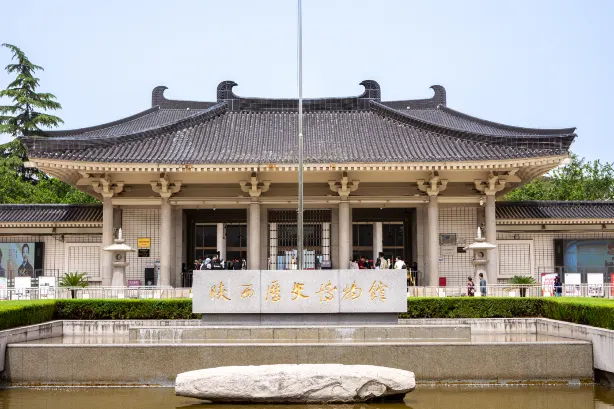
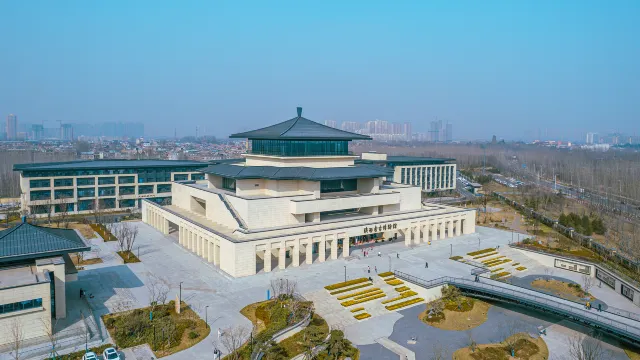
Shaanxi History Museum is a large modern museum built after China's reform and opening up and officially opened in 1991. The building was designed by architect Zhang Jinqiu and adopts a Tang-style architectural layout of "central hall and four corner towers," with a symmetrical central axis and a clear hierarchy of primary and secondary structures; in 2016 it was included in the first batch of the "Chinese Architectural Heritage of the 20th Century" list. Shaanxi was once the political center of dynasties such as the Zhou, Qin, Han, and Tang, and the museum's collection spans a million years of history, covering categories such as Shang and Zhou bronzes, pottery figurines of successive dynasties, Han and Tang gold and silver wares, and Tang tomb murals, with a total of over one million items. The permanent exhibition "Ancient Civilization of Shaanxi" follows a chronological main line and presents the historical process from prehistoric Lantian Man to the eve of the Opium War across three galleries, with the Zhou, Qin, Han, and Tang periods as the focus. The east and west sides of the central hall each host a thematic exhibition: on the west side, "Treasures of the Great Tang: Hejiacun Hoard Unearthed Artifacts Exhibition" concentrates on fine gold and silver wares of the High Tang, while on the east side, the "Tang Dynasty Mural Treasures Gallery" displays authentic murals removed from Tang tombs, with subjects covering figures, architecture, ceremonial guards, and more, making it a uniquely distinctive category of the museum's collection. Among the many artifacts in the museum, several are particularly notable. The agate cup with gold-inlaid beast head, from the Hejiacun hoard, is carved from a single piece of banded agate into the form of a curved-horn beast head, resembling Central Asian rhyton cups, and is one of the first batch of cultural relics prohibited from being exhibited abroad. The tri-color glazed camel carrying musicians figurine vividly recreates the lively scene of musicians playing and singers performing on a camel's back, with bright glaze colors and figures with distinct expressions. The Empress's Seal is made of Western Han Hetian mutton-fat jade and carved with a chi-tiger knob, and is the only known actual jade seal of a Han dynasty empress discovered to date. In addition, the gilt silver flask with a dancing horse holding a cup design, the celadon ewer with an overhead handle and bottom-filling design, and the black-glazed oil-spot bowl each have their own distinctive features. The gold and silver wares unearthed from the Hejiacun hoard are concentrated in the thematic gallery and are a highlight of any visit; visitors are advised to allow time to examine them closely.

China · Xi'an
Free attraction
Longmen Grottoes
2027 Asia 100 - Best Things to Do

Longmen Grottoes

9
4.7/5
62.7k reviews

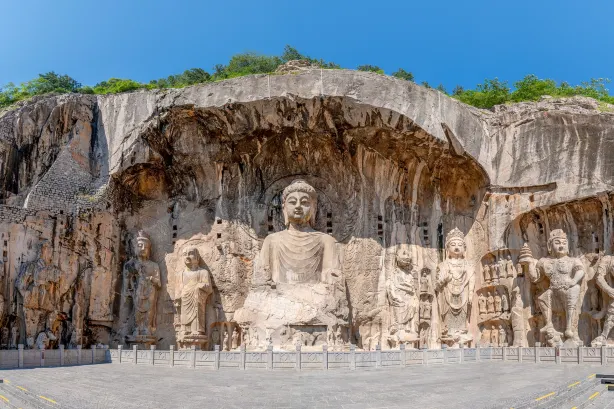
Longmen Grottoes are located in the southern suburbs of Luoyang, Henan Province, on the cliffs along both banks of the Yi River. As one of China's three major grotto art treasures, they were inscribed on the World Cultural Heritage list in 2000. The grottoes were first carved when Emperor Xiaowen of Northern Wei moved the capital to Luoyang, and construction continued through the Eastern Wei, Western Wei, Northern Qi, Sui, and Tang dynasties, with the vast majority of niches and statues left from the Northern Wei and Tang periods. Today, more than 2,000 niches and over 100,000 statues remain, along with a large number of inscriptions and steles, making the site an important representative of Chinese stone carving art. The attraction is divided by the Yi River into two parts: West Hill and East Hill. The West Hill Grottoes are the essence of the site, carved from the Northern Dynasties through the Sui and Tang periods. Famous caves include Guyang Cave, Binyang Cave, Lotus Cave, Wanfo Cave, and Fengxian Temple. The Lushena Buddha at Fengxian Temple stands about 17 m tall, making it one of the larger Buddha statues at Longmen Grottoes. Its face is dignified and serene, with a faint smile, and legend holds that it was modeled on the appearance of Wu Zetian, earning it the name "Oriental Mona Lisa." The inner walls of Wanfo Cave are densely covered with about 15,000 small Buddha statues, each only a few cm tall, neatly arranged and finely crafted. Guyang Cave is the earliest cave carved at Longmen, and its inscription calligraphy is exquisite; the selected "Twenty Masterpieces of Longmen" are representative works of Wei stele calligraphy. Binyang Cave consists of the South, Middle, and North caves and took more than twenty years to complete. Its original reliefs depicting emperors and empresses worshipping the Buddha were looted and lost overseas in the 1930s. In Binyang North Cave, a Buddha statue has a distinctive hand gesture, with the right index and middle fingers raised in a shape resembling the modern "scissors hand," though it is actually a Buddhist mudra, and it once sparked heated discussion online. The East Hill Grottoes are mostly Tang dynasty works and are smaller in scale than those on West Hill, but from the opposite bank visitors can enjoy panoramic views of West Hill from different angles, especially distant views of the Lushena Buddha. The attraction also includes Xiangshan Temple and Bai Juyi Memorial Park (Bai Garden). The Tang dynasty poet Bai Juyi lived in Luoyang in his later years and once praised it, saying, "Of the scenic splendors of Luoyang's surrounding mountains and waters, Longmen ranks first." When visiting, simply follow the route West Hill—East Hill—Xiangshan Temple—Bai Garden, proceeding in one direction without backtracking. The West Hill Grottoes are densely packed with content, so it is advisable to set aside ample time for a closer look; East Hill is quieter and more secluded, suitable for a brief visit and gazing across the river when energy is limited.

China · Luoyang
From €12.31
The Hukou Waterfall Scenic Area
No. 4 of Best Things to Do in Shanxi

The Hukou Waterfall Scenic Area

8.5
4.7/5
22.8k reviews

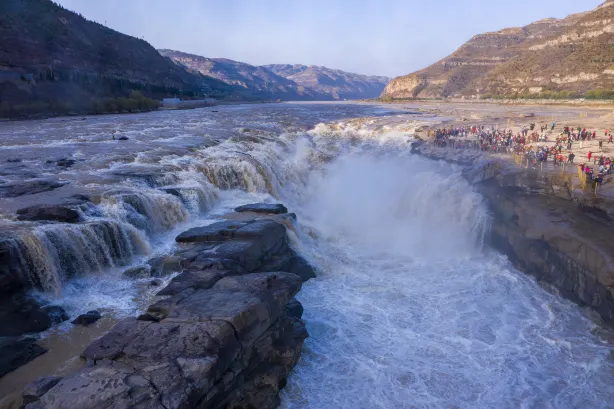
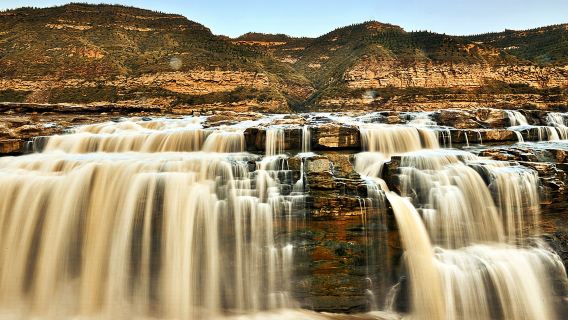
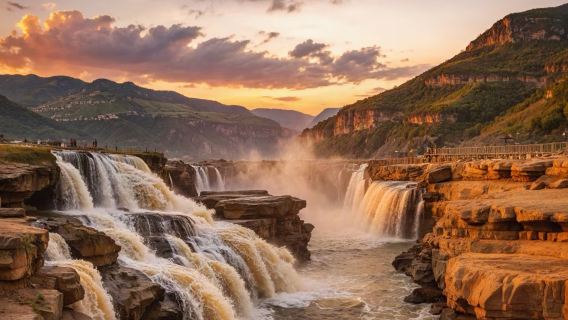
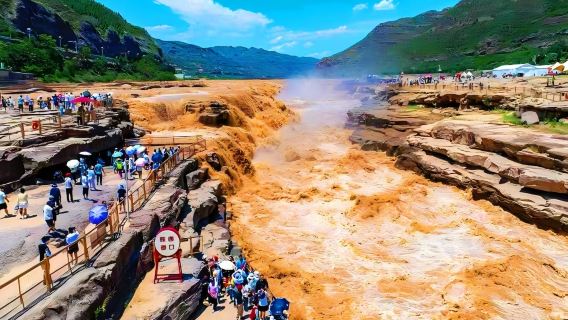
The Hukou Waterfall Scenic Area is located in the Jin-Shaan Grand Canyon in the middle reaches of the Yellow River and is the Shanxi-side section for viewing Hukou Waterfall. As the Yellow River rushes here, its surface suddenly narrows from several hundred meters wide to just a few dozen meters. The water, laden with silt, churns and pours down like water being poured into a giant kettle, which is how the name "Hukou" (Kettle Mouth) came to be. This is a rare yellow waterfall on the Yellow River, with muddy waves surging skyward and a roar like thunder, displaying magnificent momentum. The attraction is located on the east side of the waterfall, where the bank is relatively low, allowing visitors to look up and take in the full panorama of the Yellow River plunging downward. Below the waterfall, mist rises and fills the air, appearing like smoke or clouds from afar and creating the wondrous sight known as "smoke rising from the water"; on clear days, sunlight refracts through the mist to form a rainbow arching across the river, called "rainbow reaching the heavens." Within the attraction, Dragon Cave is a natural stone cave; following the stone steps down leads to a viewing platform close to the waterfall, where you can look up as the river pours down from above—an ideal spot to feel the force of the waterfall up close. Downstream from the waterfall, the Ten-Mile Dragon Trough is a deep channel formed by the river's long-term erosion of the riverbed; in the dry season, the trough floor is wide and flat, and ancients once used this terrain to haul boats along the bank, leaving behind the unique scene known as "sailing on dry land." Further downstream is Mengmen Mountain, where two huge rocks in the river split the Yellow River in two before the streams merge again; carved on the rock face are the four characters "Wo Zhen Kuang Liu" (Resting Here, Quelling the Raging Flow). The view of Hukou Waterfall is distinctive in each of the four seasons. Every year between April and May, peach blossoms bloom and the ice melts, coinciding with the "March peach blossom flood," when the abundant water volume makes the waterfall particularly spectacular. From September to November, the air is crisp in fall, and rainbows often appear in the mist, a phenomenon known as the "Hukou fall wind." Water volume is greater in spring and fall, and the sound of the water striking the rocks is like thunder, making these the best periods to admire the waterfall. The image of Hukou Waterfall once appeared on the CNY 50 banknote of the fourth series of the renminbi, making it a widely recognized classic symbol of Yellow River culture.

Ji County · 82.4 km from Huanglong
From €10.94
Xi'an City Wall
2027 Asia 100 - Night Attractions

Xi'an City Wall

8.8
4.6/5
63.4k reviews

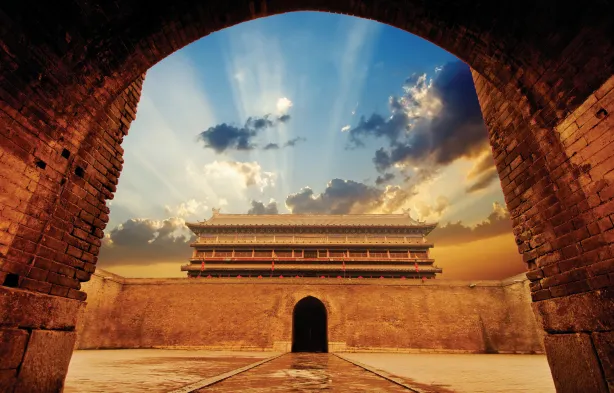
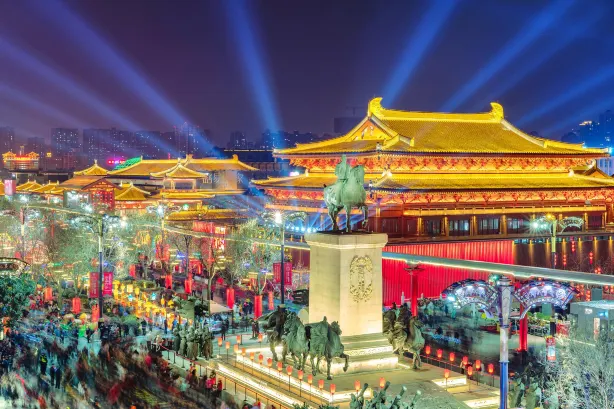
Xi'an City Wall, also known as the Xi'an Ming City Wall, is an ancient city wall defense system encircling the old city of Xi'an from the Ming and Qing dynasties. The main body of the existing wall was built during the Hongwu period of the Ming Dynasty, expanded on the foundation of the imperial city of Chang'an from the Sui and Tang dynasties, and has undergone multiple renovations since then, remaining well preserved to this day. The wall is roughly rectangular in plan, with a perimeter of about 14 km, and the area it encloses is the old city of Xi'an. The wall is about 12 m high, about 15 to 18 m wide at the base, and about 12 to 14 m wide at the top. The top of the wall is broad and flat, allowing visitors to cycle or stroll along it while overlooking the scenery inside and outside the city. The defensive system of the wall consists of the wall body, city gates, barbicans, bastions, corner towers, and the moat. Nearly a hundred bastions were built along the outer face of the wall, spaced about 120 m apart, precisely within bow-and-arrow range, reflecting the defensive wisdom of the cold weapon era. There is a corner platform at each of the four corners, among which the southwest corner platform is circular, forming a striking contrast with the other three square corner platforms—a unique form rarely seen among surviving ancient city walls. The moat outside the wall encircles the entire city, together with the wall forming a complete defensive layout. The wall currently has 18 city gates, among which Yongning Gate (South Gate), Anding Gate (West Gate), Anyuan Gate (North Gate), and Changle Gate (East Gate) are the four main gates originally built in the Ming Dynasty. Each main gate features three tiers of gate towers—the gate control tower, arrow tower, and main tower—forming a layered barbican defense. Yongning Gate is the one that has been in use the longest, with a history dating back to the Sui Dynasty, and is also the one whose form is relatively well preserved. The section of the wall at Hanguang Gate encloses the remains of the Sui and Tang imperial city, with a site exhibition that offers an intuitive sense of the wall's layered history spanning over a thousand years. Cycling a full loop around the city on the wall is a popular experience, taking about one and a half to two hours in total. Ascending the wall in the evening allows you to take in both the traditional architecture inside the city and the modern urban skyline outside, with the wall and moat set off beautifully against the glow of the setting sun.

China · Xi'an
45% offFrom €7.39
Mount Hua
2027 Asia 100 - Best Things to Do

Mount Hua

8.7
4.7/5
55.8k reviews

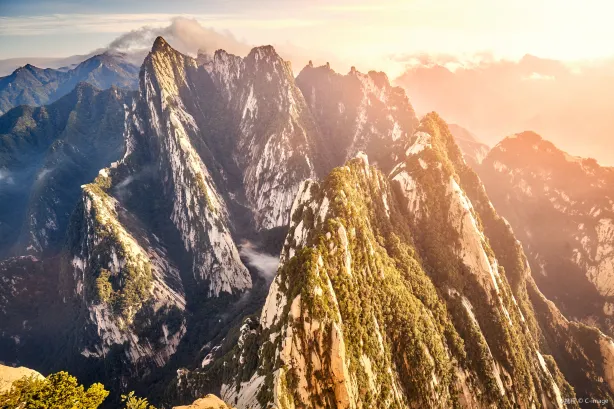
Mount Hua, known as the "Western Great Mountain" in ancient times, is one of China's Five Great Mountains. Located in Huayin, Shaanxi Province, it is also elegantly called "Taihua Mountain." The "Hua" in both "Zhonghua" and "Huaxia" originates from this mountain. "Steep and perilous" are the essence of Mount Hua's scenery, and the saying "there has always been only one path up Mount Hua" precisely describes its steepness—the Plank Road in the Sky, the Sparrowhawk Turn, the Thousand-Foot Precipice, the Hundred-Foot Gorge, the Laojun Plow Ditch, and other perilous sights leave every visitor awestruck. The Mount Hua attraction covers a vast area, including the main peak attraction, the Western Great Mountain Temple attraction, and the Xianyu attraction, among which the main peak attraction is the core, encompassing the five main peaks—east, south, west, north, and center—as well as the classic "Mount Hua Valley" climbing trail. The five main peaks each have their own distinctive features. The East Peak, at an elevation of approx. 2,100 m, has the open and expansive Chaoyang Terrace at its summit, making it an excellent spot for watching the sunrise, and is therefore also known as Chaoyang Peak; the natural stone patterns on the cliff face along the side of the peak resemble a giant palm print—this is the Huayue Immortal Palm, listed since ancient times as one of the Eight Views of Guanzhong. The West Peak, at an elevation of approx. 2,080 m, is named Lotus Peak because the giant rock at its summit resembles a lotus flower; the Cuiyun Palace, the Axe-Split Rock, and the Self-Sacrifice Cliff are scattered across it, and the myth of Chenxiang splitting the mountain to save his mother is said to have originated here. The South Peak, at an elevation of over 2,150 m, was called the "head of Mount Hua" by the ancients; it consists of two summits—Songgui Peak and Luoyan Peak—with a sheer cliff dropping straight down on one side. The North Peak, at an elevation of approx. 1,600 m, is also known as Yuntai Peak; it stands isolated and towering with precipitous drops on all four sides, and the story of "Taking Mount Hua by Strategy" took place here; the peak features views such as the Zhenwu Hall and the Jiaogong Stone Chamber. The Central Peak lies at the center of the East, West, and South Peaks, with serene and lush vegetation; on the peak is the Jade Maiden Shrine, said to be the place where Nongyu, daughter of Duke Mu of Qin during the Spring and Autumn period, cultivated herself, hence it is also known as Jade Maiden Peak. The Plank Road in the Sky is located on the mountainside east of the South Peak. It was built by the Yuan Dynasty Taoist He Zhizhen, who embedded stone stakes into the cliff face and laid wooden planks. At the end of the plank road, visitors can see Hezu Cave, where he cultivated himself. Visitors must press close to the cliff, hold the iron chains, and step on the wooden planks while moving sideways slowly—an extremely thrilling experience. The ridge of Canglong Ridge is as narrow as a blade, flanked by bottomless chasms, and walking on it makes one's heart race and vision blur. Golden Lock Pass is the vital gateway to the East, West, South, and Central peaks. Taoists believe that passing through this pass marks entry into a fairyland, and there is a folk saying: "Once past Golden Lock Pass, you enter another realm."

China · Huayin
From €13.67
Huaqing Palace
No. 5 of Global Traveller-Picked Attractions in Xi'an

Huaqing Palace

8.7
4.6/5
34k reviews

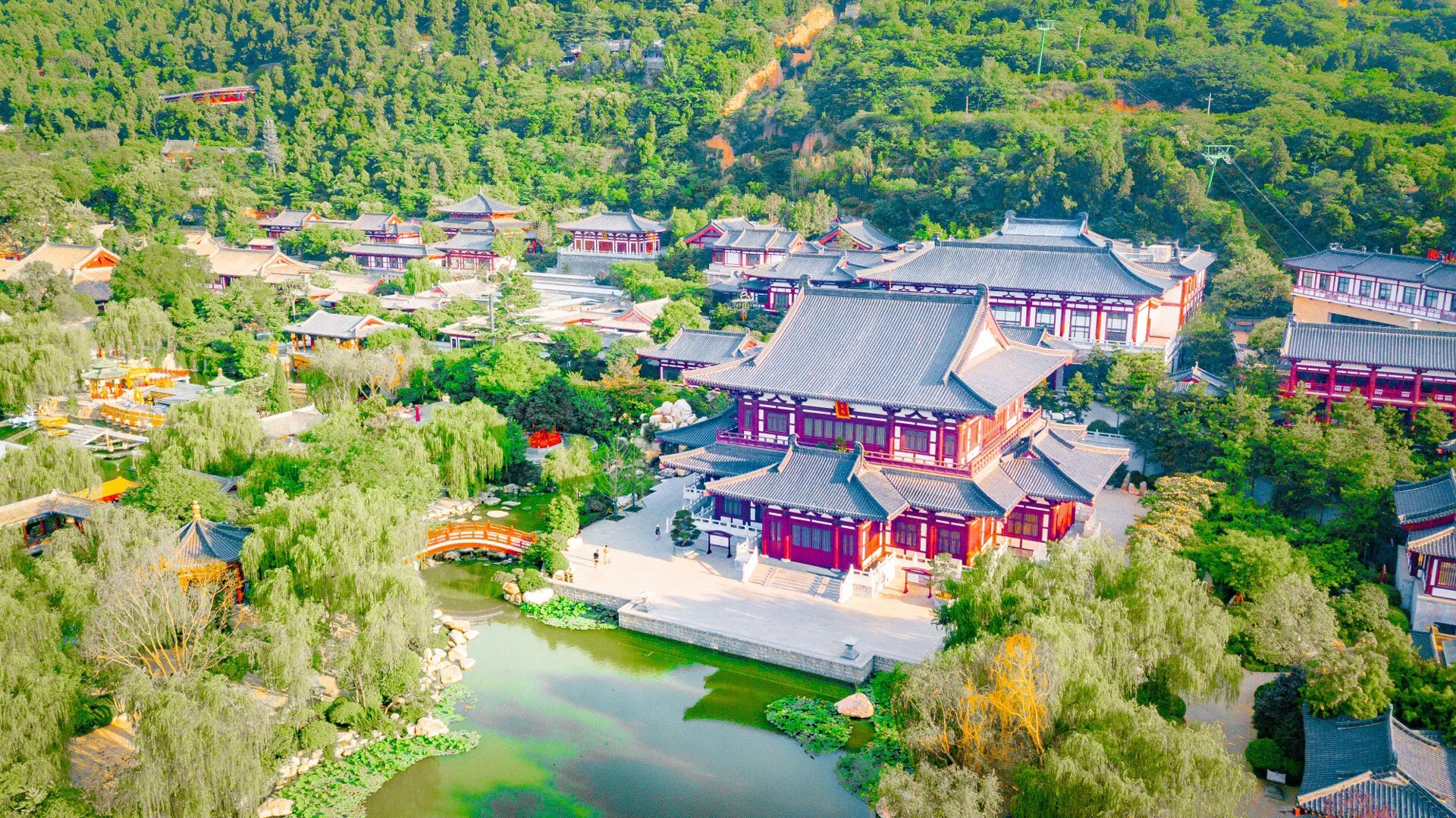
Huaqing Palace attraction is located 30 km east of Xi'an, adjacent to the Terracotta Warriors. Renowned for its timeless hot spring resources and numerous historical events, it has become an iconic cultural tourism attraction of Tang Dynasty palaces in China. Palace scenic spots Huaqing Palace boasts a long history, serving as an imperial retreat for emperors from the Zhou, Qin, Han, Sui, and Tang dynasties. The palace features cultural zones like the Tang Imperial Hot Spring Relics Museum, the Xi'an Incident site—Five-Room Hall, Nine Dragon Lake and Lotus Lake scenic areas, and the Tang Pear Garden Museum. Notable architectural complexes include Feishuang Hall, Wanshou Hall, Changsheng Hall, Huanyuan Garden, and Yuwang Hall. The stele of "hot spring ode" Mount Li hot springs, developed early and favored by emperors throughout history, enjoy the reputation of being "the imperial hot springs under heaven." As far back as the Yangshao culture period 6,000 years ago, the ancient Jiangzhai people began utilizing these springs. With their profound cultural heritage spanning millennia, Mount Li hot springs represent an indispensable part of Chinese historical culture. The stele of hot spring ode in the attraction stands 154 cm tall, 72 cm wide, and 19 cm thick, featuring a coiled dragon design and a trapezoidal base. Engraved by Yuan Chang, the governor of Yongzhou during the Northern Wei Dynasty, the inscription reads, "The hot spring is nature's prescription and the primordial healer of the universe. People from all nations and those suffering from ailments come with provisions to seek relief in its waters." This stele is the earliest surviving written artifact at Huaqing Palace. Tang Imperial Hot Spring Relics Museum This is the site of the bathing pool described in the "Song of Everlasting Sorrow" where Yang Guifei emerged from her bath. After the An Lushan Rebellion, little remained of the original structure. In 1982, while constructing the "Guifei Pavilion," the Lintong County Government accidentally discovered the ruins of a Tang Dynasty bathing pool. After excavation and restoration, the Huaqing Palace imperial hot spring ruins museum was established. This small yet exquisitely designed pool measures 3.6 meters east-west and 2.9 meters north-south, with an oval-like shape. The pool walls are entirely built with bluestone slabs, featuring a two-tiered terrace structure composed of 18 arched stone sections. Inside the pool lies a dedicated bathing stone for Yang Guifei, engraved with the character "Yang." At the center of the pool bottom is a 10 cm diameter water inlet. A white marble lotus pedestal was unearthed here, connecting to both a showerhead above and ceramic water pipes below that linked to the main water source. Due to natural pressure, hot spring water would spray outward through the lotus showerhead, creating a mist effect remarkably similar to modern showers. Adjacent to the Guifei Pool to the east lies Emperor Xuanzong's exclusive imperial hot spring. During the Tang Dynasty, the Nine Dragon Hall stood above this pool, featuring nine white jade-carved dragons spouting water outside. This pool's surface resembles a realistic lotus shape, hence its alternate name "Lotus Pool." Xi'an incident site The five-room hall at the Xi'an incident site in Huaqing Palace is where the Xi'an incident took place. To this day, the glass windows and walls of the five-room hall still bear bullet marks from the fierce battle during the military remonstrance. The desks, chairs, beds, sofas, tea sets, stoves, carpets, telephones, and other office items in each room are replicated and arranged according to their original appearance. Historical events: Beacon fire to deceive the feudal lords In 779 BC, King You of Zhou obtained the beautiful Bao Si, yet she never smiled. To solve this, the king conspired with the treacherous minister Guo Shifu and lit the beacon fires at the Huaqing Palace attraction. The feudal lords across the land saw the signals.Beacon fireHe quickly led his troops to rescue the king, but King You told the feudal lords, "I lit the beacon fires just to make my queen laugh," upon which Bao Si burst into laughter. The feudal lords arrived valiantly but left resentfully. Seeing King You's incompetence and the people's discontent, the Quanrong tribe seized the opportunity to launch an attack. As the enemy troops approached the mountain, King You urgently raised the beacon fires.Beacon fireHe mobilized troops, but none of the feudal lords came to his rescue. King You fled with Bao Si toMount LiHe was later killed by the Quanrong tribe, leaving behind historical anecdotes such as "a smile worth a thousand gold," "losing the kingdom for a smile," and "playing with beacon fires to deceive the feudal lords." And this beacon tower at Huaqing Palace attraction towers at an altitude of 913.6 m.Mount LiThe beacon tower at Huaqing Palace attraction on the first peak of Xixiu Ridge. Su Dongpo composing poetry at Mount Li During the Jiayou era of the Northern Song Dynasty, the Lishan hot springs, meticulously restored by Liu Ziyong and others, became breathtakingly beautiful, attracting crowds of visitors who composed poems and essays to express their nostalgia. Among the countless poetic works, the emerging literary giant Su Shi stood out with his masterpieces like "Lady of Guo's night outing" and "Lishan" during his visit to the hot springs. Xi'an incident The Xi'an incident, also known as the "double-twelfth incident". Zhang Xueliang and Yang Hucheng launched a mutiny at Huaqing Palace, detaining the then chairman of the Military Commission of the National Government. Performance items You can watch a large-scale dance drama at the attraction. ▲ The Song of Everlasting Sorrow is China's first large-scale live historical dance drama created by Shaanxi Tourism Group. Based on Bai Juyi's timeless poem of the same name, it fully utilizes the attraction's resources and employs high-tech stage lighting to combine historical storytelling with live performances, recreating the love story of Emperor Li Longji and Yang Guifei at Huaqing Palace over 1,300 years ago. ▲There is also the historical adaptation "12-12 Xi'an Incident," which vividly and authentically recreates the lesser-known details of the "Xi'an Incident."

China · Xi'an
29% offFrom €11.62

Experiences you can't miss in Huanglong

Featured Culture & history in Huanglong

View all Culture & history
Huanglong Today's weatherClear -3-14℃
Huanglong weather for the next 2 days11/26: -6-7℃, 11/27: -6-11℃

Free things to do in Huanglong
What travelers say about Huanglong

user-avatar
kai***29November 24, 2026
5.0
Using the global pass coupon, the ticket price was much cheaper than the actual fare. The Terracotta Army is truly a wonder of the world; each statue is lifelike, and the wisdom and craftsmanship of the ancients are astonishing.

Emperor Qinshihuang's Mausoleum Site Museum

user-avatar
M71***03November 24, 2026
5.0
Teacher Dapeng's explanation was excellent, giving us a better understanding of the country's historical relics. The children listened with great interest, making it a very worthwhile experience in Xi'an.

Shaanxi History Museum

user-avatar
M32***71May 5, 2025
5.0
The only treetop walk in the country, the log cabin hotel is also very comfortable. It is worth bringing the elderly and children to experience, there are also go-karts and slides, the eight-story high topic and slide of the treetop walk are definitely worth trying. It is just enough for those who occasionally stimulate.

Treetop Walk

user-avatar
Emily ZNNovember 25, 2026
5.0
It's definitely worth a visit. Our guided tour was very detailed. There were many small, unseen inscriptions in the grottoes, which the guides pointed out to us, and they also provided further explanations. It blends the ancient and modern, showcasing what it looked like a hundred years ago; we learned a great deal. The guides were meticulous and patient.

Longmen Grottoes

user-avatar
133***95November 14, 2026
4.0
I booked a day trip to Xiaoxitian and Hukou Waterfall; buying tickets separately is more cost-effective. The water level wasn't high in winter, so I didn't see a very spectacular sight, although the current was still quite strong. The waterfall itself is a small area; half an hour is enough. If you want to see the waterfall up close, you need to buy a separate ticket to go down to the river. It's quite a distance from Taiyuan, so the time cost was too high, and I felt it wasn't worth the price. There's a commercial street outside the scenic area with many restaurants, so you don't have to worry about finding a place to eat.

The Hukou Waterfall Scenic Area

user-avatar
M49***53December 16, 2025
4.0
Check out the "Yan'an Huanglong Treetop Walk," Asia's first treetop walkway, located in the Yan'an Huanglong Mountain Forest Park, a former revolutionary base area, offering a unique experience of northern Shaanxi. The park boasts over 93% vegetation coverage, with various birch, crabapple, and pine trees scattered throughout Huanglong Mountain, creating a fresh and beautiful environment.

shan xi huang long shan guo jia sen lin gong yuan

user-avatar
M2t***8zNovember 25, 2026
5.0
The Xi'an City Wall truly lives up to its reputation as a landmark of Xi'an. Its ancient brick walls exude a profound sense of history, and walking atop them offers panoramic views of the city, a harmonious blend of ancient and modern scenery, creating a truly immersive atmosphere. The scenic area is well-managed, with clear signage at the ticket checkpoints, and patient and attentive staff who promptly answer any questions. The facilities are comprehensive, and the tour routes are well-planned, making it suitable for leisurely strolls or taking photos. Immerse yourself in the charm of this ancient city, a truly enjoyable and relaxing experience. Highly recommended to experience the unique romance of this ancient city.

Xi'an City Wall

user-avatar
_TI***ucNovember 25, 2026
5.0
Subí por el camino desde la base de la montaña por lo que no usé el teleférico que te lleva al North Peak. Todo el recorrido es súper amigable porque hay una sola ruta desde Huashan Gate Management Station a North Peak. Hay botes de basura y pequeños puestos de comida a lo largo de la ruta por lo que no es necesario que lleves comida o agua desde el inicio. Puedes comprar tu boleto del teleférico de bajada en el mismo sitio (no hay necesidad de comprarlo online). Hay una atracción para bajar en carritos (no pude subir porque estaba lloviendo) pero creo que vale totalmente la pena intentarlo. Al salir del teleférico hay una taquilla donde puedes comprar el shuttle bus de bajada y hay muchos pequeños restaurantes. Es un sitio increíble para visitar en Noviembre pero pueden cerrar por lluvia o nieve, así que revisa el clima antes de tu viaje. Pongo fotos del lugar por el que entré, el camino inicial, la cumbre y los arcos de salida. Definitivamente volvería a visitar el lugar.

Mount Hua

user-avatar
frank2020November 24, 2026
5.0
The price was reasonable, 20 yuan per person. The explanations were good, and the information was interesting. It was an hour long, so it was good value for money; we saw most of the content. It was submitted as an official guide, but it seemed to be a tour group's explanation as well.

Huaqing Palace

Trip Moments in Huanglong
Popular cities near Huanglong

Frequently asked questions

How can I contact Trip.com customer support?

Get help anytime, anywhere within 30 secondsContact customer support

Change and cancellation policies vary by attractions and tours. Please check the product details page for more information.

Ticket prices may vary between weekdays and weekends, as well as during peak and off-peak seasons. When booking with Trip.com, you can also use Trip Coins to get extra savings. For more tips on booking discounted tickets, please visit Trip.com for the latest information.