Dujiangyan from Chengdu 2026: How to Get There & What to See
Contents
- How Far Is Dujiangyan from Chengdu?
- How to Get to Dujiangyan from Chengdu
- By High-Speed Train (the Default Choice)
- By Metro and Train, Step by Step
- By Car, Taxi or DiDi
- By Direct Tourist Bus
- From Chengdu's Airports
- Inside the Dujiangyan Irrigation System: What to See
- Yuzui (Fish Mouth)
- Feishayan (Flying Sand Weir)
- Baopingkou (Precious Bottle-Neck)
- Anlan Suspension Bridge
- Erwang Temple and Fulong Temple
- Yulei Pavilion and Songmao Ancient Trail
- The Best Walking Route Through the Scenic Area
- Tickets, Opening Hours and How to Book
- Ticket Prices
- Opening Hours
- How Many Days Do You Need in Dujiangyan?
- What Else to Visit Around Dujiangyan
- Dujiangyan Panda Base (China Conservation and Research Center)
- Panda Valley
- Mount Qingcheng
- Guanxian Ancient Town and Nanqiao Bridge
- Yangtianwo Square and Zhongshuge
- One-Day and Two-Day Dujiangyan Itineraries
- One Day from Chengdu
- Two Days with Mount Qingcheng
- Best Time to Visit Dujiangyan
- Best Time of Day
- Where to Eat in Dujiangyan
- What to Order
- Where to Eat
- Where to Stay in Dujiangyan
- Near the Scenic Area and Old Town
- In Guanxian Ancient Town
- At Mount Qingcheng
- How Much Does a Dujiangyan Day Trip Cost?
- More Chengdu and Sichuan Travel Guides
Show more
Dujiangyan is the 2,000-year-old irrigation system that turned the Chengdu Plain into one of China's richest farming regions, and it still works today. The site sits about 60 km (37 miles) northwest of Chengdu, roughly 30 minutes away by high-speed train, which makes it one of the easiest day trips from the city. This guide covers how far it is, how to get there, how many days you need, what to see inside the scenic area, and what else is worth visiting nearby.
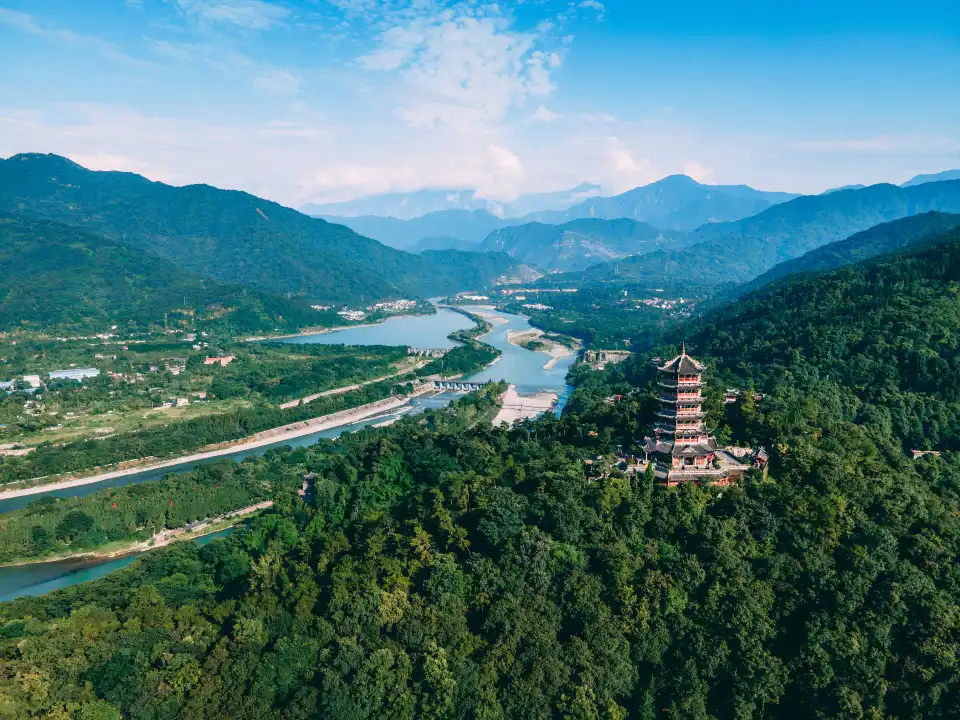
Dujiangyan is about 60 km (37 miles) northwest of central Chengdu, in Dujiangyan City. By road the drive takes 1 to 1.5 hours depending on traffic. By rail it is much quicker: the intercity train from Xipu Station reaches Lidui Park Station, the stop closest to the scenic area, in about 25 to 30 minutes.
Because the town sits at the foot of the mountains where the Chengdu Plain meets the Tibetan Plateau, the last part of the journey climbs gently and the air cools noticeably. That also explains why Dujiangyan and nearby Mount Qingcheng are usually paired in one trip: the two are only about 17 km apart.
| Starting point | Distance | Fastest option | Travel time | Notes |
|---|---|---|---|---|
| Chengdu city center (Tianfu Square) | About 60 km | Metro + intercity train | 1 h 10 min | Cheapest and most predictable |
| Chengdu Xipu Station | About 40 km by rail | Intercity train | 25-30 min | Direct to Lidui Park |
| Chengdu Shuangliu Airport (CTU) | About 65 km | Car or DiDi | 1 h 10 min | Metro to the city first is slower |
| Chengdu Tianfu Airport (TFU) | About 90 km | Car or DiDi | 1 h 30 min | Allow 2 hours in traffic |
| Mount Qingcheng | About 17 km | Car, taxi or tourist tram | 30-40 min | Easy add-on after the irrigation system |
Almost everyone takes the train, and for good reason: it is fast, cheap and drops you within walking distance of the South Gate. The alternatives are a car or DiDi, a direct tourist bus, or a guided day tour if you would rather not plan the transfers.
Take Metro Line 2 to Xipu Station in Pidu District, then follow the signs upstairs to the intercity rail platform. The transfer is inside the same station, so you do not need to exit and re-enter. Two stops serve Dujiangyan: Dujiangyan Station, about 18 to 20 minutes away, and Lidui Park Station, about 25 to 30 minutes away.
For the scenic area, get off at Lidui Park. Take Exit D, walk past the giant panda statue at Yangtianwo Square, and you will reach the South Gate in about 10 minutes. Trains run from roughly 07:00 to 21:40, and a second-class ticket costs CNY 10 each way. Tickets sell out on weekend mornings and holiday evenings, so book the early outbound and late return trains in advance.
| Departure | Arrival | Journey time | Fare | Best for |
|---|---|---|---|---|
| Chengdu Xipu | Lidui Park | 25-30 min | CNY 10 | The scenic area and the old town |
| Chengdu Xipu | Dujiangyan Station | 18-20 min | CNY 10 | Panda Valley and western Dujiangyan |
| Chengdu Station | Dujiangyan Station | 35-40 min | CNY 10-15 | If you are staying near Chengdu Station |
From Chunxi Road or Tianfu Square, Metro Line 2 takes about 40 minutes to Xipu. Allow 10 minutes to change platforms, then 30 minutes on the train, then the 10-minute walk to the gate. Door to gate, budget around 1 hour 20 minutes and less than CNY 15 in total, metro fare included.
Driving is straightforward: take the Chengdu-Guanxian expressway and follow signs for Dujiangyan Scenic Area. A DiDi from central Chengdu usually costs CNY 120 to 180 one way outside surge pricing and takes about 1 hour 15 minutes. The advantage is flexibility, especially if you want to combine the irrigation system with the panda base and Mount Qingcheng in one day. Parking is available at the main gates, but it fills up by mid-morning on weekends.
Shuttle buses leave from Chunxi Road, near the climbing panda statue at IFS, and from the Wide and Narrow Alleys. They drop passengers near the South Gate and are convenient if your hotel is in the city center, but departures are less frequent than trains and the journey takes longer in traffic.
From Shuangliu Airport (CTU), take Metro Line 10 to the city and change to Line 2 for Xipu, or take a car directly in about 1 hour 10 minutes. From Tianfu Airport (TFU), the metro ride into the city is long, so a direct car or the airport rail link plus a transfer is usually better. If you land in the morning and want to see Dujiangyan the same day, a pre-booked transfer is the least stressful option.
Li Bing, the Qin governor of Shu, built the system in 256 BC with his son and a workforce that had no explosives, no concrete and no steel. Instead of damming the Min River, they split it, steered it and let the river clean itself. UNESCO listed the site, together with Mount Qingcheng, as a World Heritage Site in 2000. Four parts of the system do all the work, and each one is a stop on the walking route.
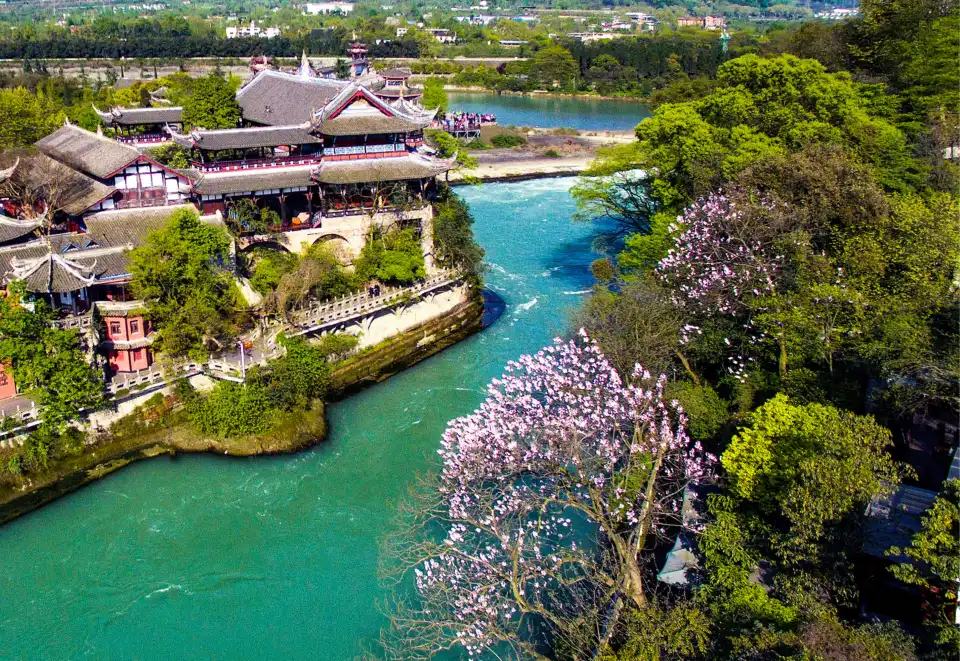
The Fish Mouth is a wedge-shaped levee in the middle of the Min River that divides the flow into two channels. The inner river feeds the Chengdu Plain; the outer river carries floodwater away. In the dry season the split is roughly 40 to 60, and in flood season it reverses to 60 to 40. The original structure was built from bamboo cages packed with stones, and the viewing platform here is the best place to understand the whole design at a glance.
The Flying Sand Weir is the safety valve. When the inner river rises, excess water spills over the low weir and back into the outer river, and the swirling current carries sediment with it. In flood season, from June to September, you can see the water release at full power, especially after rain. The best view is from the terrace at Fulong Temple, looking down on the weir and the river junction.
Baopingkou is the narrow channel cut through the rock that controls how much water enters the Chengdu Plain. Its width sets the flow: enough for irrigation, never enough to flood the plain. Standing beside it, with the Min River roaring through a gap not much wider than a road, is the moment most visitors remember. Fulong Temple sits directly above the channel and gives the classic view.
The Anlan Bridge, also called the Couple's Bridge, crosses the Min River on a chain of wooden planks between two pavilions. It sways gently underfoot and offers the best photograph of the river splitting around the Fish Mouth. In peak season the queue can reach an hour, so cross before 9 am or after 4 pm if you can. Hold the hand ropes and keep walking; stopping mid-span is what makes the bridge feel more unstable than it is.
Erwang Temple, on the east bank, honours Li Bing and his son and is the main ceremonial site of the complex. Fulong Temple, on the Lidui peninsula, overlooks Baopingkou and houses a Han dynasty stone statue of Li Bing recovered from the river. Both are working temples with courtyards, old trees and views, and both are included in the entrance ticket.
Yulei Pavilion stands on the ridge above the site and is the highest point in the scenic area, with a panorama over the rivers, the old town and the mountains. The Songmao Ancient Trail connects the pavilion area to Erwang Temple through forest and old stone gates. It is the quietest part of the park and the only section with real climbing, so it suits travellers with time and good shoes rather than families with strollers.
The park is built on a slope, and most visitors arrive at the South Gate at the bottom. That means the classic route starts with a gentle climb and ends with the river. If you want an easier day, take a taxi or the local bus to Qinyan Tower at Gate 6 and walk downhill instead.
| Stop | Place | What you see | Time needed | Tip |
|---|---|---|---|---|
| 1 | Qinyan Tower (Gate 6) | Model of the system and a short film with English subtitles | 20 min | Start here for a downhill walk |
| 2 | Yulei Pavilion | Panorama over the Min River and the old town | 30 min | Clearest on dry, cool mornings |
| 3 | Songmao Ancient Trail | Forest path, stone gates and the Yulei Pass | 30 min | Steep in places, wear grippy shoes |
| 4 | Erwang Temple | Shrines to Li Bing and his son | 30 min | Quiet courtyards, good shade |
| 5 | Anlan Suspension Bridge | The river split around the Fish Mouth | 15 min | Go early to skip the queue |
| 6 | Yuzui (Fish Mouth) | The levee that divides the Min River | 30 min | Shuttle bus to Flying Sand Weir costs CNY 10 |
| 7 | Feishayan (Flying Sand Weir) | Flood release and sediment channel | 30 min | Most dramatic from June to September |
| 8 | Baopingkou | The intake channel cut through rock | 20 min | Best seen from Fulong Temple |
| 9 | Fulong Temple and Lidui Park | Li Bing statue, gardens, exit at Gate 1 | 30 min | Walk out into the old town for lunch |
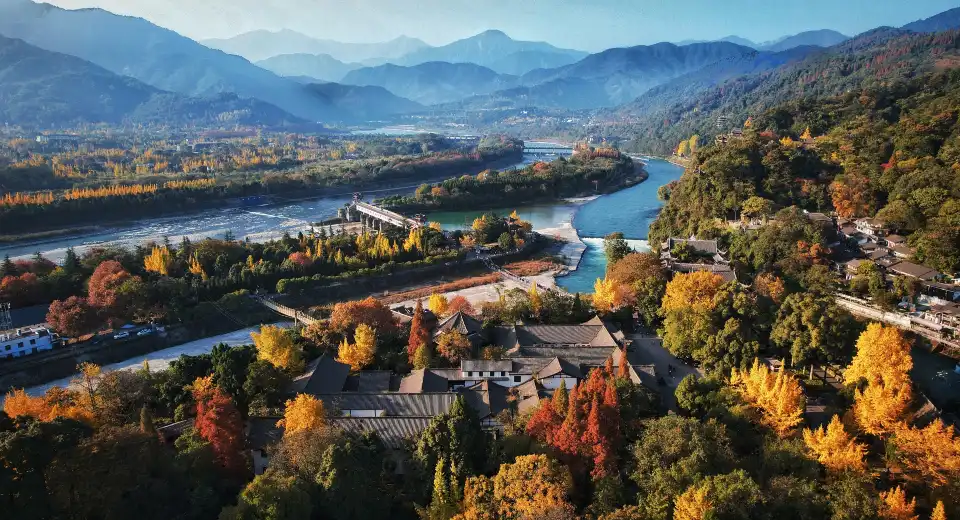
Dujiangyan uses seasonal pricing and a real-name, timed-entry booking system. There are no ticket windows at the gate, so arriving without a reservation means turning around. Book through the official WeChat accounts, "Qingcheng Mountain Dujiangyan" or "Yueyou Dujiangyan", or through an authorized platform such as Trip.com.
| Ticket type | Peak season | Off-season | Who qualifies |
|---|---|---|---|
| Adult | CNY 80 | CNY 60 | Peak is Mar 16 to Oct 31; off-season is Nov 1 to Mar 15 |
| Student / minor | CNY 40 | CNY 30 | Ages 6 to 18, or full-time students with ID |
| Senior 65 and over | Free | Free | A free ticket must still be reserved in advance |
| Child under 6 or 1.3 m | Free | Free | Must enter with an adult |
| Sightseeing bus (Beiting to Yuzui) | CNY 10 one way | CNY 10 one way | CNY 15 return; saves about 1 km of walking |
| Buyunlang escalator | CNY 20 one way | CNY 20 one way | CNY 40 return; useful if you start at the bottom |
Foreign visitors book with a passport rather than a Chinese ID and enter through the staffed channel, where the passport is checked against the reservation. The same rule applies to Hong Kong, Macao and Taiwan travellers, who use their travel permits.
| Period | Opening hours | Last entry |
|---|---|---|
| March 1 to December 31 | 08:00-18:00 | 17:30 |
| January 1 to February 28 | 08:00-17:00 | 17:00 |
| Peak days | Timed slots from 08:00 | Slots close when the daily cap is reached |
The scenic area caps daily visitors at 48,000 and pauses entry at 43,000, so holiday tickets disappear days in advance. A normal visit takes about 3.5 hours at an easy pace, and 2 hours if you take the shuttle and skip the upper trail.
 Such a clever system, especially invented when literacy is not common. I learnt so much and can't wait to bring my kids here
Ready to lock in a date? Check live availability and book your Dujiangyan Scenic Area ticket on Trip.com before you travel.
Most people treat Dujiangyan as a day trip, and that works well. The irrigation system itself needs half a day, the old town and Nanqiao Bridge add a couple of hours, and Mount Qingcheng or the panda bases need a second day if you want to see them properly.
| Time | What you can cover | Who it suits |
|---|---|---|
| Half day | The irrigation system only, using the downhill route from Gate 6 | Travellers with a tight Chengdu schedule, or anyone combining it with a city tour the same day |
| One day | Irrigation system, Lidui Park, Guanxian Ancient Town, Nanqiao Bridge at dusk | First-time visitors who want the classic experience without rushing |
| Two days | Day one as above, day two Mount Qingcheng or the Dujiangyan Panda Base | Anyone who wants both the engineering and the mountains |
| Three days | Add Panda Valley, the panda volunteer program, or the back mountain of Qingcheng | Families, photographers and slow travellers |
Dujiangyan is more than one UNESCO site. Within half an hour of the scenic area you can watch pandas, climb a Taoist mountain, wander a riverside old town and photograph one of the most striking bookstores in China. If you only have one day, pick one of these as a second stop rather than trying to do all of them.
This is the base at the foot of Mount Qingcheng, about 19 km and 40 minutes from the scenic area. It houses around 20 giant pandas, many of them born overseas and returned to China, in a small valley where the enclosures feel unusually close. Tickets are CNY 58 for adults and CNY 29 for children and students, and it is open from 08:30 to 17:00 with last entry at 16:30. Go in the morning: pandas are active before the heat builds, and by 11 am on a summer day most of them have retreated indoors.
Panda Valley is the field research and reintroduction center of the Chengdu Panda Base, set in 2,004 mu of forest about 3 km from downtown Dujiangyan. It is quieter than the city base and far less crowded than the main Chengdu park. Official records list 12 giant pandas and 20 red pandas, and the red pandas roam freely along the wooden walkways. Tickets are CNY 55 for adults and CNY 27 for students. In winter, entry runs from 08:00 to 16:30; in summer, from 07:30 to 17:00.
Mount Qingcheng is one of the birthplaces of Taoism and the other half of the UNESCO listing. The front mountain, with its temples and cable car, is the easier visit; the back mountain is a longer, wilder hike. Tickets are CNY 80 for the front mountain and CNY 20 for the back mountain, with the cable car charged separately. It is about 17 km from Dujiangyan, reachable by taxi in 35 to 40 minutes or by the tourist tram from Bajiaomiao, near Lidui Park Station.

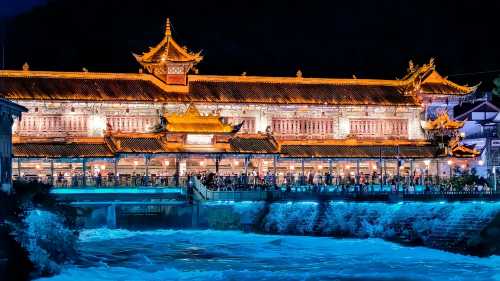
Guanxian Ancient Town sits directly outside the South Gate, and Nanqiao Bridge crosses the river at its edge. After dark the bridge and the riverbanks are lit in blue and green, the effect locals call the "blue tears". Lights usually come on around 19:30 and stay on until about 23:00. The old town itself is free to walk, with teahouses, snack stalls and the West Street food lane running inland from the bridge.
Yangtianwo Square, between Lidui Park Station and the South Gate, has a 12-metre-tall panda statue that has become the town's selfie landmark. Zhongshuge, a bookstore inside the Rongchuanmao mall on Zhizhen Road, is free to enter, open from 10:00 to 21:00, and famous for its mirrored ceilings and spiral shelves. Both are quick stops rather than destinations, best used to fill the gap before your train back.
The timings below assume you are coming from central Chengdu and returning the same day. They leave room for queues at Anlan Bridge and for a proper lunch, which is where most rushed itineraries fall apart.
| Time | Stop | What you do | Notes |
|---|---|---|---|
| 07:00 | Xipu Station | Metro Line 2 from the city, then the intercity train | Book the 07:30-08:00 departure |
| 08:00 | Lidui Park Station | Walk to the South Gate via Yangtianwo Square | 10 minutes on foot |
| 08:30 | Scenic area | Fulong Temple, Baopingkou, Feishayan, Yuzui | Enter early to beat the bridge queue |
| 11:30 | Anlan Bridge and Erwang Temple | Cross the bridge, climb to the temple | Add Yulei Pavilion if you have energy |
| 13:00 | Guanxian Ancient Town | Lunch on West Street, walk the old lanes | Try zhazha noodles and scallion rolls |
| 15:30 | Nanqiao Bridge | Coffee or tea by the river | Stay for the lights if you are not rushed |
| 18:00 | Lidui Park Station | Train back to Chengdu | Last trains run until about 21:40 |
On day one, follow the one-day plan and stay overnight in Dujiangyan so you can see Nanqiao lit up without worrying about the last train. On day two, take a taxi or the tourist tram to Mount Qingcheng after breakfast, ride the cable car up the front mountain, and walk down through the temples. If you would rather see pandas, swap Qingcheng for the Dujiangyan Panda Base in the morning and return to Chengdu after lunch.
If you would rather not plan the transfers, this Dujiangyan and Mount Qingcheng day tour covers both sites with hotel pickup from Chengdu.
Dujiangyan works in every season, but the experience changes a lot. Spring and autumn are the most comfortable, summer is the most dramatic for the water, and winter is the cheapest and quietest.
| Season | What it is like | Why go then |
|---|---|---|
| Spring (Mar-May) | Mild, green, occasional rain | Blossoms along the river and the Water Worship Ceremony around Qingming in April |
| Summer (Jun-Aug) | Hot and humid, heavy rain possible | Flood season makes Feishayan spectacular; riverside paths stay cool |
| Autumn (Sep-Nov) | Clear, dry, comfortable | The best all-round season, with golden ginkgo along the avenues in November |
| Winter (Dec-Feb) | Cold, misty, very quiet | Off-season ticket at CNY 60 and almost no queues |
Arrive at 08:00 or 08:30, or come after 16:00. Morning is cooler, the light is better for photographs and the Anlan Bridge queue has not formed. Afternoon is busier because tour groups arrive after their morning panda visits, but the last two hours before closing are calm again. Avoid weekends, the first week of May, the first week of October and the whole of July and August if you can choose.
Dujiangyan food is Sichuan food with a mountain accent: less chilli oil than Chengdu, more river fish, cured pork and wild vegetables. The old town around Nanqiao is where most of it is concentrated, and prices are lower than in the city.
Start with zhazha noodles, a bowl of thin noodles topped with minced pork and a spoonful of lard and chilli. Try scallion rolls, spring-onion pancakes rolled while hot, and ginkgo chicken soup, a clear broth simmered with local ginkgo nuts. Cold-water fish from the Min River is usually steamed or braised with pickled vegetables, and cured pork with garlic shoots is the winter staple. For dessert, look for ice jelly or fermented glutinous rice, both sold from street stalls.
West Street, running inland from Nanqiao Bridge, has the densest cluster of snack stalls and small restaurants. Wenmiao Mountain Street, a five-minute walk from Yangtianwo Square, is older and quieter, with teahouses where locals sit for hours. For a proper sit-down meal, the lanes behind the South Gate have family restaurants serving river fish and Sichuan classics at prices well below Chengdu's tourist districts.
Where you stay depends on what you want from the trip. Staying near the South Gate puts the scenic area and the old town on your doorstep; staying at Mount Qingcheng trades convenience for quiet and mountain air.
Hotels within walking distance of the South Gate are the best choice for a one-night stay. You can walk to the gate at opening time, come back for lunch, and see Nanqiao lit up without a taxi. Expect CNY 300 to 700 for a comfortable mid-range room, more on holiday weekends.
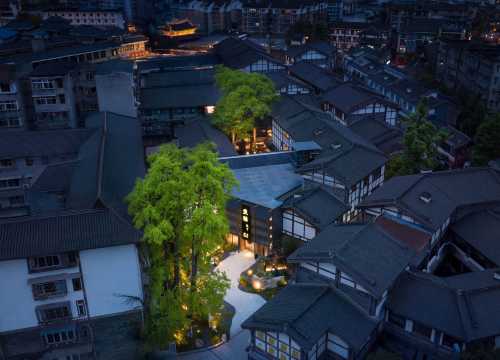
Panda Hotel (Dujiangyan Irrigation System Scenic Area & South Bridge)
 No. 3 of 4-Star Select Hotels in Dujiangyan
Guesthouses inside the old town are smaller and more atmospheric, often in converted wooden buildings along the river. They are ideal if you want evening food stalls and the bridge lights, but rooms can be compact and soundproofing is limited.
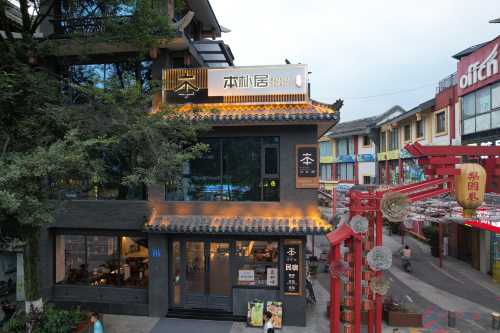
Benpuju Hotel(Dujiangyan Scenic Area South Bridge Branch)
Resorts at the foot of Mount Qingcheng suit travellers staying two nights or more. The air is cooler, the setting is forested, and you can start hiking before the day trippers arrive. Rates run from CNY 600 to 2,000 depending on the property and season.
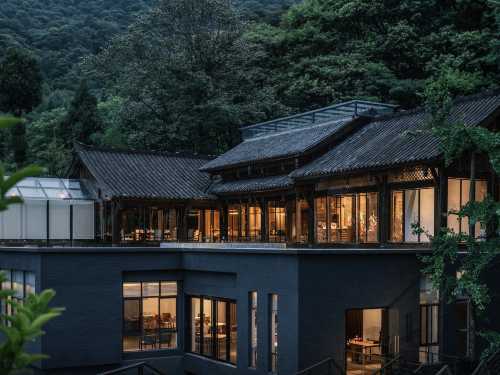
Dujiangyan Shili Mountain Jing Private Tang Hot Spring Resort Hotel (Qingchengshan Branch)
A day trip from Chengdu is inexpensive by international standards. The train is the biggest saving: a return ticket costs less than a single taxi ride across Chengdu.
| Item | Typical cost | Notes |
|---|---|---|
| Return train, Chengdu to Lidui Park | CNY 20 | CNY 10 each way, second class |
| Scenic area ticket | CNY 60-80 | Off-season versus peak season |
| Sightseeing bus and escalator | CNY 0-55 | Optional; walking is perfectly manageable |
| Lunch and snacks | CNY 50-100 | Old town street food is cheaper than sit-down restaurants |
| Panda base add-on | CNY 58 | Plus CNY 40-60 for a taxi each way |
| Mount Qingcheng add-on | CNY 80 | Front mountain; cable car extra |
| Hotel, if staying overnight | CNY 300-700 | Mid-range, near the South Gate |
In practice, a comfortable day trip costs CNY 150 to 250 per person including food and transport. Add a night and a second attraction and you are looking at CNY 600 to 900, still well below the cost of a similar trip in Europe or Japan.
If Dujiangyan is part of a longer Chengdu trip, these guides will help you plan the rest of it.
Book your train, your ticket and your hotel before you go, and keep a copy of your passport details with your booking: Dujiangyan runs on real-name reservations, and the gate staff will check them against your passport.
Popular recommendations
Chengdu Hotpot 2026: Sichuan Style, Menu & Where to Eat
 OneVoyager

Panda Zoos in China 2026: Chengdu, Wolong & 12 More Parks
OneVoyager
Latest Trip.com Promo Codes, Flight Discounts & Hotel Savings (Weekly Update)
 Trip.com Official

6 Things to know before Exploring the Montmorency Falls, Quebec
 _TS***4m