Shanghai to Chongqing 2026: Train, Flight & Cruise Compared
Contents
- Shanghai to Chongqing Transport at a Glance
- By High-Speed Train: The Most Comfortable Way
- Is there a high-speed train from Shanghai to Chongqing?
- Shanghai to Chongqing train times and fares
- Second class, first class or business class?
- Which Shanghai station should you leave from?
- Chongqing North, West, Shapingba or East?
- Booking and boarding
- By Overnight Sleeper: The Cheap Way to Cross China
- Which sleeper trains run
- What the night is like
- Who should take it
- By Plane: Fastest, but Only With the Airport Links
- Flight time and frequency
- Fares and how far ahead to book
- Airport transfers
- By Bus: There Is No Direct Coach
- What actually runs
- If you still want to go by road
- Yangtze River Cruise: The Slow Way to Arrive
- The three routes that matter
- What is included
- Embarkation in Chongqing
- When to sail
- Driving Shanghai to Chongqing
- Chongqing to Shanghai: The Return Trip
- Booking Checklist Before You Go
- Where to Stay in Chongqing After You Arrive
- Jiefangbei and Hongya Cave
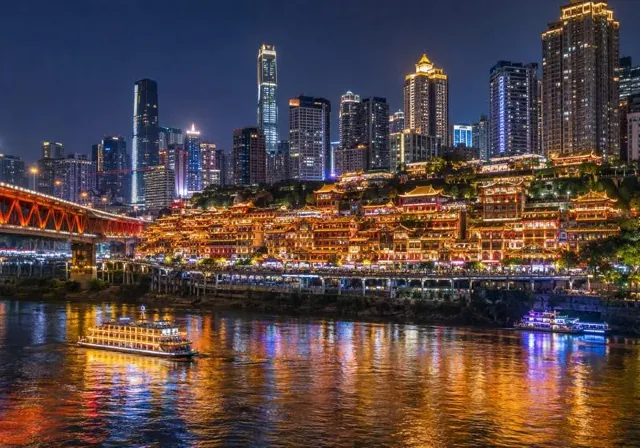
- Hongyadong and the riverside
- Yubei, near Chongqing North
- What to Do With Your First Evening
- More China Travel Guides
Show more
Shanghai and Chongqing stand 1,670 km apart, one at the mouth of the Yangtze and the other where the Jialing runs into it. The distance is the same for everyone; the way you cross it is not. A direct flight lands in under three hours, the fastest high-speed train takes nine, an overnight sleeper trades comfort for a hotel bill, and a river cruise turns the transfer into an eleven-day holiday.
This guide compares every option on the route with current train times and fares, the stations each one uses, and the cruise routes that actually sail, so you can choose by schedule and budget rather than by guesswork.
| Option | Journey time | Typical cost | Best for |
| Flight, Shanghai to Chongqing | 2 h 45 m-3 h | ¥400-1,500 | Tight schedules; anyone with four nights or fewer |
| G train, Hongqiao to Chongqing North or West | 9 h-11 h 30 m | ¥870-1,030 second class | Comfort, luggage, no airport transfer |
| D train, daytime | 12 h-13 h 30 m | ¥572-655 second class | Saving ¥300 without losing a night |
| Z or K sleeper | 17 h 40 m-27 h | ¥240 hard seat, ¥390-625 sleeper | Budget travel; sleeping through the distance |
| Long-distance bus | No direct service, 20 h+ with a transfer | ¥400 and up | Nothing on this route |
| Yangtze cruise | 4-5 days to Yichang, 11-12 days on the full river | From about $445; about $2,700 full river | Slow travel; the crossing is the trip |
The short answer: fly if you have less than a day to spare, take a G train if you want one comfortable travel day and no airport queues, and take the cruise only if the Yangtze is the reason for the trip. The sleeper is the budget bridge between the last two.
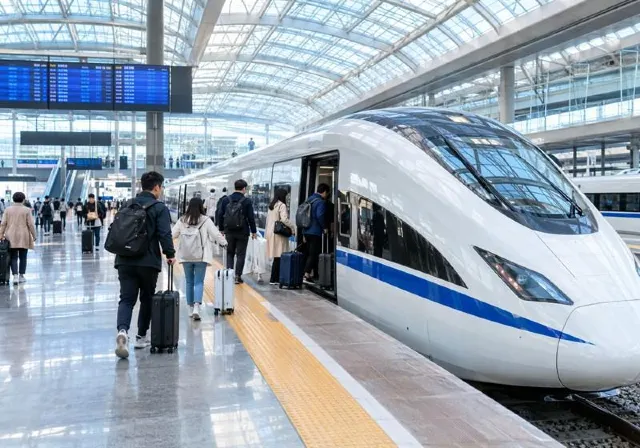
Yes, and it is a full-day ride rather than a commuter hop. Around 21 direct trains leave Shanghai for Chongqing on a typical day, six of them G services and the rest D services that run on the same corridor at slightly lower speeds. The railway distance is 1,672 km, and the route crosses Jiangsu, Anhui and Hubei before the line climbs into the Sichuan Basin.
Times below are from the current timetable and fares are second class; peak dates and advance purchase move both, so check live availability before you commit.
| Train | Departs | Time | Arrives | Time | Journey | 2nd class |
| G241 | Shanghai Hongqiao | 11:56 | Chongqing West | 20:55 | 8 h 59 m | ¥870 |
| G1476 | Shanghai Hongqiao | 09:51 | Chongqing North | 20:48 | 10 h 57 m | ¥1,010 |
| G1333 | Shanghai Hongqiao | 11:37 | Chongqing West | 22:55 | 11 h 18 m | ¥907 |
| D3056 | Shanghai | 07:23 | Chongqing North | 19:16 | 11 h 53 m | ¥572 |
| D352 | Shanghai Hongqiao | 06:12 | Chongqing North | 18:14 | 12 h 02 m | ¥617 |
| D2212 | Shanghai | 07:09 | Chongqing North | 20:14 | 13 h 05 m | ¥621 |
| D2206 | Shanghai Hongqiao | 06:01 | Chongqing North | 19:29 | 13 h 28 m | ¥625 |
Two patterns are worth noting. Every departure leaves before midday, because the train needs the whole day to arrive the same evening. And the fastest trains are not always the most expensive: G241 covers the route in nine hours for less than G1476, which takes two hours longer.
| Class | Price range | What you get |
| Second class | ¥572-1,030 | Five seats across in a 3+2 layout, a fold-down table shared with the seat in front, a power socket at each row, overhead racks that take cabin bags. Fine for a nine-hour daytime run. |
| First class | ¥913-1,650 | Four seats across in a 2+2 layout, wider seats with leg rests, a quieter carriage and a reserved seat that reclines further. The step up is worth it on the 12-hour D trains. |
| Business class | ¥2,710-3,480 | A lie-flat pod, meal service and lounge access at the largest stations. Available on G trains only, and priced close to a business-class flight. |
G and D trains to Chongqing use Shanghai Station and Shanghai Hongqiao. Hongqiao is the big one: Metro Lines 2, 10 and 17 connect it to the city, it is about 20 minutes from downtown on Line 2, and a covered walkway links it to Terminal 2 of the city airport, which matters if you are connecting from a domestic flight. Shanghai Station sits closer to the centre, roughly 5 km from the Bund, on Metro Lines 1, 3 and 4. Sleeper trains leave from Shanghai South instead, which is a smaller station with fewer facilities and a Metro Line 1 and 3 connection.
This is where people lose an hour. The station on your ticket is not a detail: Chongqing's four main stations sit in different districts, and the metro does not link all of them.
Book on Trip.com or the official 12306 app; both accept a foreign passport, and tickets usually go on sale about 15 days before departure. For foreign travellers the passport is the ticket: there is nothing to collect at the station unless you buy at a counter, and staff scan your passport at the gate. Arrive 40 minutes before departure for the security and ID check, and note that gates close five minutes before the train leaves. Luggage is not weighed or checked in, so you carry everything yourself.
The conventional-railway trains from Shanghai South are slow, cheap and the only option that saves a hotel night. The two useful ones are Z257, which is the fastest sleeper on the route, and K71, which is the cheapest seat in China for this distance.
| Train | Departs | Time | Arrives | Time | Journey | Sleeper |
| Z257 | Shanghai South | 19:09 | Chongqing North | 12:49 +1 | 17 h 40 m | ¥598-625 soft |
| K71 | Shanghai | 14:34 | Chongqing North | 15:47 +1 | 25 h 13 m | ¥388-407 hard |
Hard sleeper is an open bay of six berths in three tiers, with a pillow, a quilt and a shared table; soft sleeper is a closed four-berth compartment with a door. Both have a dining car, hot water at the end of each carriage and a washroom, and both are comfortable for one night if you bring earplugs. The K71 hard seat, at ¥240, is the cheapest way to reach Chongqing, and also the one nobody recommends for 25 hours.
Take Z257 if you want to leave Shanghai after dinner, sleep through the distance and arrive in time for a late lunch. It is the best value on the route for anyone travelling alone and paying for their own hotel. Skip it if you have a fixed appointment in Chongqing the next morning: a 17-hour train is a schedule, not a guarantee.
Nonstop flights from Shanghai to Chongqing take 2 hours 45 minutes to 3 hours, and more than 30 a day leave Pudong and Hongqiao for Jiangbei, roughly hourly from about 06:00 until 22:00. In practice the flight is a half-day door to door: allow two hours at the Shanghai end for check-in and security, and another hour in Chongqing for the metro or taxi into town.
Economy fares run from about ¥400 in low season to ¥1,500 around holidays, with business class from ¥900 to ¥5,500. Booking three to six weeks ahead and avoiding Friday and Sunday evenings is usually worth ¥200-400. The lowest fares on this route are often on the early morning departures, which pair badly with the 06:00 metro but well with a cheap airport hotel.
Shanghai Hongqiao is the easiest departure point because Terminal 2 is a covered walkway from the railway station, and Metro Line 2 connects both terminals to the city. Pudong is the long haul: Line 2 takes 60-75 minutes to Hongqiao, or 50 minutes to People's Square with a change. At the Chongqing end, Jiangbei Airport has two terminals linked by Metro Line 10, which reaches Chongqing North in 20 minutes, and Line 3, which runs into the city centre in about 50 minutes.
No scheduled long-distance coach runs from Shanghai to Chongqing. The service exists only in the other direction: three buses every two days leave Chongqing for Shanghai from Wanzhou and the two squares of Chongqing North station, take about 18.5 hours and cost ¥385-418. From Shanghai you would be building the trip yourself, with a change at a provincial hub and a night in a bus station town.
The realistic version is a train to an intermediate city and a coach from there, which adds 20 hours or more to a journey the sleeper train already covers in 17 hours 40 minutes in a bed. There is no cost advantage either. Treat the coach as a fallback for a broken railway, not as a plan.
The river is the reason this route is different from any other city pair in China. Chongqing is the upstream terminal of the Yangtze cruise fleet, and Shanghai is the downstream end of the full-river route, so you can sail between the two cities instead of travelling between them.

| Route | Duration | Sailings | From |
| Chongqing to Yichang, through the Three Gorges | 4 days 3 nights downstream, 5 days 4 nights upstream | 26 ships in 2026 | About $445 per person |
| Chongqing to Wuhan | 6 days 5 nights | Yangtze 2, returned in 2026 | Varies by cabin |
| Shanghai to Chongqing, full river | 11 days 10 nights downstream, 12 days 11 nights upstream | Century Legend | About $2,700 per person |
The full-river route covers 2,644 km and calls at cities along the middle and lower Yangtze before the Three Gorges, the dam and finally Chongqing. It is the only way to arrive in Chongqing with the whole river behind you, and it is priced like a cruise rather than like transport.
Standard fares cover a cabin with a private balcony, all meals on board, the scheduled shore excursions and onboard lectures. Gratuities, drinks, the optional excursions sold at the reception desk and transfers at either end are extra. Cabins on the upper decks cost more and sell out first in spring and autumn.
Most ships sail from Chaotianmen, the peninsula where the Jialing meets the Yangtze, 15-20 minutes by taxi from Jiefangbei. Boarding usually runs through the late afternoon and the ship leaves in the evening, which gives you a full day in the city first. Check the pier on your ticket: Chaotianmen has several berths along the same stretch of riverbank, and taxis drop passengers at the wrong one regularly.
March to April and September to November are the best months, with mild temperatures, visible gorges and no summer heat. July and August are hot and busy, and winter sailings are cheap but often hazy, which matters when the point of the trip is the view.
The drive is about 1,700 km on the G42 and G50 expressways and takes 18-20 hours behind the wheel, so it is a two-day trip with a night somewhere in between. Tolls come to roughly ¥800 and a one-way rental with a drop-off in another city carries a fee that often exceeds the tolls. Unless you are moving between the two cities with a car full of luggage, the train does the same journey in a day for less.
Everything above works in reverse, with two adjustments. Daytime high-speed trains from Chongqing to Shanghai take 10.5-13 hours and cost ¥585-870 in second class, so the fastest trains run slightly longer than they do outbound. The sleepers are the better return: Z258 leaves Chongqing North at 14:10 and reaches Shanghai South at 09:12 the next morning, and K73 leaves at 09:31 and arrives at 12:15 the day after, 26 hours 44 minutes later, for a hard seat fare of ¥224. If your flight home leaves from Shanghai, an overnight train that lands in the morning is the cheapest way to connect.
Where you sleep depends on when you arrive. A train that lands at Chongqing North at 20:48 argues for a hotel in Yubei; a flight into Jiangbei argues for the same; anything arriving in daylight is better spent around Jiefangbei, where the food and the river views are.
The centre of the city, walkable to Hongya Cave, the Yangtze cableway and the best hotpot in Chongqing. Rooms here cost more and the streets are loud at night, which is either the point or the problem.
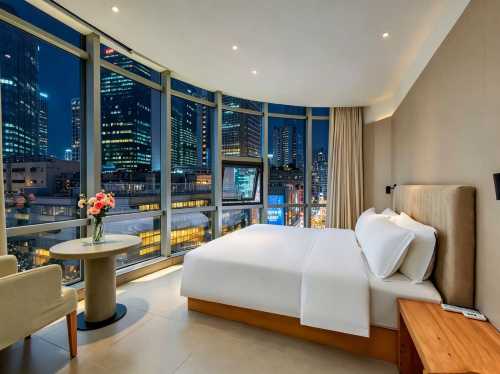
Jingmu Hotel Chongqing (Jiefangbei Pedestrian Street)
A block or two back from Hongya Cave buys you the same skyline from a higher floor at half the noise. The riverside walk starts at the door, and the cableway station to the south bank is five minutes away.

YOLO Skyline Riverview Designer Hotel (Chongqing Jiefangbei Hongyadong Branch)
The practical choice for one-night stopovers and early trains: 20 minutes from the airport on Line 10, 10 minutes from the station by taxi, and half the price of the peninsula.

DoubleTree by Hilton Chongqing North
Chongqing rewards a short walk more than a long list. Start at Hongya Cave at dusk, when the stilted complex lights up above the Jialing; ride the Yangtze cableway across the river for the skyline; watch a monorail pass through a residential block at Liziba; and eat hotpot within sight of the river. The panda house at Chongqing Zoo is a half-day trip in the morning, and the karst country around Wulong is the natural next stop if you have two more days.

 The ferry offers commentary on the scenery along both sides of Chongqing, including iconic landmarks like Hongyadong and Raffles City. Enjoying the ferry ride while sightseeing is a very pleasant experience! The price could be lowered to make it more affordable.
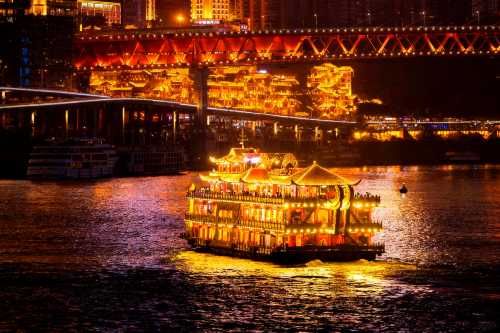
A two-river night cruise takes about an hour from either Hongya Cave or Chaotianmen pier and puts both waterfronts and the lit bridges in one loop, which is the cheapest way to see the whole skyline without a taxi.
Popular recommendations

How to Get to Wulong 2026: Train, Bus, Flight & Shuttle
 OneVoyager

Chongqing Zoo 2026: Panda House, Tickets, Hours & Metro
OneVoyager
Chongqing to Zhangjiajie Train 2026: Times, Fares & Stations
OneVoyager
Latest Trip.com Promo Codes, Flight Discounts & Hotel Savings (Weekly Update)
 Trip.com Official