
Things to do in Shishi
Explore top experiences
Top 10 attractions in Shishi


Luojia Temple
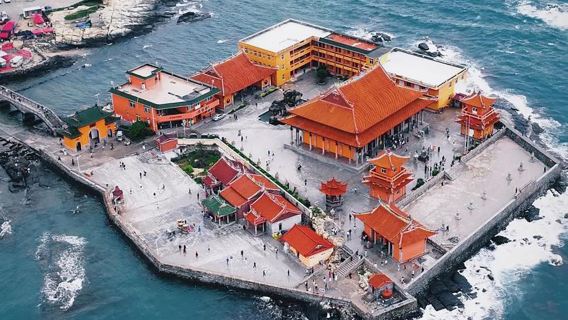
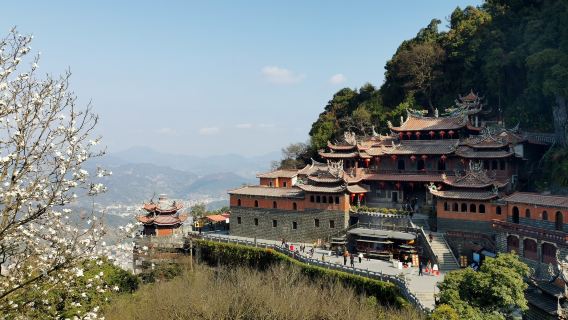
Luojia Temple is located on the golden coast of southern Fujian in Shishi City. The sea is vast and the scenery is charming It is surrounded by Baogai Mountain in the northwest and the Taiwan Strait in the southeast. Surrounded by mountains and sea, it covers an area of more than 20 acres. Luojia Temple is a rare building with one island and one temple. attracting countless tourists to come here in the ebb and flow of the sea Walking here, you can feel the grandeur and grandeur of Buddhism and the momentum of embracing all rivers. In case of high tide Luojia Temple looks like it is floating on the sea Therefore, it is called "Pengdao Buddha Country" Quanzhou City has a long coastline There are many Buddhist temples on the seaside Luojia Temple is just a Buddhist temple standing on a floating island. And the three words "Luojia Temple" It was even inscribed by Zhao Puchu, president of the Buddhist Association of China. There are "Tianwang Hall" and "Yuantong Hall" built in the temple. "Buddha Chanting Hall", "Sutra Collection Pavilion", "Bell and Drum Tower" and "Five Views Hall" etc. The whole temple is majestic and magnificent, with carved beams and painted pillars and magnificent splendor. With the sea and sky as the background, the artistic conception is broad Pavilions and pavilions interweave with the vast mist and the distant shadows of solitary sails. Make up a wonderful landscape painting To the east extend the auspicious pulse of Baogai, and to the west embrace the auspiciousness of Purple Hat The spirit of Zhong Haitian, the beauty of Yujia point Luojia Temple is uniquely endowed with precious resources Be tolerant to diversity, tolerance is a virtue In your spare time, you might as well go to Luojia Temple Take a break from the troubles of this worldShishi · 9.2 km from downtown

Jinjiang Wulin Traditional Village
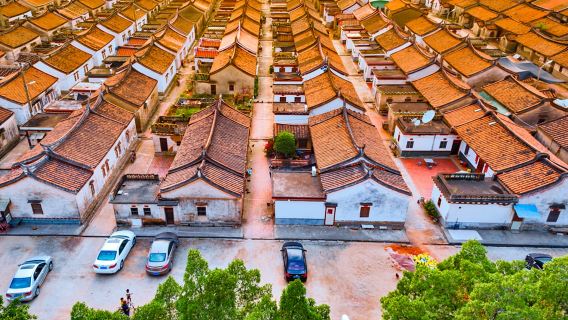
Jinjiang Wulin Traditional Village Attraction a long history and beautiful scenery. It is a well-preserved traditional ancient village in southern Fujian. The ancient buildings in the Attraction are very distinctive, and the architectural forms include southern Fujian mansions, Gothic and ancient Romanesque styles. There are folk performances and cultural and creative exhibitions here from time to time.Jinjiang · 5.7 km from Shishi

Yongning Ancient Town
Yongning is located in the coastal area of Shishi City, Quanzhou City, and is a famous hometown of overseas Chinese. It is an ancient city with a history of more than 600 years. Due to its special geographical location, it has always been an important port and coastal defense in southeastern Fujian. During the Ming Dynasty, the imperial court established a city here. In its heyday, it was known as one of the three major cities in China along with Tianjin Wei and Weihai Wei. It has made indelible contributions to resisting pirates, foreign invasions, and maritime transportation and trade exchanges in history. Yongning Town is rich in cultural and historical heritage. At present, there are two provincial-level cultural relics protection units in the town, namely: Sister-in-law Tower (also known as Wanshou Tower or Guansuo Tower) and City God Temple; there are eight municipal-level cultural relics protection units in Shishi, namely: Huxiu Temple Cliff Carvings, Yongningwei Stone Carvings (Zhenhai Stone), Former Residence of Martyr Li Zifang, Former Residence of Martyr Dong Yunge, Tomb of Chen Yougang, a military scholar in the Ming Dynasty, Cihang Temple, "7.16 Martyrdom Memorial", Cendou Ancient Salt Field; other historical sites include: Ancient Acropolis Ruins, Chaotian Temple, Jade Emperor Pavilion, Islamic Holy Tomb, Sun Viewing Platform, Shadi Stalagmites, etc.Shishi · 7.8 km from downtown

Jinjiang Wudianshi Traditional Blocks
Jinjiang Wudianshi Traditional Blocks has a thousand-year history and is the origin of Jinjiang City. The red brick buildings with southern Fujian characteristics span the Ming, Qing and Republic of China periods. Wudian City has produced 11 champions in history. During the Wanli period, Zhuang Jichang was the champion in the same subject as Yuan Chonghuan. The champion Wang Zeng, a descendant of the King of Fujian who lived in Quanzhou, won three first prizes in a row (first place in the first, provincial and palace examinations). It has also produced more than 1,400 Jinshi scholars, making it an outstanding representative of the humanities, history, art, architecture and customs of southern Fujian. As the treasure of southern Fujian art, puppetry has not only become an indispensable part of the folk customs of Quanzhou and the entire southern Fujian region for thousands of years, but also has become a popular opera art that is appreciated by the general public and even scholars and literati with its unique skills and wonderful performances. The traditional cultural block of Wudianshi, located between many high-rise buildings, forms a sharp contrast with modern urban civilization, just like an old man who has experienced vicissitudes but is becoming more vigorous, insightful of the changes in history. Walking into Wudian Street, stepping on the ancient stone road, under the sunshine, passing through the alleys and wind, touching the bricks and stones baptized by the years, chewing marshmallows in the mouth, holding the food I loved when I was a child, I returned to the carefree childhood. Every house here has its own story, and each one tells the unique southern Fujian architecture. The large and small buildings in the block are like a thick book of Jinjiang historical architectural art, from the tall Lu Sili Art Museum and Su Xianzhong Art Museum to the Western-style buildings that combine Chinese and Western styles, the "Imperial Palace" red brick buildings with southern Fujian characteristics, and the contemporary literary and artistic freshness of Wumen Gate, you can see that there is no barrier between literature and art here, they complement each other, and the inclusiveness of this kind of architecture makes Wudianshi more diversified and attracts more and more people to come.Jinjiang · 11.8 km from Shishi

Shishi Gold Coast
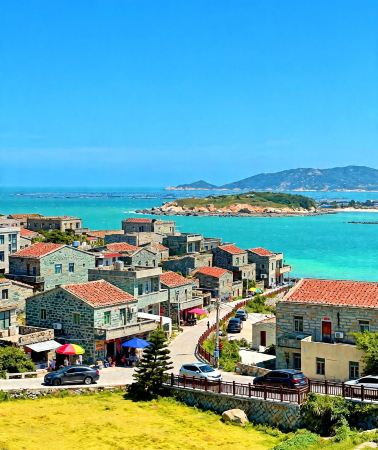
Shishi Gold Coast is located in Yongning Town, Shishi, Quanzhou City, Fujian Province, on the western coast of the Taiwan Strait. The attraction featuresGold Coast Tourist Resort,City God Temple, Zhenhai Stone, Ancient Weicheng Ruinsattractions, including Sands Fun Park,Underwater World and Dolphin Show TheaterBuddhist paradise, Guanyin statue by the waves, yacht club, equestrian centerSeaside Bathing BeachShopping street, Golden Coast Hotel, Post and Telecommunications HotelOcean HotelEducational training centers and other large-scale, distinctive recreational attractions and facilities.Gold CoastWith its perpetual spring-like climate, this coastal resort has developed into a comprehensive tourism destination integrating transportation, sightseeing, dining, accommodation, shopping, and entertainment. Boasting rich tourism offerings, it ranks among Fujian Province's top ten key tourist attractions.Shishi · 9.1 km from downtown

Xunpu Village
Xunpu village is a thousand-year-old fishing village located in Quanzhou, Fujian, at the mouth of the Jinjiang River. Backed by the Partridge Mountain and surrounded by the sea on three sides, it is famous for its "flower hairpin adornments" and "oyster shell houses." Not only was it an important starting point of the maritime Silk Road, but it has now also become a popular cultural tourism destination. The flower-adorned bun: The "flower-adorned bun" headdress is particularly famous in the Xunpu women's custom. Women coil their hair into a round bun and decorate it with fresh flowers all around, earning it the nickname "a garden on the head." The Xunpu flower-adorned bun tradition originated during the Song and Yuan dynasties, became popular in the Ming and Qing dynasties, and continues to this day. Oyster shell houses: Xunpu Village has developed a unique local architectural landscape, with its most distinctive buildings being the oyster shell houses. These structures, dating back to the late Song and early Yuan dynasties, are constructed primarily from oysters. The oyster shell walls not only feature natural ventilation pores but also possess excellent heat absorption properties, keeping interiors warm in winter and cool in summer. Local villagers observed that oyster shell walls are sturdy, resistant to corrosion, and don't retain rainwater, making them more suitable than red bricks as building materials in the coastal climate. This construction method helps withstand the humid seaside environment and extends the houses' lifespan. The main materials used in Xunpu Village's oyster shell houses are oyster shells, red bricks, stone slabs, wood, and tiles. Over time, these structures have evolved - typically featuring red bricks and stone slabs around the base, with white oyster shells embedded in the remaining walls. Some houses incorporate square red brick windows, while others use double-hooked stone slabs or irregular stones from the foundation up to window level, combined with red brick frames and oyster shell decorations, creating a striking red-and-white decorative effect.Quanzhou · 14.4 km from Shishi

Quanzhou Kaiyuan Temple
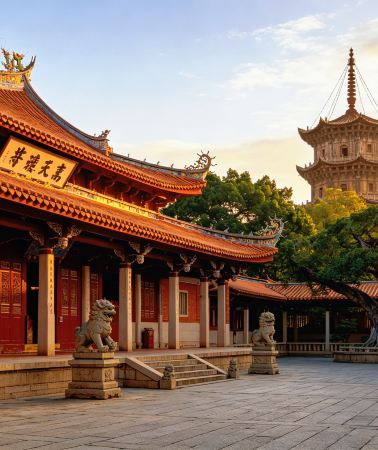
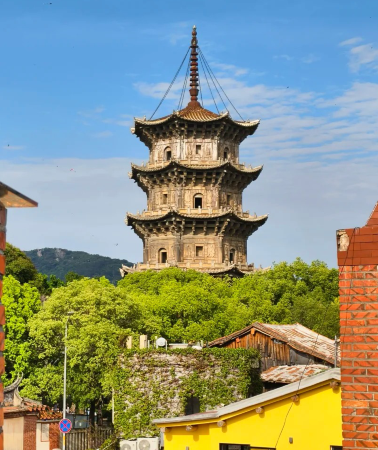
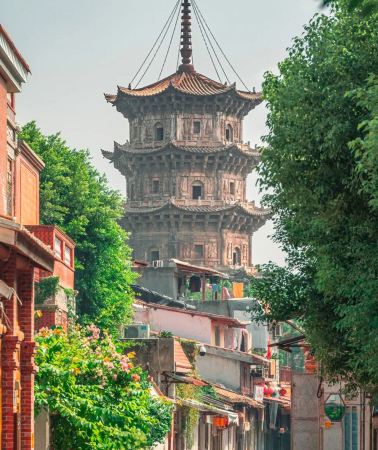
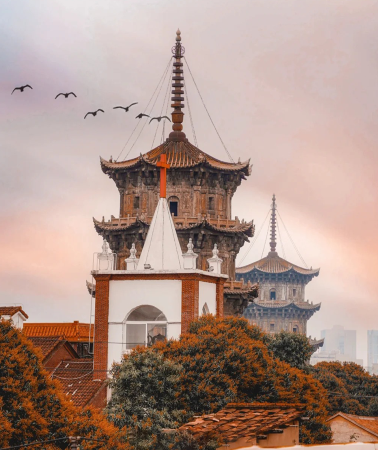
Kaiyuan Temple is located in QuanzhouWest Street, Licheng DistrictBuilt in the second year of the Chuigong era during the reign of Empress Wu Zetian of the Tang Dynasty, it has a history of over 1,300 years. It is an important cultural relic along the southeastern coast of China and one of the larger-scale Buddhist temples in Fujian Province. The attractions of the monastery are arranged along the central axisWorship pavilion, the Baiting, the main hall of Kaiyuan Temple, the Sangpeng historic site, the Kaiyuan Temple's Sweet Dew Ordination Platform, the scripture depository, etc.Also,, as well as the stone pagodas on the east and west sides and the east and west corridors. Quanzhou Kaiyuan Temple - The heavenly king hall, also the mountain gate of the temple, was built in 1925. The stone pillars are slightly thinner at the top and bottom, thicker in the middle, shaped like a shuttle, reflecting the Tang dynasty stone pillar style. A wooden couplet hangs on the stone pillars, reading "This place is called the land of Buddha, where every street is filled with saints." It was composed by Zhu Xi, a great Neo-Confucian scholar of the Southern Song dynasty, and written by the modern eminent monk Hongyi. Crossing the mountain gate brings you toWorship pavilionStanding here, you can see the east and west pagodas rising from the ground and the spacious, bright east and west corridors symmetrically arranged on both sides. The east and west pagodas are among the more famous attractions in the area. The east pagoda is called "Zhenguo Pagoda (East Pagoda)," while the west pagoda is named "Renshou Pagoda." Standing over 40 m tall, they are one of the tallest pairs of stone pagodas in China and serve as landmarks and symbols of the ancient city of Quanzhou. Worship pavilionIn front, there is a large stone courtyard where officials and commoners from ancient and modern times gather for activities, becoming particularly lively during events. On both sides of the stone courtyard stand eight large banyan trees, beneath which are arranged 11 ancient sutra pillars and small stupas from the Tang, Song, and Ming dynasties in various styles, as well as two stone tortoises. Then there is the main structure, the Mahavira Hall of Kaiyuan Temple. The Mahavira Hall of Kaiyuan Temple also has an elegant name, "Hundred-Pillar Hall." Originally, the hall was planned to have one hundred pillars, but later, to accommodate the placement of Buddha statues and create space for Buddhist activities, the beams were extended, and the number of pillars was reduced, resulting in the "Hundred-Pillar Hall" with 86 pillars.Quanzhou · 21.2 km from Shishi

South Shaolin Temple
First built during the Longshuo era and abandoned in the Tianyou era. According to Cai Yongjian's "Xishan magazine" from the Qing Dynasty, which cited the Tang Dynasty's "Minzhong records," before the first year of Longshuo in the Tang Dynasty (661 AD), "Zhikong entered Minzhong and built the Shaolin Temple at the foot of Qingyuan Mountain, consisting of thirteen courtyards." "The Shaolin Temple had thirteen sections, surrounded by walls three zhang high, with vast fields and lush forests." "Beside the celestial altar stood the Shaolin Temple, where Zen master Zhikong met with Governor Wang at the celestial altar." Zhikong (styled Daoguang) was one of the thirteen staff-wielding monks from the Songshan Shaolin Temple renowned for saving the Tang emperor. His arrival in Min marked the beginning of martial monks in Fujian, and he trained twelve disciples—some capable of capturing tigers or lifting massive cauldrons, others skilled in wielding heavy crossbows, mastering chain hammers, or moving with extraordinary speed... The "Minzhong records" also states: In the first year of the Tang Tianyou era (907), "the Shaolin Temple rebelled against Wang Shenzhi's allegiance to the Liang Dynasty and was destroyed." Shi Mengshuo of the Southern Song Dynasty wrote in his "Donglu poetry collection": "The Shaolin Temple was built in Qingyuan, with ten grand gates and towering walls; a hundred acres of fields across three ridges, where a thousand monks practiced martial arts to rebel against the Wang regime." The "Wang regime" refers to the Min King Wang Shenzhi. Wang Shenzhi's destruction of the South Shaolin Temple in Quanzhou marks its first destruction. Prospered during the Taiping Xingguo era and declined during the Zhiyuan era The "Xishan magazine" records that in the sixth year of the Taiping Xingguo era of the Northern Song Dynasty (981 AD), an imperial decree was issued to rebuild the South Shaolin Temple in Quanzhou. This marked the second revival of the South Shaolin Temple in Quanzhou. Liu Changyan of the Northern Song Dynasty wrote in his poem: "The legacy of Qingyuan was built during the Xingguo era, the Shaolin spirit pervades throughout southern Quanzhou." "Xingguo" refers to the reign era of Emperor Taizong of Song, Taiping Xingguo (976–983). A copy of the Zhang family genealogy preserved in Donghu village, Dongqiao town, Hui'an county, states: "Shizhi, styled Fayi, renowned for stone carving, his craftsmanship was unparalleled, such as the stone lions in front of the Shaolin Temple in Quanzhou..." Zhang Shizhi was the younger brother of Zhang Shixun, a figure from the Song Dynasty, indicating his involvement in carving the stone lions at the entrance of the Shaolin Temple in Quanzhou during the Song Dynasty. Northern Song Dynasty records document that the South Shaolin Temple originally comprised a mountain gate, Mahavira Hall, dharma hall, Bodhidharma ancestral hall, thirteen halls, arhat hall, xuannü hall, scripture repository, heavenly king hall, Guanyin hall, Ksitigarbha hall and other supporting facilities, covering 400 mu of land. During the 2002 reconstruction of the heavenly king hall, over 40 stone temple components were excavated underground, including 1 pagoda base, 1 pagoda cover, 7 finials resembling those of Yinggeng Pagoda at Chengtian Temple, 4 stone caps, 4 column bases, 6 stone pillars, and notably 20 intact mortise stones measuring 1 m in diameter - all testifying to the temple's grand architectural scale. Numerous roof tiles and covers were also unearthed. Experts speculate these components likely belonged to the Quanzhou South Shaolin Temple's structures during the Tang and Song dynasties. During the peak periods of the Tang and Song dynasties, the temple housed thousands of martial monks. The "Xishan magazine · general records" also records: "In the first year of the Song Jingyan era (Yuan Dynasty's Zhiyuan 13th year, 1276), a thousand monks from the Qingyuan Shaolin Temple rebelled against Pu Shougeng's surrender to the Yuan Dynasty. The abbot of the Shaolin Temple, Yuan Miao... commonly known as Zhao Mengliang... (Yuan troops) pursued them to the Shaolin Temple... The vanguard, Qi Wotunsi, known for his cruelty, ordered an assault on the Shaolin Temple, provoking the fury of the thousand monks. Amidst the clash of swords, each monk fought like ten, leaving Yuan soldiers' corpses strewn across the east of Qingyuan city, with bones littering the fields. When Suodu arrived, he ordered arrows to be shot, killing most of the thousand monks, with only a hundred surviving... The survivors fled to Dehua (Daiyun Temple)." This marks the second destruction of the South Shaolin Temple in Quanzhou. In the mid-Ming dynasty, Li Sen (born in 1398), a wealthy philanthropist from Anxi, funded the purchase of large tracts of wasteland on Dongyue Mountain to establish charitable burial grounds for the free interment of remains by Quanzhou residents. These burial sites appear to have been the same wastelands where the Shaolin Temple was destroyed after its thousand monks resisted the Yuan dynasty in the late Southern Song period. Prospered during the Hongwu era and declined during the Qianlong era The "Xishan magazine" records: In the tenth year of the Hongwu era of the Ming Dynasty (1377 AD), Faben of the Xuanmiao Temple (a Shaolin monk who fled to Dehua after the resistance of a thousand monks against the Yuan Dynasty in the late Song period, aged 135) persuaded the local official Huang Zhongli to "petition the court for imperial approval to rebuild the Shaolin Temple." The monks then spread martial arts throughout southern Quanzhou. This marked the third revival of the South Shaolin Temple in Quanzhou. The Annals of Jinjiang County, Volume 69, from the Daoguang era of the Qing Dynasty records: "The South Shaolin Temple is located by the East Lake outside Renfeng... It was rebuilt in the 10th year of the Xuande era (1435) during the Ming Dynasty, but later fell into disrepair. Monks restored one-tenth of its original site and also enshrined County Magistrate Peng Guoguang, as Peng had helped monks reclaim temple lands." In the book "Records of Shaolin warrior monks" by master Deqian of the Shaolin Temple on Mount Song (published by Beijing Sports University Press, 1988), it is stated: "According to the 'Internal Chronicles of Shaolin Temple,' monk Yuanran possessed extraordinary martial arts skills and was commended by Emperor Jiajing of the Ming Dynasty (reigned 1522-1566). His eminent disciple, master Yuekong, was ordered to lead over 30 warrior monks who had proven their skills to Quanzhou, Fujian, to suppress Japanese pirates and establish merits. There, they built the South Shaolin Temple, where he became the abbot." This confirms that the "Internal Chronicles of Shaolin Temple" from the northern Shaolin Temple clearly records the existence of a South Shaolin Temple in Quanzhou during the Ming Dynasty, while the claim of it being newly built is a misconception. To this day, southern Fujian still circulates stories of northern Shaolin warrior monks suppressing Japanese pirates. During the Qianlong era of the Qing Dynasty, Emperor Qianlong toured southern China and feared that the warrior monks of the South Shaolin Temple might collude with the remnants of Zheng Chenggong (see "Quanzhou biographical records: Zheng Chenggong"). "In the fall of the 28th year of Qianlong's reign (1763), an imperial decree ordered the burning of the Shaolin Temple... From then on, no one dared to rebuild it." Some temple monks took refuge at Yipian Temple in Nan'an. This marks the third destruction of the South Shaolin Temple in Quanzhou. After the burning of Shaolin Temple, the monk Zhishan sought refuge among the people, continuing to recruit Shaolin disciples to oppose the Qing dynasty and restore the Ming. Zhishan, Hong Xiguan, and their disciples spread to Guangdong, further developing Southern Shaolin boxing, which produced the Southern Shaolin boxing champion Wong Fei-hung. Later, Wong Fei-hung's disciples brought the art to Hong Kong and spread it as far as the United States.Quanzhou · 21.1 km from Shishi

All Love Park Ocean Kingdom
All love park ocean kingdom is a masterpiece by Shandong baxian cross-sea tourism group in Fujian, adhering to high-standard positioning, design and quality. It is a large marine-themed park integrating rare marine and polar animal breeding and display, family-friendly amusement facilities, special performances, and marine science education. The park has been selected for the national preferred tourism project list and Fujian's major marine province construction projects, becoming a tourist attraction in Quanzhou and a cultural tourism landmark in Fujian province. The park features an ocean-themed culture, covering seven distinctive venues including whale bay, penguin venue, tropical rainforest, underwater world, finless porpoise venue, dolphin venue, and swan castle, showcasing diverse ecosystems from the equator to the polar regions. This place gathers over a thousand species and tens of thousands of rare creatures from around the world, establishing populations in Fujian. Visitors can observe polar species like polar bears, penguins, beluga whales, and arctic foxes up close, along with marine animals such as dolphins, walruses, sea lions, seals, and finless porpoises, as well as featured species like arapaima and sea turtles, experiencing their original ecological habitats. In terms of performances, the park presents seven star shows including Beluga Love, Dolphin Romance, Sea Lion Academy, Walrus Dance-off, Mermaid Legend, and Water Ballet, along with the O'Le Circus featuring international acts such as aerialists, royal cavalry, extreme magic wheels, and globe riders performed by Chinese and foreign artists, delivering a rich audiovisual experience. For amusement facilities, the park is equipped with nine outdoor family-friendly rides, including the flight theater, mine train, Atlantis Adventure, Royal Treasure Ship, luxury ocean carousel, spinning wave coaster, sky jumper, and riding the waves, suitable for visitors of all ages. The park, with marine culture at its core, offers marine life viewing, special performances, family-friendly entertainment, and marine science education services. It enriches the tourism product types in the Xiamen-Zhangzhou-Quanzhou economic zone and supports the development of regional cultural tourism.Hui'an · 18.9 km from Shishi

Quanzhou All Love Park
Quanzhou Ocean Park Resort is a large tourist destination that combines parent-child, adventure, fantasy and excitement. It has diversified theme areas such as Ocean Kingdom, Water World and Fairy Tale World, and provides a wealth of rides and wonderful performances, suitable for the whole family to enjoy happy time together.Hui'an · 18.9 km from Shishi
Experiences you can't miss in Shishi
Featured Cultural experiences in Shishi
View all Cultural experiences
4.5/5
· 4 reviews· 50 bookedFree cancellation
Instant confirmation
Book now for tomorrow
FromSAR 133.89

Free cancellation
Instant confirmation
Book now for tomorrow
FromSAR 70.14
FromSAR 22.45
Free cancellation
Instant confirmation
Book now for tomorrow
FromSAR 311.38
Free cancellation
Book now for today
FromSAR 71.82
![Kulangsu Hanfu experience [costume and makeup experience + amazing floral hairpin photography + exquisite and diverse outfits]](https://ak-d.tripcdn.com/images//0584h12000qnngxx2EF36_C_568_320.jpg?_fr=wc)
Free cancellation
Book now for tomorrow
FromSAR 55.55
![Xiamen Gulangyu Island Private Half-Day Tour[Flexible Departure + Hustle-Free!]](https://ak-d.tripcdn.com/images/0355512000snu64dc11A4_C_568_320.jpg?_fr=wc)
Free cancellation
Instant confirmation
Book now for tomorrow
FromSAR 215.18
Featured Food & drink in Shishi
View all Food & drink
5.0/5
· 3 reviews· 64 bookedFree cancellation
Instant confirmation
Book now for tomorrow
FromSAR 94.76
![Kulangsu private tour 1-day tour [Shuzhuang Garden + VIP afternoon tea in Republic of China style + 1-hour travel photo shoot]](https://ak-d.tripcdn.com/images//0581z12000nkcf1y1F6E5_C_568_320.jpg?_fr=wc)
5.0/5
· 11 reviews· 33 bookedFree cancellation
Instant confirmation
Book now for tomorrow
FromSAR 889.26
Instant confirmation
Book now for today
FromSAR 279.96
Free cancellation
Instant confirmation
Book now for tomorrow
FromSAR 139.64

Free cancellation
Instant confirmation
Book now for tomorrow
FromSAR 1,122.09
5.0/5
· 9 reviews· 192 bookedFree cancellation
FromSAR 78.55

Free cancellation
Instant confirmation
Book now for tomorrow
FromSAR 1,907.55
Featured Spa & wellness in Shishi
View all Spa & wellness![[Spa + buffet] Xiamen Huangjia Water Resort: Massage + spa + star-rated buffet](https://ak-d.tripcdn.com/images/0355b12000t0bl2xbD5BC_C_568_320.png?_fr=wc)
4.5/5
· 2 reviewsFree cancellation
Instant confirmation
Book now for tomorrow
FromSAR 142.14
![[Foot therapy + buffet] Xiamen Shoujia health club: Foot massage + star-rated buffet](https://ak-d.tripcdn.com/images/0350u12000s7wtp589EB6_C_568_320.jpg?_fr=wc)
5.0/5
· 1 reviewFree cancellation
Instant confirmation
Book now for tomorrow
FromSAR 241.88
Free cancellation
Instant confirmation
Book now for tomorrow
FromSAR 77.30
![[Hot spring getaway] Xiamen Shengzhixiang hot spring resort: A leisure experience of nature and hot springs](https://ak-d.tripcdn.com/images/0356a12000syzqvua4095_C_568_320.jpg?_fr=wc)
Free cancellation
Instant confirmation
Book now for tomorrow
FromSAR 100.99

Instant confirmation
Book now for tomorrow
FromSAR 155.85

Free cancellation
Book now for tomorrow
FromSAR 169.64
![[Hot spring getaway] Xiamen JinSuiYuan hot spring | Outdoor bath wellness experience](https://ak-d.tripcdn.com/images/0353012000sz1yxm8BEBA_C_568_320.jpg?_fr=wc)
Free cancellation
Instant confirmation
Book now for tomorrow
FromSAR 66.08
Free cancellation
Instant confirmation
Book now for tomorrow
FromSAR 194.72
Featured Outdoor experiences in Shishi
View all Outdoor experiences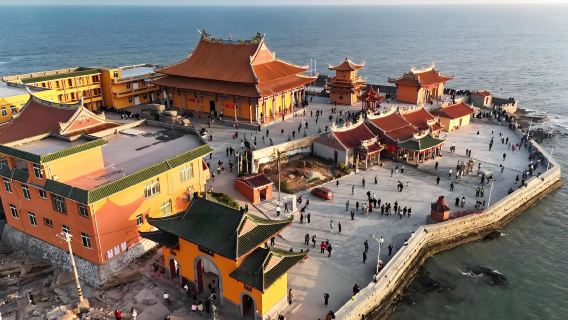
Free cancellation
Instant confirmation
Book now for tomorrow
FromSAR 436.37
5.0/5
· 2 reviewsFree cancellation
Instant confirmation
Book now for tomorrow
FromSAR 846.06

4.9/5
· 19 reviews· 165 bookedFree cancellation
Instant confirmation
Book now for tomorrow
75 travelers saved
FromSAR 279.96
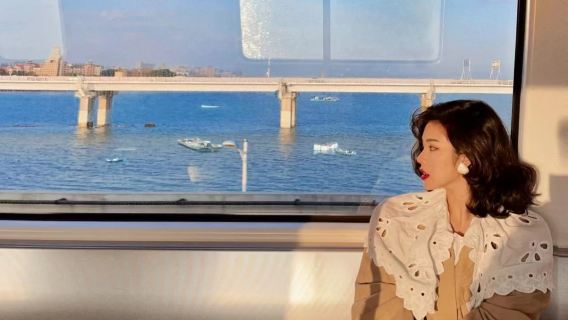

Xiamen Island Ring Road + Jimei University Village + Sea Train + Shapowei + Nanputuo Temple Day Trip
4.7/5
· 32 reviews· 218 bookedFree cancellation
Instant confirmation
Book now for today
90.6% of travelers recommend
FromSAR 610.42
Free cancellation
Instant confirmation
Book now for tomorrow
FromSAR 254.12
Free cancellation
Book now for tomorrow
FromSAR 350.49
![Xiamen University + Kulangsu + International Architecture Expo 1-day tour [guide + round-trip boat ticket]](https://ak-d.tripcdn.com/images/0355912000p10jf1v46A2_C_568_320.jpg?_fr=wc)
5.0/5
· 4 reviews· 60 bookedFree cancellation
Instant confirmation
Book now for tomorrow
FromSAR 397.78
Free things to do in Shishi
Luojia Temple
Shishi · 9.2 km from downtownJinjiang Wulin Traditional Village
Jinjiang · 5.7 km from ShishiYongning Ancient Town
Shishi · 7.8 km from downtownJinjiang Wudianshi Traditional Blocks
Jinjiang · 11.8 km from ShishiShishi Gold Coast
Shishi · 9.1 km from downtownXunpu Village
Quanzhou · 14.4 km from ShishiQuanzhou Kaiyuan Temple
Quanzhou · 21.2 km from ShishiSouth Shaolin Temple
Quanzhou · 21.1 km from ShishiAll Love Park Ocean Kingdom
Hui'an · 18.9 km from ShishiBook now for tomorrow, Cancel anytimeQuanzhou All Love Park
Hui'an · 18.9 km from ShishiBook now for tomorrow, Cancel anytime
More ways to travel from Shishi
Private Tours in Shishi
View More Private Tours in Shishi



Group Tours in Shishi
View More Group Tours in Shishi
What travelers say about Shishi

CK1688CKJanuary 14, 2026
5.0
Luojia Temple is located on Gongyu Island, on the eastern shore of the Minnan Golden Coast in Shishi City, covering an area of over 20 mu (approximately 3.3 hectares) facing the Taiwan Strait. The temple was built on land donated by the Hong Kong Youbang Group to the Shishi Buddhist Association as a sacred site for Guanyin Bodhisattva. A temple facing the sea, it truly feels like a "Buddhist kingdom by the sea." The temple is surrounded by the vast ocean, where the tides rise and fall, and waves constantly wash over the reefs and seawalls.
Luojia Temple

amy323June 4, 2026
4.0
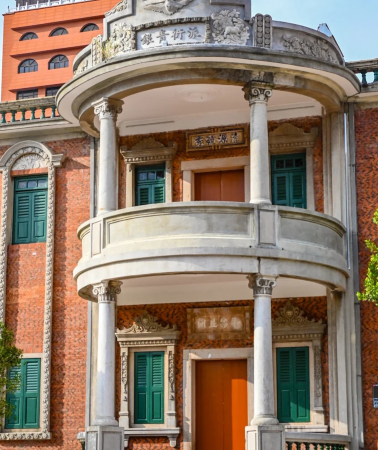
Wulin Ancient Village was originally a settlement of the Cai clan, with a history of 700 years. In the past, clan members went to Southeast Asia to make a living, and after returning home, they built a large number of residences. The village has well-preserved various overseas Chinese buildings, with complete styles and forms, thus it is known as a living museum of overseas Chinese architecture.
Jinjiang Wulin Traditional Village

M39***74May 24, 2026
5.0
Yongning Ancient Town in Quanzhou is a less-traveled, pristine seaside town, perfect for tourists who enjoy strolling through historical buildings and seeking a tranquil atmosphere. However, its commercial facilities are relatively weak, so it's recommended to visit it as part of your trip if you're short on time. Key Highlights:
Profound Historical Heritage: Founded in the 20th year of the Hongwu reign of the Ming Dynasty, it was one of the three major defensive cities of the Ming Dynasty. It still retains a complete Ming Dynasty street layout. Over 600 years of resistance against Japanese pirates has left behind numerous historical imprints such as the Zhenhai Stone and the blood of generals, creating a rich cultural atmosphere.
Unique Architectural Features: The ancient town features both traditional Minnan red-brick houses and "foreign-style buildings" built by overseas Chinese in the late Qing Dynasty and early Republic of China. These buildings blend Minnan style with Southeast Asian and Western features, each telling a story of overseas Chinese's struggles in Southeast Asia, making it ideal for architecture enthusiasts to explore at their leisure.
Authentic Local Life: Without excessive commercialization or the ubiquitous trendy shops, many local residents still live here. You can see old barbershops, blacksmith shops, and bustling morning markets, experiencing the purest Minnan daily life. **Adjacent to Coastal Resources:** Located next to the ten-mile-long Golden Coast, after exploring the ancient town, you can enjoy the beach, take a stroll, and even visit the nearby Luojia Temple, creating a complete seaside day trip.
**Main Drawbacks:** The ancient town's tourist facilities are incomplete, lacking clear tourist guidance; finding the traditional Western-style buildings takes considerable time; some old buildings lack maintenance, appearing abandoned or cluttered with debris; there are limited activities, which may bore visitors who don't enjoy a leisurely pace.
**Suitable for:**
Suitable for: Visitors who appreciate historical architecture, authentic local culture, and a slow-paced travel experience. It is recommended to allocate at least half a day for a leisurely exploration.
Not suitable for: Visitors with limited time or those seeking a mature, commercialized tourist experience. If you are visiting the Golden Coast or Luojia Temple, these can be conveniently located along the way; there's no need to make a special trip for them.
Yongning Ancient Town

西格玛 123July 27, 2025
5.0
When you arrive in Jinjiang, Quanzhou, you can go to Wudianshi. Wudianshi is the birthplace of Jinjiang City. There are more than 100 historical and cultural buildings in southern Fujian. The buildings have distinctive characteristics and are an important carrier for understanding the history and culture of Jinjiang. Walking in the alleys of Wudianshi is like walking into a large maze, but there is no rush to find the exit. Walking in it is like talking with time and space, which is very pleasant. There are also many unique coffee shops and restaurants in the block. You can sit down and rest when you are tired of shopping.
Jinjiang Wudianshi Traditional Blocks

M93***47February 11, 2026
5.0
Strolling along the Shishi Ten-Mile Golden Coast, the crescent-shaped beach stretches out, its golden sands soft and fine, the sea crystal clear, and the gentle sea breeze utterly delightful.
The red walls of Luojia Temple reflected in the waves, the incense smoke mingling with the sound of the surf, perfectly capturing the tranquil poetry of this Buddhist paradise by the sea. Hongta Bay features scattered reefs; at low tide, one can collect shells and go beachcombing, experiencing the lively charm of a Minnan fishing village. Lighthouses, viewing platforms, and glass houses are scattered along the coast, offering picturesque views at every turn.
Watching the sunset paint the sea with golden hues, accompanied by the fresh aromas of seafood stalls, allows you to fully appreciate the gentle beauty of the mountains and the sea. This seaside paradise holds the most captivating coastal charm of Minnan.
Shishi Gold Coast

张家老飞侠September 8, 2026
5.0
If you're visiting Quanzhou, be sure to check out this village. Children can wear traditional floral-adorned clothing, which is very unique. There are many shops offering photo opportunities; I recommend trying them out. The village isn't large, making it perfect for taking pictures.
Xunpu Village

菁菁 者莪July 23, 2026
5.0
Kaiyuan Temple, a thousand-year-old temple, boasts imposing twin pagodas and towering banyan trees, offering a tranquil escape from the bustling city. Just a wall away lies West Street, a vibrant hub of activity, with its exquisitely carved ancient buildings that blend the diverse cultures of the Maritime Silk Road, making it a worthwhile destination to savor and appreciate the rich heritage of Quanzhou.
Quanzhou Kaiyuan Temple

300***34October 7, 2026
5.0
The performance, priced at around seventy yuan, was well worth it. The Shaolin monks all gave their all, and the applause was constant throughout the performance. This was not only an affirmation of their performance but also a praise and expression of confidence in the spirit of traditional Chinese martial arts. There was especially a cute little monk, about four or five years old, who could even make a hand gesture, eliciting constant laughter.
South Shaolin Temple

Anonymous userSeptember 28, 2026
4.0
The online hype is overwhelming. The park isn't very big, and the shows are good, but the walks to the shows are too far. We arrived in the morning, and the shows were all in the afternoon, so we didn't have enough time to enjoy them. I don't think it's worth the special trip; it wasn't as good as I expected.
All Love Park Ocean Kingdom
Anonymous userJune 25, 2026
5.0
Great place to visit, fun for kids and kids at heart, performance and interactions with staff makes it even better, most rides only require 105cm, not too exiting but enough to be enjoyed. We went there on a weekday so literally ride all you can without having to line up for any ride🤣
Quanzhou All Love Park


