Forbidden City Beijing 2026: Map, Route & How to Get There

Contents
- Forbidden City Beijing | Getting There and Map
- Where Is the Forbidden City in Beijing?
- How to Get to the Forbidden City by Metro and Bus
- How to Get to Beijing by Train from Shanghai and Xi'an
- How to Get to the Forbidden City from Beijing's Airports
- Forbidden City Tickets | Prices, Booking and Discounts
- Forbidden City Ticket Prices in 2026
- How to Book Forbidden City Tickets with a Passport
- Discounts, Free Entry and the Two Paid Galleries
- Forbidden City Opening Hours | Best Time to Visit
- Forbidden City Opening Hours 2026
- Best Time to Visit the Forbidden City
- Forbidden City Highlights | Must-See Halls and Palaces
- Meridian Gate and the Golden Water Bridges
- Hall of Supreme Harmony: The Dragon Throne Room
- Hall of Central Harmony and Hall of Preserving Harmony
- Palace of Heavenly Purity and the Inner Court
- Imperial Garden
- Treasure Gallery and Clock and Watch Gallery
- Best Photo Spots for Pictures of the Forbidden City
- Forbidden City Map | Layout, Route and Facilities
- The One-Way Route from Meridian Gate to Shenwu Gate
- Forbidden City Map
- Facilities Inside the Palace Museum
- Forbidden City Special Exhibitions and Events
- Seasonal Exhibitions at the Palace Museum
- When the Forbidden City Opens at Night
- Forbidden City Tour | One-Day Itinerary
- Morning: Tiananmen Square to the Meridian Gate
- Midday: The Three Great Halls and the Inner Court
- Afternoon: Galleries, Jingshan Park and Shichahai
- Restaurants Near the Forbidden City
- Where to Eat Inside the Palace Museum
- Beijing Duck and Local Food Nearby
- More Beijing Attractions and Guides
- Forbidden City FAQ
- How long does it take to visit the Forbidden City?
- Is the Forbidden City open on Mondays?
- Can I buy Forbidden City tickets at the gate?
- Where should I stay near the Forbidden City?
- Is the Forbidden City the same as the Palace Museum?
Show more
The Forbidden City is the imperial palace at the centre of Beijing, home to 24 Ming and Qing emperors between 1420 and 1912 and now the Palace Museum. It covers 72 hectares, about three times the size of the Louvre Palace, and holds around 980 surviving buildings behind a 10-metre wall. It is also the Beijing sight most visitors get wrong: tickets are sold online only, released seven days ahead and capped at 40,000 a day, and the walk through the palace is one-way from south to north.
This guide covers what you need before you book and what to do once you are inside: how to reach the Meridian Gate, what Forbidden City tickets cost in 2026, opening hours and closed days, the halls and galleries worth your time, a simple map of the one-way route, and where to eat when you come out.
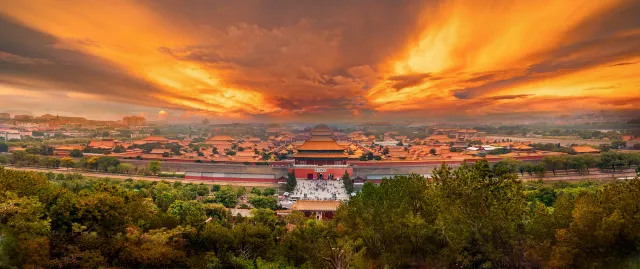
The Forbidden City seen from Jingshan Park, the classic view over the golden roofs. Photo: Trip.com
The palace sits on Beijing's central axis, directly north of Tiananmen Square in Dongcheng District. The address is 4 Jingshan Front Street, but the entrance you want is the Meridian Gate (Wumen) at the south end. Visitors enter there only and leave through the Shenwu Gate in the north or the Donghua Gate in the east. The route has been one-way since 2011, so plan a single south-to-north walk rather than looping back.
The complex is 961 metres north to south and 753 metres east to west. The wall is 10 metres high and 3,430 metres around, with a corner watchtower at each turn. Inside, the palace divides into the Outer Court for ceremony and the Inner Court for the imperial household.
The metro is the easiest option. Take Line 1 to Tiananmen East and leave by Exit A, or to Tiananmen West and leave by Exit B. Both are an 8 to 12 minute walk from the Meridian Gate along the moat. Line 8 to Qianmen also works, but the walk crosses Tiananmen Square, which needs its own reservation and a security check.
Several city buses stop at Tiananmen East and Tiananmen West, including routes 1, 2, 52, 82 and 120. Taxis and DiDi cars cannot stop on Chang'an Avenue, so set the drop-off point at the East Gate (Donghuamen) or Nanchizi Street and walk the last 10 minutes. From Wangfujing the drive takes about 15 minutes; from Sanlitun, 30 to 40 minutes in traffic.
If you are arriving from another city, high-speed trains pull into Beijing South or Beijing West. From Beijing South, take Metro Line 4 to Xidan and change to Line 1 eastbound for Tiananmen East, about 35 minutes door to door. From Beijing West, Line 9 to Military Museum and Line 1 gets you there in about 40 minutes. Shanghai Hongqiao to Beijing South takes 4 hours 20 minutes to 4 hours 40 minutes; Xi'an North to Beijing West takes 4 hours 20 minutes to 5 hours 30 minutes, depending on the service.
Book train seats in advance through Trip.com train tickets; passport details are required because the ticket is tied to your ID. From either station a taxi to the Meridian Gate takes 25 to 40 minutes.
From Beijing Capital Airport (PEK), take the Airport Express to Dongzhimen, switch to Line 2 for Jianguomen and then Line 1 to Tiananmen East; allow 60 to 70 minutes. From Beijing Daxing Airport (PKX), the Daxing Airport Express runs to Caoqiao, where you change to Line 19 and Line 4 before joining Line 1; allow 80 minutes, or take a taxi for about an hour. Both airports are covered in our Beijing Daxing Airport guide.
| Ticket type | Peak season | Treasure Gallery | Clock Gallery | All three together |
| Adult admission | 60 yuan | +10 yuan | +10 yuan | 80 yuan |
| Adult admission, off-peak | 40 yuan | +10 yuan | +10 yuan | 60 yuan |
| Student with ID | 20 yuan | Full price | Full price | - |
| Visitor aged 60+ | Half price | Full price | Full price | - |
| Child aged 6 or under | Free, still reserved | Full price | Full price | - |
Peak season runs from 1 April to 31 October at 60 yuan per adult. Off-peak, from 1 November to 31 March, admission drops to 40 yuan. The Treasure Gallery and the Clock and Watch Gallery cost 10 yuan each in both seasons, and buying all three in one order costs 80 yuan in peak season and 60 yuan off-peak.
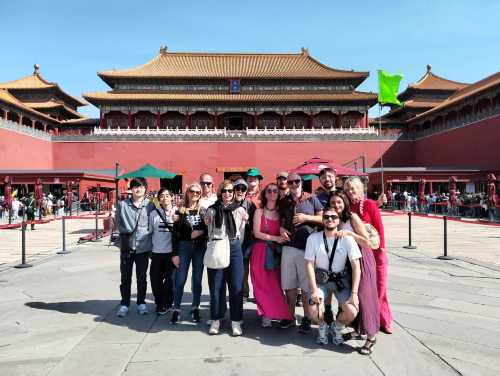
 秀才说王导 I enjoyed the tour, the guided tour brought the palace to life and she took great care of the group
Tickets are released seven days ahead at 20:00 Beijing time, in a single daily release, and there is no same-day sales window. Register on the Palace Museum booking site or its multilingual portal with the passport you will carry, add each visitor's details exactly as printed, choose a date and a session, then pay and save the QR code offline. Morning entry must be checked in by 12:00; afternoon entry opens at 11:00.
Weekends, school holidays, Chinese New Year and the first week of October sell out within minutes. If your date is gone, refresh later the same evening and again the day before, because cancelled tickets return to the pool. The museum does not authorise third-party agents to sell its tickets, so treat any guaranteed-ticket offer with caution.
For booking steps, refund rules and official entry requirements, read our Forbidden City tickets guide.
Children aged 6 and under enter free but still need a reservation. Students pay 20 yuan with a student card or a letter from their school, and visitors aged 60 and over pay half price on production of an original ID. The under-18 free rule applies to Chinese citizens, including Hong Kong, Macao and Taiwan residents, so a foreign passport does not qualify and teenagers should budget for a full ticket.
The two paid galleries are the best value add-on in the palace. The Treasure Gallery in the Ningshou Palace area holds imperial gold, jade and ceremonial objects, plus the Nine Dragon Wall. The Clock and Watch Gallery in Fengxian Hall displays Qing-era clocks and automata collected from Canton and Europe. Budget an extra hour for both and visit them while you still have energy.
If you would rather not manage the booking yourself, a guided entry package includes the official reservation and an English-speaking guide. See the Forbidden City tour with ticket on Trip.com for dates and prices.
| Season | Opening hours | Last entry |
| Peak: 1 April to 31 October | 08:30 to 17:00 | 16:00 |
| Off-peak: 1 November to 31 March | 08:30 to 16:30 | 15:30 |
| Mondays | Closed, except public holidays | - |
| Chinese New Year's Eve | Closed | - |
The closing time is fixed and guards start moving visitors towards the exits about 30 minutes before it. When a public holiday falls on a Monday the palace usually opens, but the arrangement is announced case by case, so check the official notice for your date instead of assuming.
Late April to May and September to October give the best light and the most comfortable walking weather. Autumn is the most photogenic, with clear skies and the first colour in the trees. Winter is quiet and the red walls look their best against snow, but the halls are cold and the day is short.
Arrive at opening, between 08:30 and 10:00, or come after 14:00 when the tour groups have moved on. Avoid the first week of October, the first week of May, Chinese New Year and summer weekends, when the daily allocation disappears and the central axis is shoulder to shoulder. A weekday in the shoulder season is worth more than any ticket upgrade.
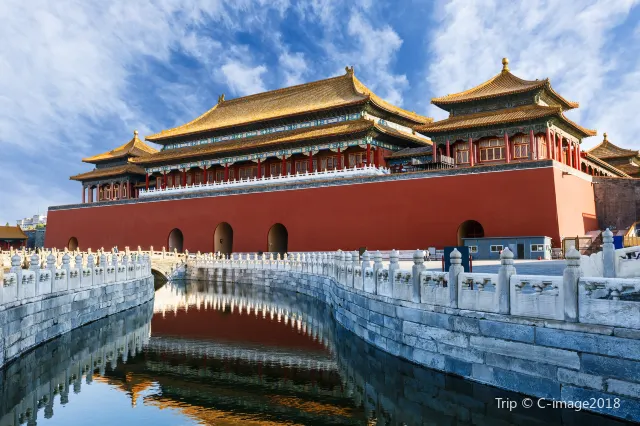
The Meridian Gate is the largest gate in the palace, a U-shaped red wall with five towers on top. Only the emperor used the central arch; officials entered through the side arches according to rank. The gate now holds exhibition space, and the walk through its dark passage onto the Golden Water Bridges is the moment the palace opens up in front of you.
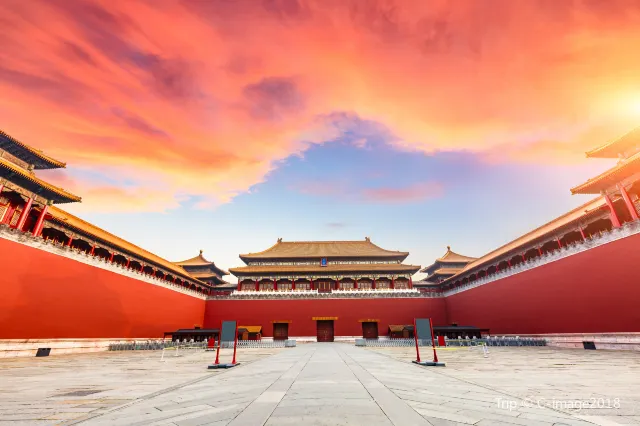
The Meridian Gate, the only entrance to the Forbidden City. Photo: Trip.com
The Hall of Supreme Harmony (Taihedian) is the tallest and most important building in the complex, 35 metres high and set on a three-tier marble terrace. It held coronations, imperial weddings and the New Year audience, and the Dragon Throne still sits inside. Count the roof figurines: this hall carries ten, the only building in China allowed that many.
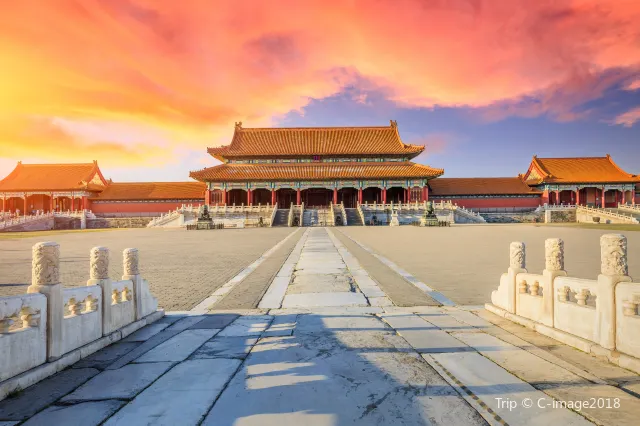
The Hall of Supreme Harmony, the ceremonial heart of the palace. Photo: Trip.com
The Hall of Central Harmony is the small square hall between the other two, where the emperor rested before ceremonies and rehearsed his speeches for the Temple of Heaven. Behind it, the Hall of Preserving Harmony hosted banquets and, later, the imperial examinations. Look for the carved marble ramp behind the hall, a single 200-tonne block of stone dragged into the palace on an ice road in winter.
Pass through the Gate of Heavenly Purity and you leave ceremony behind for the imperial household. The Palace of Heavenly Purity was the emperor's residence and later his audience hall; the Hall of Union held the imperial seals; the Palace of Earthly Tranquility was the empress's chamber and the setting for the Manchu wedding rite. The Hall of Mental Cultivation, west of the palace, is where the last eight Qing emperors actually ran the empire.
The Imperial Garden at the north end is small, about 12,000 square metres, and deliberately informal after the symmetry of the halls. Cypresses, rockeries, pavilions and a pair of bronze elephants fill the space, and the Hall of Imperial Peace anchors the centre. It is the best place to slow down before the exit and the most popular spot for a last photograph.
The Treasure Gallery occupies the Ningshou Palace area in the northeast, a quieter set of courtyards with the Nine Dragon Wall as its centrepiece. Gold, jade, pearls and ceremonial objects are displayed in low light, and the courtyards themselves are worth the detour. The Clock and Watch Gallery near Fengxian Hall shows the mechanical clocks and automata that Qing emperors collected from Canton and Europe; the hourly chimes draw a crowd.
The classic picture of the Forbidden City is not taken inside it. Walk to the northeast corner of the moat, outside the wall, for the corner tower reflected in the water, or climb Jingshan Park for the roofline at sunset. Inside, the Golden Water Bridges and the long red walls of the Six Eastern and Western Palaces give clean lines without crowds. Tripods and selfie sticks are refused at security, so travel light.
The northeast corner tower and the moat, the best exterior view. Photo: Trip.com
Enter at the Meridian Gate, cross the Golden Water Bridges, pass the Gate of Supreme Harmony and walk the central axis through the three great halls. Continue through the Gate of Heavenly Purity into the Inner Court, then the Imperial Garden, and leave by the Shenwu Gate. The full axis is about 3.5 kilometres on foot and takes three to four hours at an easy pace; add the side palaces and both galleries and you are looking at five to six hours.
For a shorter visit, walk from the Meridian Gate to the Imperial Garden in about 90 minutes and skip the side courtyards. For a quieter route, turn east after the Hall of Preserving Harmony for the Treasure Gallery, or west for the Hall of Mental Cultivation and the Six Western Palaces.

Schematic map of the Forbidden City and the one-way walking route. Not to scale.
Audio guides rent at the Meridian and Shenwu gates in several languages, including English, for around 40 yuan with a 100 yuan deposit. Free paper maps are available at the entrance, and staff at the information desks speak some English. Toilets are spread through the courtyards and marked on the map; cafes, snack stands and the Ice Cellar restaurant are concentrated in the northern half.
Wheelchairs can follow the main axis, but the side courtyards and galleries have steps. Wheeled luggage and carts are not allowed inside; use the paid luggage transfer between the Meridian and Shenwu gates if you are heading to a station afterwards. Expect two security checks, one around Tiananmen and one at the palace gate, and allow 15 to 20 minutes at peak times.
The Palace Museum rotates its collection through temporary exhibitions in the Meridian Gate galleries and the side halls. Recent seasons have focused on imperial porcelain, court painting, clockwork and the architecture of the palace itself. Exhibitions are included in admission unless marked otherwise; check the official Palace Museum channels in the week before you go, because the programme changes with the season.
Night openings are occasional rather than regular. The palace has opened after dark for Lantern Festival and a handful of cultural events, with separate timed tickets released days ahead and sold within minutes. Unless an official notice names your date, plan a daytime visit and treat a night opening as a bonus.
Start at 08:00 at Tiananmen Square, which needs its own free reservation, or walk the east moat road to skip the square entirely. Be at the Meridian Gate for the 08:30 opening with your passport and QR code ready. The first hour is the quietest: cross the bridges, walk the three great halls and reach the Inner Court before the tour groups catch up.
By 11:00 you will be in the Inner Court, where the Palace of Heavenly Purity, the Hall of Union and the Palace of Earthly Tranquility sit close together. Break for lunch around 12:00 at the Ice Cellar restaurant or one of the snack stands, then use the early afternoon for the Treasure Gallery or the Clock and Watch Gallery while the central axis is busiest.
Finish at the Imperial Garden and leave by the Shenwu Gate around 15:00. Cross the road to Jingshan Park, climb to the Wanchun Pavilion for the view back over the palace, then walk west to Shichahai for the hutongs, the lake and an early dinner. If you have energy left, the Drum and Bell Towers are 20 minutes further north.
The Palace Museum is the anchor of any Beijing itinerary. Check opening times, reviews and nearby hotels on Trip.com before you lock in dates.
The Ice Cellar restaurant, built into a Qing-era ice store in the northern half of the palace, serves simple Chinese meals and hot drinks. Smaller cafes and snack stands sit near the Imperial Garden and the side courtyards, with noodles, dumplings and ice cream. Prices are higher than outside and queues build between 12:00 and 13:30, so an early or late lunch works better.
For roast duck, Siji Minfu near Dengshikou is the local favourite and takes reservations; Dadong in Jinyu Hutong is the splurge version. TRB Hutong, in a restored temple near Shatan, is the special-occasion choice for European cooking. Wangfujing Snack Street, 20 minutes east on foot, is convenient rather than excellent, and the hutongs around Shichahai have small noodle and dumpling shops that are better value.

Red doors and gold studs frame almost every courtyard in the palace. Photo: Trip.com
The Forbidden City sits in the middle of the city's historic core, and most of Beijing's other sights are within 30 minutes by metro. The Temple of Heaven, the Summer Palace, the Great Wall at Mutianyu and the hutongs around Shichahai all work as half-day add-ons.
Use the Beijing travel guide to plan the rest of the trip, or start with these:
Three to four hours covers the central axis from the Meridian Gate to the Imperial Garden. A thorough visit with the side palaces and both paid galleries takes five to six hours and about 3.5 kilometres of walking.
No. The Palace Museum closes every Monday except public holidays, and it also closes on Chinese New Year's Eve. When a public holiday falls on a Monday the palace usually opens, but check the official notice for your date.
No. Tickets are sold online only, released seven days ahead at 20:00 Beijing time and capped at 40,000 a day. Book with the passport you will carry, because the same document is checked at the gate and there is no ticket window to fall back on.
The Dongcheng hutongs around Nanluoguxiang and Shichahai are the most atmospheric base, within walking distance of the north gate. Wangfujing suits travellers who want metro access and larger hotels, and the area around Qianmen is convenient for Tiananmen Square and Beijing South station.
Yes. The Forbidden City is the historic palace; the Palace Museum is the institution that manages it and displays the imperial collection. Locals call it Gugong, and the two names refer to the same 72-hectare site.
Popular recommendations

7 Reasons to Put Cancun Mexico Into Your Vacation Bucket List.
 _TS***4m

30 Things to do near Taksim Square Istanbul 2026
_TS***4m
Latest Trip.com Promo Codes, Flight Discounts & Hotel Savings (Weekly Update)
 Trip.com Official

6 Things to know before Exploring the Montmorency Falls, Quebec
_TS***4m