Seoraksan National Park is one of the earliest established national parks in Korea (1970), renowned for its magnificent granite peaks, crystal-clear valleys, and dense forests. Known as the "Alps of Korea," it represents the epitome of Korean natural scenery.
The scenery is distinct in each season, each with its own charm: spring brings blooming mountain flowers, summer is lush and green, autumn sets the maple leaves ablaze, and winter drapes the landscape in a silvery-white coat.
Ulsan Rock
This is a massive granite cliff towering into the clouds, truly spectacular. The trail leading to Ulsanbawi Rock is relatively gentle, making it one of the most popular routes in Seoraksan Mountain.
Reaching the summit involves climbing a metal staircase, which is an adventure in itself. From the top, you can enjoy breathtaking views of Sokcho City and the East Sea. A small temple, Ulsanbawi Rock Temple, sits atop the rocky peak, creating a striking contrast with the massive boulders.
Quanjincheng
Located within Seoraksan Small Park, this stone fortress ruin is said to have been built by Generals Kwon and Kim as a refuge from war.
You can easily reach near the mountaintop by taking the cable car, saving a lot of energy. From the observation deck at the summit, you'll enjoy panoramic views of Seoraksan's continuous mountain range and Sokcho cityscape, making it an excellent spot for taking classic photos.
Thousand Buddha Cave Valley
This is the most representative valley of Seoraksan Mountain, featuring crystal-clear waters and bizarre rock formations lining both banks. The rocks take on various shapes resembling thousands of Buddha statues, hence the name "Thousand Buddha Caves."
The valley features a concentration of scenic spots, including Feixian Platform, Guimian Rock, and the Five-Step Waterfall. It's an excellent trail for forest bathing and listening to the murmuring streams, as well as a popular route for admiring maple leaves in autumn.
Xinxing Temple
Located at the entrance of Seoraksan Mountain, this thousand-year-old ancient temple is a must-pass site when entering the national park.
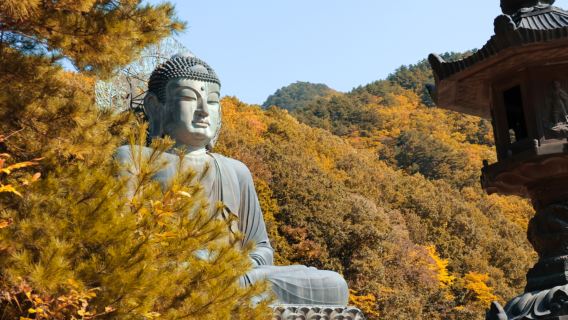
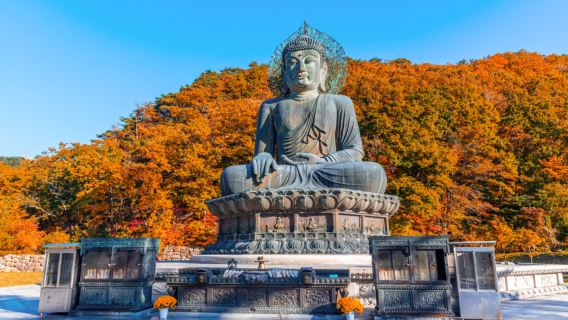
The temple houses a massive bronze seated Buddha statue, exuding solemnity and serenity. The temple blends harmoniously with the backdrop of Seoraksan Mountain, creating a tranquil landscape painting. From Sinheungsa Temple, visitors can embark on separate journeys to Ulsanbawi Rock and Cheonbuldong Valley.
Naksansa Temple is one of the Eight Scenic Views of Gwandong in Korea, located in Yangyang County, Gangwon Province. This thousand-year-old seaside temple was founded in 671 AD by the revered monk Uisang during the Silla Dynasty. Its greatest feature is the perfect harmony between Buddhist solemnity and the majestic East Sea, creating a sacred and serene atmosphere.
Yixiang Temple
This is the most central and famous structure of Naksansa Temple, as well as its iconic view. It is not an ordinary Buddhist hall, but a small hermitage built on a massive rock by the East Sea.
The temple enshrines the Bodhisattva Guanyin. Watching the sunrise here in the early morning is considered one of the most beautiful sunrise views in Korea. As the sun rises from the horizon, golden light bathes both the sea and the Buddhist temple, creating an extremely awe-inspiring and sacred scene.
Rainbow Gate
The entrance to Yixiang Nunnery is a red archway. Its name means "Rainbow Gate," symbolizing that passing through this gate leaves worldly troubles behind and enters a pure land.
The red Hongni Gate forms a striking color contrast with the blue sea and gray rocks, making it an excellent photo spot. Passing through this gate, the ocean view and Buddhist nunnery suddenly come into sight, creating a highly ceremonial atmosphere.
Naksansa Temple Bronze Bell
The temple houses the oldest bronze bell preserved in Korea.
This bell, cast in 725 AD, boasts a long history and exquisite craftsmanship, serving as a precious artifact for studying Korean Buddhist history and metalworking techniques.
Seawater Guanyin Statue
Near the temple along the coast stands a pristine white statue of the standing Guanyin Bodhisattva, facing the sea and compassionately watching over passing fishing boats and all living beings.
The statue of Guanyin and the boundless sea form a harmonious picture, appearing particularly sacred whether under the blue sky during the day or illuminated by lights at night.