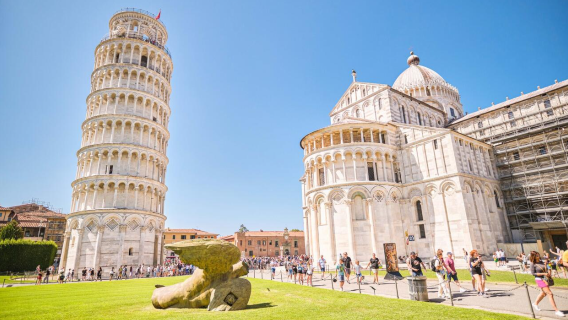
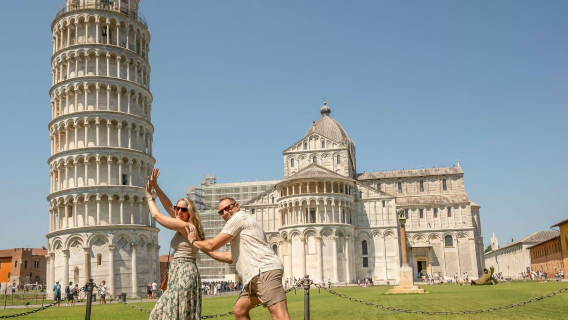
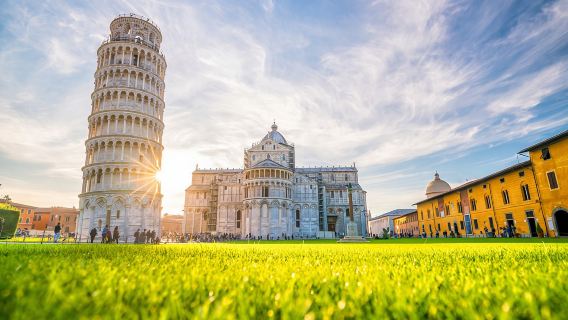
▲ The Leaning Tower of Pisa is an iconic landmark in Italy and a marvel in the history of world architecture, designated as a UNESCO World Heritage Site. The tower is actually a freestanding bell tower of the Cathedral of Pisa, located in the central Piazza dei Miracoli (Square of Miracles) in Pisa. The square is always crowded with visitors striking creative poses with outstretched arms to take photos with the leaning tower. The tower stands about 20 m away from the cathedral, featuring a cylindrical shape constructed from white marble.

▲ The foundation of the tower is inscribed with the Latin year 1174 as the start of construction, and it was completed in 1350. However, the calendar used in ancient Pisa was one year ahead of the Gregorian calendar, so the actual construction of the Leaning Tower of Pisa began in 1173. It is said that the tower was built using spoils of war transported by the Pisa fleet on six ships. The Leaning Tower of Pisa stands 54.5 m tall with a diameter of 16 m, tilting towards the southeast at an angle of approx. 3.9 degrees. In its early construction phase, the tower leaned an average of 1 mm per year, leading to a temporary halt in construction. Most believe the tilt was caused by uneven foundations and soft soil layers. In 1998, workers wrapped cables around the third level, attached them to a framework, and removed some accumulated soil from the north side to stabilize the tower.


▲ Climb the Leaning Tower to overlook the city of Pisa. Each level of the tower features archways, totaling 213 in all. The walls at the base are adorned with relief carvings, while the top level houses a bell chamber. Inside the tower, a spiral staircase with 294 steps allows visitors to ascend and enjoy panoramic views of the city. Some steps can be slippery, so watch your footing. On summer evenings, you can admire the beautiful nightscape of Pisa from the tower. The experience of entering the tower is unique—as you ascend the extremely narrow spiral staircase, you might feel as if you're on a ship. Upon reaching the top, the view suddenly opens up. The tower's summit has glass panels, and since the interior is hollow, you can see directly down to the base. Currently, there are time and visitor number restrictions for climbing to the top of the Leaning Tower.

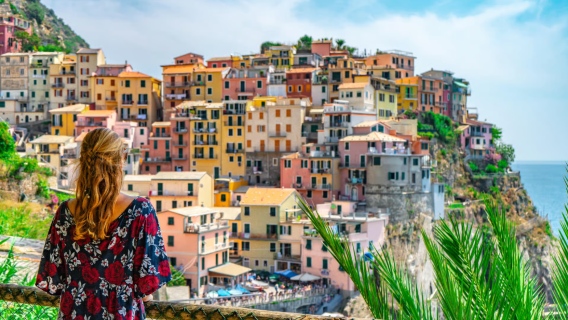
▲ Cinque Terre is located along the coast of La Spezia province in Italy's Liguria region. This small yet exquisite Italian national park consists of five cliffside villages - Monterosso Al Mare, Vernazza, Corniglia, Manarola, and Riomaggiore - along with Cinque Terre, Portovenere, and the three islands of Palmaria, Tino, and Tinetto. It has been inscribed on the UNESCO World Heritage List as an outstanding example of human settlement that harmoniously transforms the natural landscape without disrupting its beauty.

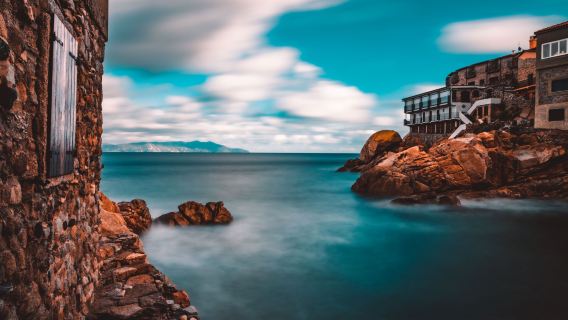
▲ Overlooking the Mediterranean Sea from historic, magnificent, and colorful small villages nestled between rocky reliefs and steep cliffs, with world-renowned terraced hillside vineyards in Monterosso Al Mare.

▲ Overlooking the Mediterranean from historic, magnificent, and colorful small villages nestled between rocky reliefs and steep cliffs, gazing at the coastline, the world-renowned terraced hillside vineyards, Monterosso Al Mare, the village of Vernazza, Corniglia, the historic Borgo of Manarola, and the village of Riomaggiore—this is Cinque Terre, this is the Liguria region. Seaside villages surrounded by agricultural landscapes, vibrant, charming, and exquisitely simple, form part of the Cinque Terre National Park protected area. The village of Manarola soars atop a cluster of black boulders, with colorful houses seemingly emerging from the rocks. Beyond its beauty, Manarola is also renowned for its high-quality olive oil and