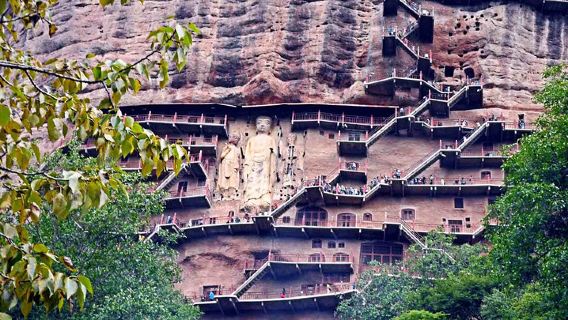
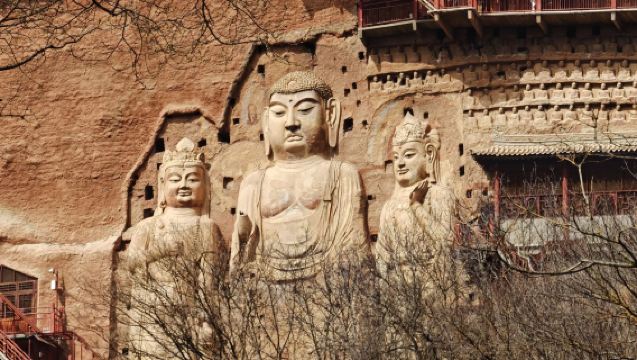
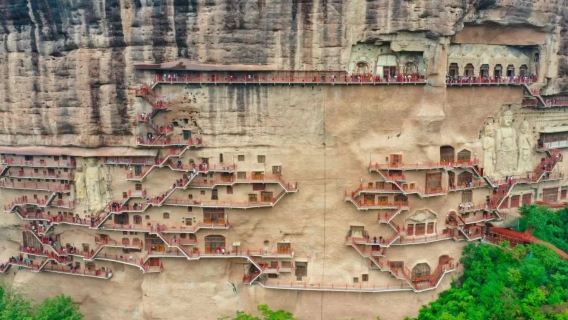
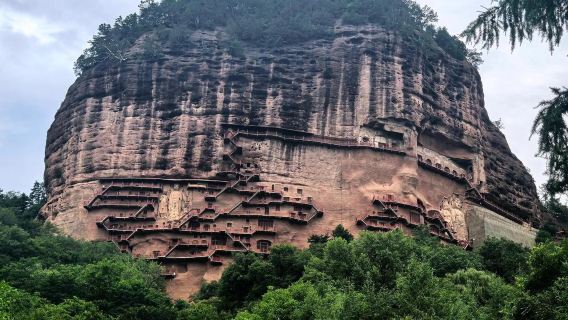
▲ The Maijishan cave-temple complex is located on Maiji Mountain in the western Qinling range southeast of Tianshui, Gansu. The solitary peak resembles stacked wheat piles, hence its name. As one of China's four great grottoes, it's a UNESCO World Heritage Site, national 5A-level attraction, and key cultural relic protection unit. First carved during the Later Qin of the Sixteen Kingdoms period over 1,600 years ago, it underwent continuous excavation and renovation through twelve dynasties from Northern Wei to Qing. Across 100-meter crimson cliffs stand 221 staggered caves preserving over 10,000 clay and stone-core sculptures with nearly 1,000 square meters of murals. Renowned as the "Oriental Sculpture Gallery," it showcases the most complete chronological collection of clay sculptures in China.


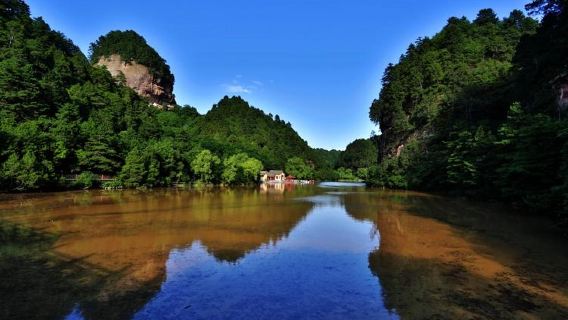
▲ Immortal Cliff is located in Maiji District, Tianshui, and belongs to the Maiji Mountain scenic attraction. Built during the Northern Wei Dynasty and granted imperial titles during the Ming and Qing Dynasties, it is named after the legend of immortals residing here. This attraction integrates Danxia landscapes with ancient grottoes and structures blending Buddhism, Taoism, and Confucianism. It consists of the eastern, western, and southern cliffs, along with five peaks and six temples. The Lingying Temple on the western cliff preserves colorful grotto sculptures and ancient murals, complemented by the Immortal Lake in the mountains. It boasts three renowned scenic spots: Pure Land Pine Waves, Immortal Lake Reflections, and Immortals Delivering Lanterns, featuring stunning natural scenery and cultural relics.


▲ Jingtu Temple, also known as Manjushri Temple, is located in Houchuan of Immortal Cliff in Maiji District, Tianshui, adjacent to the Maijishan Cave-Temple Complex. Originally built between the late Tang and early Song dynasties, it was once called Jigu Temple and Jingdu Temple. The ancient structures were destroyed in 1971 and rebuilt in the 1990s with expansions. As one of the largest Buddhist monasteries in southeastern Longyou, it houses the ancient "Qinzhou Ten Scenes" attraction - the pine waves of Jingtu. Surrounded by verdant mountains and ancient pines, the temple resonates with wind-whispered pine melodies resembling ocean waves. The surrounding mountains naturally form the spectacular "Eighteen Arhats Worshipping Manjushri" geological wonder. The temple complex includes over twenty halls such as the Mahavira Hall, Manjushri Hall, and scripture depository, featuring magnificent architecture and serene Zen ambiance.