▲ The Venetian Macau is located on the Cotai Strip (reclamation area), a large-scale one-stop integrated resort themed after the Italian water town of Venice: Distinctive thematic features include an indoor artificial water town landscape. The centerpiece is the Grand Canal shopping mall, featuring man-made canals, arched bridges, and cobblestone alleys; the ceiling boasts a hand-painted artificial blue sky with clouds, and lighting simulates day-to-night transitions, unaffected by external weather. Visitors can take gondola cruises with singing gondoliers, recreating the iconic Venetian waterfront scenery—a hallmark immersive experience.

▲ The Venetian Macau in Cotai features a mega one-stop integrated resort: combining an all-suite hotel (approximately 3,000 suites), the Grand Canal Shoppes (over 360 brand stores and diverse dining options), a convention center, the Cotai Arena, theaters, and entertainment facilities. With comprehensive amenities, guests can complete their stay, shopping, dining, conventions, and performance activities without leaving the resort.

▲ The Grand Canal Shoppes is located on the third floor of The Venetian Macau Resort in Cotai, Macau, and is a large indoor themed shopping center in Macau: Immersive Venetian water town theme design: It features three artificial indoor canals (Grand Canal, St. Luca Canal, and Marco Polo Canal), flanked by European-style antique buildings, stone arch bridges, and cobblestone alleys; the ceiling has a giant computer-controlled sky dome that simulates blue skies, white clouds, and changing daylight, unaffected by external weather. Travelers can take a gondola cruise, listen to the boatman's singing, and experience a recreation of Venice's aquatic charm. Large commercial scale with diverse offerings: Over 350 shops cover fashion brands, cosmetics, jewelry, and souvenirs, complemented by a wide range of Chinese and Western dining options, integrating shopping and dining; the mall uses themed squares like St. Mark's Square as pedestrian hubs, with alley-style commercial pathways and scenic spatial design. A business model blending culture and tourism: Not just a shopping venue, it prioritizes scenic experiences over shopping, featuring street performances and other photo-worthy attractions, combining commercial consumption with sightseeing.

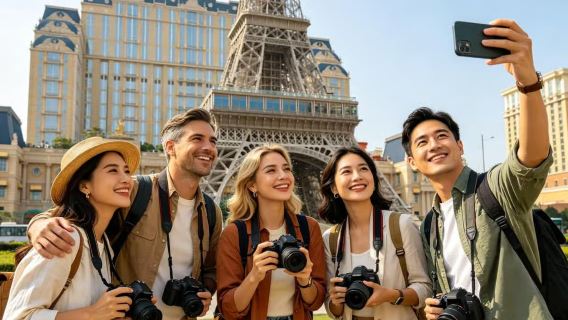
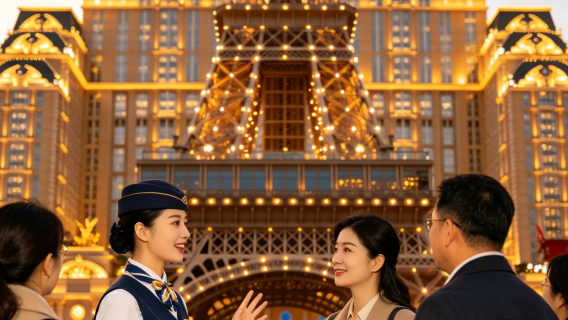
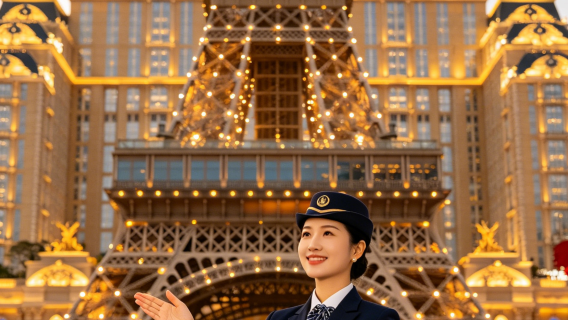
▲ The Parisian Macau is located in the Cotai Strip reclamation area, a French Paris-themed integrated resort. Core landmark: A 1/2 scale replica of the Eiffel Tower serves as the striking icon of the entire complex; the tower features an observation deck and nighttime light shows, offering vastly different views between day and night.

▲ The exterior facade of the Parisian Macau main building features French classical palace style, inspired by the architecture of Versailles Palace and Paris Opera House, with pale yellow stone walls, intricate carvings and sloped roofs, exuding grandeur and elegance. The outdoor public spaces include the Parisian Garden, a replica Arc de Triomphe and fountain sculptures, with multiple recreations of iconic Parisian views. Connected to neighboring resorts like the Venetian and Londoner via walkways, it forms part of the Cotai Strip resort complex.

▲ The public areas of The Londoner Macau in Cotai adopt a Victorian London theme, with the Crystal Palace atrium as its central public space: Crystal Palace (core atrium): Standing 33 m tall, its design is inspired by London's Crystal Palace, featuring glass and iron structures with a stained glass dome and a floor of various marble inlays. At its center stands a replica of the Shaftesbury Memorial Fountain, creating a grand and magnificent space. The atrium hosts scheduled Changing of the Guard performances, a signature immersive entertainment experience. Entrance drop-off area: Mimicking London's Victoria Station, with cobblestone pavement and glass canopies, it recreates the ambiance of a British railway station. British-themed street commercial spaces: The indoor walkway replicates London streetscapes, adorned with red telephone booths, double-decker buses and British-style street lamps as landscape features. The interconnected lanes link shops and restaurants, allowing visitors to stroll and take photos, blending commerce with scenic views.

▲ Drop-off area at the public entrance of The Londoner Macau in Cotai: modeled after London's Victoria Station, with cobblestone pavement and glass canopies to create a British station atmosphere. British-themed street commercial space: the interior pedestrian street replicates London streetscapes, featuring red telephone booths, double-decker buses and British-style street lamps as landscape elements. The streets connect shops and restaurants, allowing travelers to stroll and take photos, blending commerce and views seamlessly.

▲ The Cotai Strip is located in Macau's Cotai reclamation area, developed along the original Cotai link highway, serving as the core tourism and resort corridor of Cotai city in Macau: Land source: Formed through land reclamation. Originally, the area between Taipa and Coloane was sea, transformed into a new district through large-scale reclamation—a typical example of Macau's urban expansion and tourism development space release. Large-scale themed resort cluster. Along both sides of the strip are integrated resorts like The Venetian, Parisian, Londoner, Galaxy, and City of Dreams, each adopting distinct national themes (Italy, France, UK, etc.) with markedly different architectural styles. One-stop integrated resort model. Each resort combines hotels, large shopping malls, convention venues, performance theaters, dining, and leisure entertainment; interconnected by indoor walkways, visitors can walk between complexes without going outdoors.

▲ The large-scale integrated resort complex in Macau's Cotai is located along the Cotai Strip in the reclamation area, representing Macau's modern tourism architecture: Land foundation: A new district formed through land reclamation between Taipa and Coloane, with leveled terrain allowing for the layout of massive building clusters. Exotic thematic design: Each resort independently adopts distinct national themes, such as The Venetian (Italian water city), Parisian (France), and Londoner (UK), with highly recognizable styles reflected in architectural exteriors, interior public spaces, and themed landscape features. Enormous building scale with highly integrated functions: Single structures combine hotels, large shopping malls, convention venues, theaters, dining, and leisure entertainment—forming one-stop resort complexes where travelers can complete stays, shopping, sightseeing, performances, and convention activities without leaving the buildings.

▲ The urban development story of Macau's Cotai is fundamentally about transforming sea into land through large-scale reclamation, evolving from ocean waters to a modern tourism hub—a classic case of Macau's spatial expansion. Land transformation: From sea to city. Originally, Taipa and Coloane faced each other across the sea with Cotai waters in between; reclamation projects filled the bay, creating vast new land that became Cotai city (the Cotai Strip), solving Macau's land scarcity. Shift in development focus: Early plans for this reclaimed area prioritized residential use; later repositioning emphasized large-scale integrated resorts and convention industries, establishing Macau's modern tourism and leisure core that complements the historic district on Macau Peninsula. Construction model: Cluster development. Themed integrated resorts like The Venetian, Parisian, and Londoner were successively built along the Cotai Strip, driving simultaneous growth in hospitality, retail, conventions, and entertainment industries, diversifying Macau's tourism sector.