[Departing from Chengdu] Mount Qingcheng + Dujiangyan day tour (check in at world cultural heritage sites)
English "advance reception" explanation: Before the trip, we will arrange for online English customer service to communicate with you; during the actual trip, only Chinese-speaking staff will receive you. If you complete the booking, it will be deemed that you have accepted this arrangement by default. If this causes any misunderstanding, we will communicate with you before the trip and process a full refund for you. Thank you for your understanding and cooperation!
[Contact time] Our customer service staff will contact you before 22:00 the day before departure. If you place your order earlier, please wait patiently.
If the group is not formed, we will cancel it for you with a full refund or reschedule the trip. Thank you for your understanding and cooperation!!!
Itinerary order:
Door-to-door pickup in all areas within the Third Ring Road of Chengdu — Mount Qingcheng — Qingcheng Front Mountain — Qingcheng Front Mountain - Shangqing Palace — Qingcheng Front Mountain - Laojun Pavilion (no interior visit) — Lunch (at your own expense) — Dujiangyan Scenic Area — Yulei Pavilion (an escalator ride is required to visit this attraction) — Erwang Temple — Dujiangyan Scenic Area Yuzui Water-Dividing Dike — Baopingkou — South Bridge — Yangtianwo Square (no interior visit) — Hotels within the Third Ring Road of Chengdu
07:40 Door-to-door pickup from all areas within the Third Ring Road of Chengdu
Our customer service staff will communicate with you about the specific travel information before 22:00 the day before departure!!
Main attraction introduction:
Mount Qingcheng (Mount Qingcheng optional expenses: sightseeing bus round trip CNY 20 per person; cableway round trip CNY 60 per person; scenic area noise-cancelling earphones CNY 20 per person, all are voluntary choices)
Mount Qingcheng is located southwest of Dujiangyan, backed by the Min River and facing the Chengdu Plain, and has been renowned since ancient times for the saying "Qingcheng is the most secluded under heaven." In 2000, Mount Qingcheng was inscribed on the World Heritage List as a World Cultural Heritage site. It is also one of the important birthplaces of Chinese Taoism; Zhang Daoling of the Eastern Han Dynasty founded the Way of the Celestial Masters here, leaving a profound accumulation of Taoist culture. The temples and monasteries across the mountain are built following the terrain and blend with nature. More than ten temples and shrines still exist, including Jianfu Palace, Shangqing Palace, and Tianshi Cave. It is not only a famous Taoist mountain but also a heritage site that integrates secluded forest greenery with cultural relics.
Qingcheng Front Mountain
Qingcheng Front Mountain is the main part of the Mount Qingcheng scenic area, covering about 15 square kilometers, and is where cultural relics and historic sites are most concentrated. Taoist temples stand in great numbers here, with Tianshi Cave, Shangqing Palace, Zushi Hall, Chaoyang Cave, and other Taoist buildings distributed along the mountain's contours. The forests are lush and the stone steps are gentle, making it suitable for hiking. The front mountain is known for its cultural landscapes and also preserves well-conserved subtropical mountain vegetation. Walking through it, visitors can feel both the tranquility of the Taoist temples and the natural mood of "Qingcheng being the most secluded under heaven." The highest peak, Laojun Pavilion, sits at about 1,260 meters above sea level and offers a panoramic view of Qingcheng.
Dujiangyan Scenic Area (Dujiangyan Scenic Area optional expenses: Dujiangyan sightseeing bus CNY 20 per person, escalator CNY 40 per person, headset CNY 20 per person, all at your own discretion)
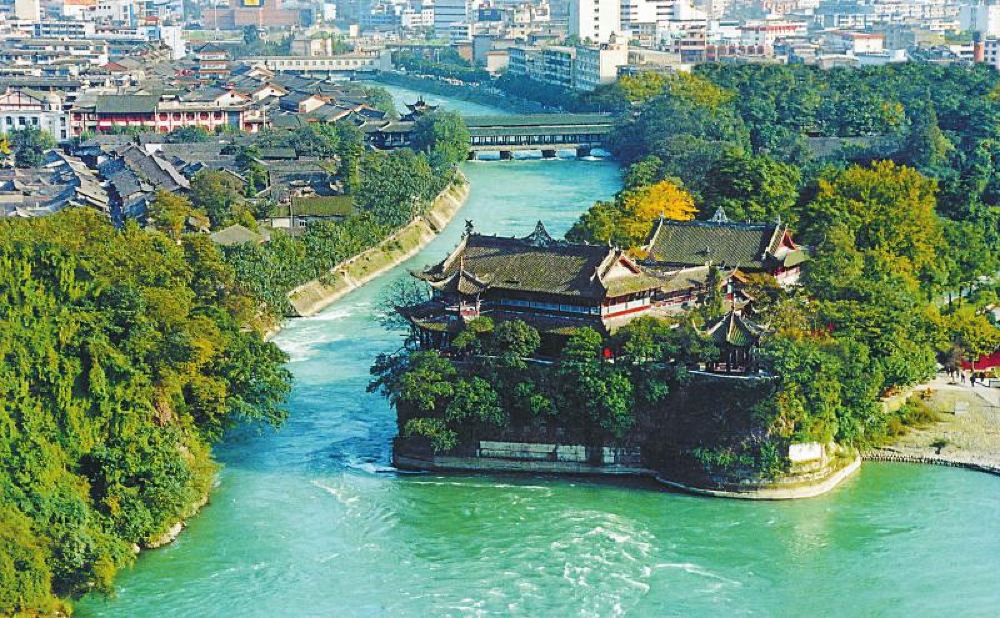
Located on the Min River, Dujiangyan is a large-scale damless water diversion project overseen by Li Bing, the governor of Shu Commandery of the State of Qin during the Warring States period, and his son. Construction began around 256 BC, and it still irrigates the Chengdu Plain today, earning it the reputation of a "living water conservancy project."
Dujiangyan Scenic Area fish mouth water-dividing dike
The fish mouth water-dividing dike is named for its fish-mouth-like front end. It is the key to water division in the Dujiangyan project and was built at the bend in the middle of the Min River.
Baopingkou
Baopingkou is the water intake of the Neijiang River at Dujiangyan. It was dug manually and is named for its resemblance to a bottleneck. Its core function is to divert and control water flow: it channels water from the Neijiang River into the Chengdu Plain irrigation area and, during flood periods, restricts excessive water from surging in, serving as a "master switch" for regulation.
South Bridge
Located on the Neijiang section of the Min River downstream from Baopingkou in Dujiangyan, South Bridge connects South Street and Fuxing Street and is the most famous covered ancient bridge in Dujiangyan. The bridge features painted decorations, carved beams, folk painted sculptures, and calligraphy couplets, and is known as a "painted tower on the water" and "the first bridge at the source of the river."
Arrive at a hotel within the Third Ring Road of Chengdu between 22:00 and 23:30. The exact time depends on the actual conditions of the day and may be affected by traffic conditions. To be safe, it is not advisable to immediately connect to high-speed trains, flights, or other major transportation after the tour ends. If you do need to book high-speed trains, flights, or other major transportation, it is recommended to allow approximately 3-4 hours of transfer time to avoid delays to your subsequent itinerary due to road congestion or other unexpected situations. Thank you for your understanding and cooperation!