Nanjing
Nanjing is the capital of Jiangsu Province.
Alongside Chang'an, Luoyang, and Beijing, it is one of China's Four Great Ancient Capitals and is also known as the "Ancient Capital of Six Dynasties."
The "Six Dynasties" refers to the Wu during the Three Kingdoms period, the Eastern Jin of the subsequent Jin dynasties, and the four southern dynasties of the Northern and Southern Dynasties period.
During the Three Kingdoms period (220-280 AD), Sun Quan of Eastern Wu established his capital here and named it "Jianye."
Later, during the Eastern Jin Dynasty (317-420) and the Southern and Northern Dynasties (420-589), the states of Song, Qi, Liang, and Chen also established their capitals here.
After Zhu Yuanzhang of the Ming Dynasty overthrew the Yuan, Nanjing served as the imperial capital from 1368 to 1421.
After the capital was moved to Beijing in 1420, it continued to prosper as the southern capital corresponding to the northern capital of Beijing.
The name "Nanjing" was given from this time onward.
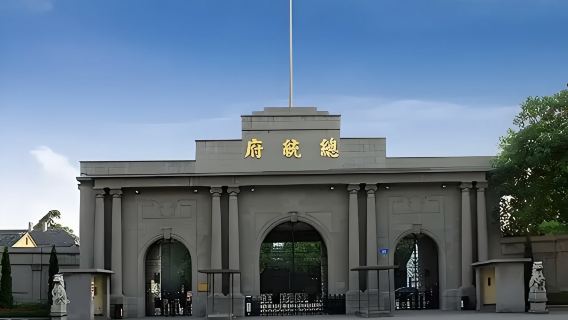
In modern times, Sun Yat-sen established the capital of the Provisional Government of the Republic of China here, and Chiang Kai-shek also made Nanjing the capital of the Republic of China.
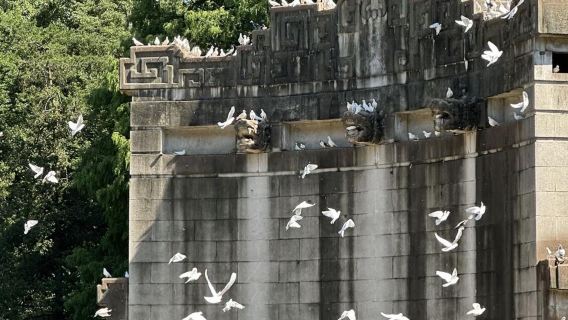
Dr. Sun Yat-sen's Mausoleum


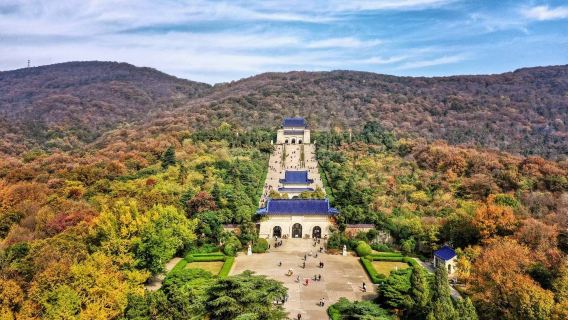
This is the mausoleum of Sun Yat-sen (also known as Zhongshan), the leader of the Chinese Revolution.
In 1911, the Xinhai Revolution overthrew the Qing Dynasty, and the Provisional Government of the Republic of China was established in Nanjing, with Sun Yat-sen assuming the position of Provisional President.
In 1925, he passed away leaving behind the words "The revolution has not yet succeeded."
He passed away in Beijing and was temporarily laid to rest at Zhongshan Park in Beijing before being moved to Nanjing, then the capital, in 1929.
The approach to the memorial hall consists of 392 steps. At the rear of the memorial hall lies a marble reclining statue, beneath which Sun Yat-sen's remains are enshrined.
The Ming Tomb


It was registered as a World Heritage Site in 2003.
This is the mausoleum of the Hongwu Emperor (Zhu Yuanzhang), the founding emperor of the Ming Dynasty (1368-1644).
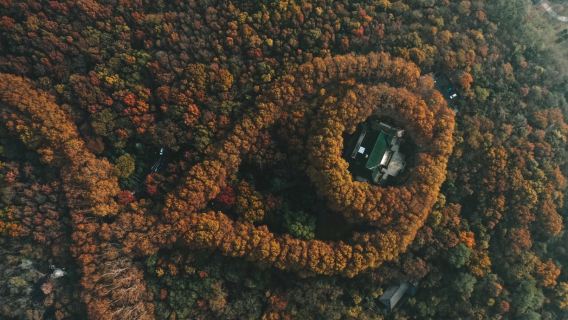
The Ming Xiaoling Mausoleum is located in the eastern suburbs of Nanjing, at the southern foot of Purple Mountain. It leans against Zhongshan Mountain to the north, surrounded by lush forests, and has been known since ancient times as "a place where purple aura lingers."
The construction spanned 25 years, and what remains today includes the stele pavilion, approach path, stele hall, square city, and Ming Tower.
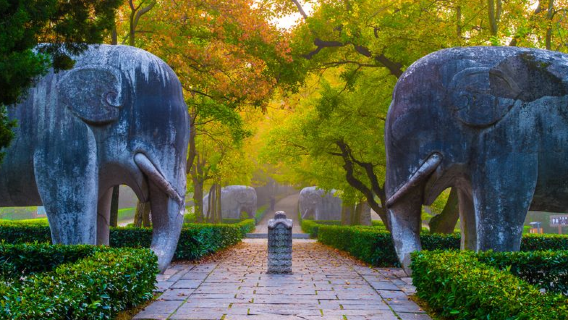
Particularly impressive is the approach path, lined with twelve pairs of stone animals and four pairs of stone figures, leading to a circular burial mound with a diameter of 400 meters.
Tomb of Sun Quan

Also known as Jiangling or the Tomb of the King of Wu.
This is the earliest tomb of a Six Dynasties period king located in Nanjing.
Only the stone monument, stone bridge, and stone statues remain today.
Ming Palace


There are four architectural complexes in China referred to as the "Forbidden City."
The Shenyang Imperial Palace from the early Qing Dynasty, the Beijing Imperial Palace from the Ming and Qing Dynasties, the Nanjing Imperial Palace from the early Ming Dynasty, and the Taipei Palace Museum from the Republic of China era
The Nanjing Imperial Palace was constructed from 1366 and completed in 1392, also known as the Ming Palace or Forbidden City.
The palace grounds covered an area of 1.16 square kilometers, with the city walls stretching 0.88 kilometers north-south and 0.85 kilometers east-west, reaching a height of 11 meters.
The Nanjing Imperial Palace, an architectural masterpiece, served as the model for the Forbidden City in Beijing and was even more magnificent in scale.
After the third emperor of the Ming Dynasty relocated the capital to Beijing, most of the above-ground structures were destroyed over the years due to fires, floods, warfare, and various forms of human destruction.
Nanjing Museum


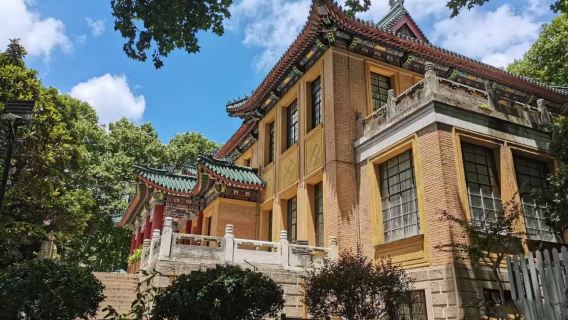
Opened in 1933, it is one of the earliest museums established in China.
While there are countless museums in China today, only two are named "Palace Museum" - the Forbidden City Palace Museum in Beijing and this one, demonstrating their exceptional prestige.
The Nanjing Museum stands out due to the presence of what is known as the "Relocated Cultural Artifacts from the South."
In 1933, to escape the flames of the Sino-Japanese War, a large number of precious artifacts from the Forbidden City in Beijing were transported to the Nanjing Museum (then known as the Central Museum). It is said that the items filled 20,000 wooden crates. Eventually, the war reached Nanjing as well, and the cultural relics were relocated once more, with many being moved to Chongqing in Sichuan Province.
After the war ended, the cultural relics were returned to Nanjing almost intact. However, during the chaos of the subsequent Chinese Civil War, it is said that 3,000 crates were transported to Taipei, 7,000 crates were returned to the Palace Museum in Beijing, and the remaining 10,000 crates were left at the Nanjing Museum. These are referred to as the "Relics of the Southern Migration."
Zhonghua Gate


The Nanjing City Wall, built during the Ming Dynasty, spans approximately 34 kilometers in circumference, with its main gate being Zhonghua Gate located in the southern section of the wall.
It's a distinctive castle gate that looks like an entire castle itself.
The castle is defended by walls measuring 90 meters east-west and 128 meters north-south.
To the west of Nanjing lies the Yangtze River, while to the east and north stands Purple Mountain. The battles surrounding Nanjing have always been fought across this Zhonghua Gate.
Qinhuai River and Confucius Temple


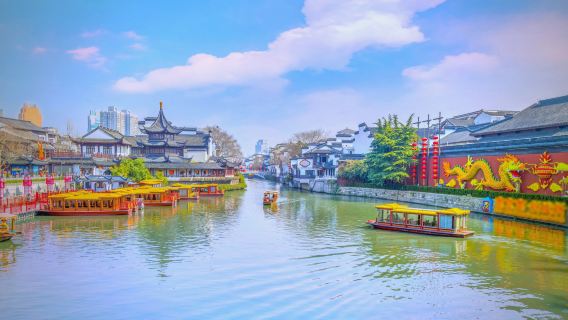
The Qinhuai River is a tributary of the Yangtze River, and boats navigating the Yangtze travel upstream along the Qinhuai River to enter the city of Nanjing.
The Qinhuai River is truly the cradle of Nanjing's culture. From the Six Dynasties to the Ming and Qing periods, it was a place where illuminated boats would come and go at night, scholars would compete in talent, and courtesans would vie in elegance.
The pier was located in Jiangnan's most bustling entertainment district, with taverns lit by red and blue lanterns lining both shores.
The famous Tang Dynasty poet Du Mu wrote a poem titled "Mooring on the Qinhuai River," which helped make the name of Qinhuai River widely known throughout the world.
The smoke envelops the cold water, the moon shrouds the sand
Night moored on the Qinhuai, near the tavern
The singing girls know not the grief of a conquered nation
Across the river, they still sing - the Backyard Flowers
The meaning of the poem is roughly as follows.
Mist hangs over the river surface, and the moonlight dimly illuminates the sandy shore.
When the boat docks, there's a tavern nearby where courtesans sing alluring songs.
I hear that might be the backyard flowers
The courtesans probably don't know the origin of the song either
The depiction of the Qinhuai River's waters, blending the sounds of revelry and a fallen nation while reflecting red and blue lights on its shimmering surface, is truly magnificent.
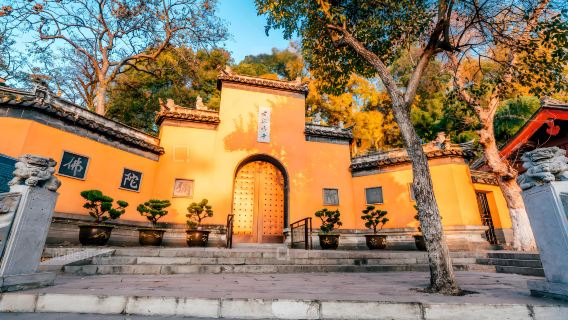
Surrounding the Qinhuai River, there are clusters of residential buildings modeled after the Ming and Qing dynasties, with the Confucius Temple located in one corner of this area.
"Fuzi" refers to Confucius, and "Fuzi Miao" means Confucius Temple.
Construction began in the 3rd year of the Xiankang era of the Eastern Jin Dynasty (337 AD), and it is considered China's first institution of higher learning.
It has now been selected as one of China's top five pedestrian paradises.