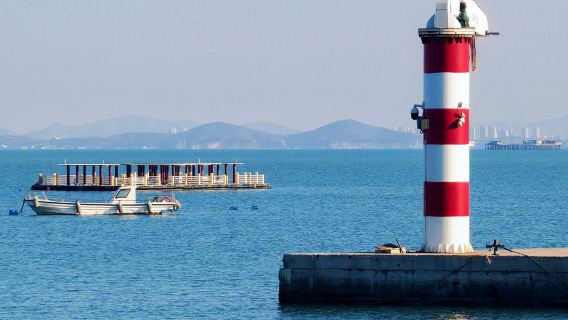
▲ Yantai Mountain is a landmark attraction in Yantai City, located at the northern end of Zhifu District. Surrounded by the sea on three sides, it covers a total area of 45 hectares and is renowned for its beacon tower, lighthouse, and clusters of modern foreign consulate buildings. It is a key cultural relic protection unit.

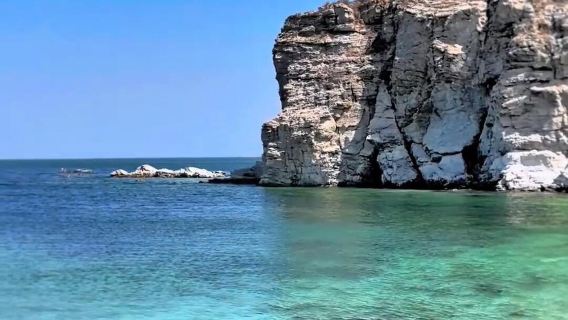
▲ Yangma Island tourism resort is an attraction in Muping district, Yantai city, Shandong province. The name "Yangma Island" originates from the legend that Emperor Qin Shi Huang raised horses here during his eastern tour. It is often praised as the "Oriental Hawaii" and "Little Maldives of the north," and is renowned as the "jelly island" for its crystal-clear waters in good weather. With a total area of about 13 km² and a 20 km ring road, it combines historical culture with coastal resort resources, making it a comprehensive tourist destination.

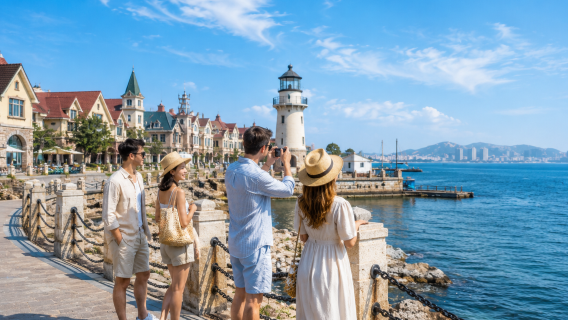
▲ Yantai Haichang Fisherman's Wharf Tourist Attraction is bordered by the Yellow Sea to the east, the Second Bathing Beach to the north, and the original fishing wharf to the south, surrounded by sea on three sides. The project integrates various elements such as tourism, dining, leisure, entertainment, shopping, and vacation, featuring a gourmet street, coastal-themed commercial street, and high-end residential area.

▲ The Dong Fort Attraction is located along the beautiful coastal road in Yantai, Shandong Province. This stretch of sea has been praised by World Tourism Organization experts as comparable to the Mediterranean coast. It harmonizes with Yantai Mountain to the west, overlooks Zhifu Island to the north, offers views of Kongtong Island to the east, and showcases Yudai Mountain to the south. With convenient transportation, it boasts unparalleled geographical advantages and scenic resources.

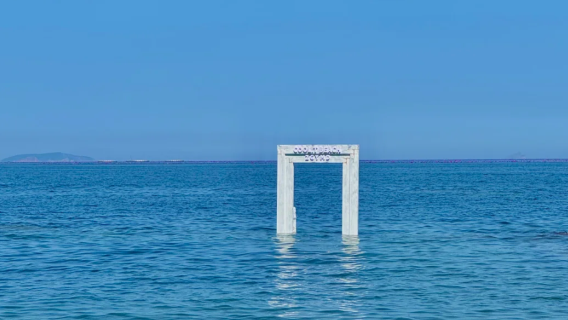
▲ Yueliangwan is located on Binhai North Road, Zhifu District, Yantai City, Shandong Province. It is a deep crescent-shaped bay formed by two headlands. The 4.06 m diameter Moon Elder bronze statue added in 1989 has become a landmark view. As a free-access attraction with a wedding theme, it attracts couples taking wedding photos year-round, with chain railings covered in love locks symbolizing their vows. The attraction forms a coastal tourism belt together with Dongpaotai, Yantai Mountain, and other scenic spots.

▲ Yantai Mountain is located on the coast of the Yellow Sea in the Jiaodong Peninsula, with an elevation of 53 m. It features low mountainous terrain, a mild climate, and dense vegetation, home to over 30,000 trees, predominantly holly. The name originates from the wolf smoke beacon tower established in 1398 during the Ming Dynasty to guard against Japanese pirates, which also gave Yantai city its name.

▲ Chaoyang Street was first built in 1872 (the 11th year of the Tongzhi reign in the Qing Dynasty). It stretches 400 m from North Road in Yantai in the south to Haian Street in the north. As it runs north-south and lies on the sunny side of Yantai Mountain, it was originally named Chaoyang Avenue. In 1912, it was renamed Chaoyang Street. This bustling commercial street in modern Yantai gathered famous foreign firms, shops, factories, banks, and entertainment venues, with Chinese and English signs seen everywhere.