Big foot (daisoku)
The cave city.
100 km from Chongqing.
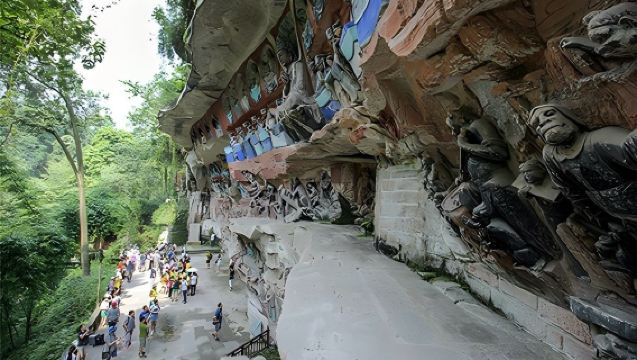
From the late Tang dynasty (907–959) to the Southern Song dynasty (960–1278), 50,000 stone statues were carved at 40 locations in the surrounding mountains.
Stone-carved Buddhist statue groups can be found all over China, but among them, the Dazu ones are noteworthy for both their scale and high artistic quality, and are ranked on par with the Yungang Grottoes, Longmen Grottoes, and Mogao Caves.
Among them, the most representative are the stone statue groups of Baodingshan and Beishan.
Hōchōzan (Hōchōzan)
It is located 15 kilometers northeast of the county seat of Dazu County.
It is said that "one climbs to worship at Emei and descends to worship at Baoding," and both are sacred sites for Buddhists.
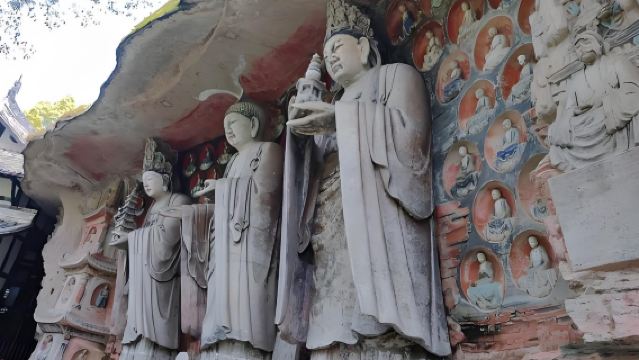
As the name suggests, there are many stone carvings of Buddhist statues, with thirteen sites of stone carvings containing over ten thousand statues of various sizes.
In addition to the vividly colored stone carvings, there are also sculptural works that turn the content of sutras into narrative form, reflecting the lifestyle of the people of the Tang and Song dynasties, which is extremely fascinating.
Among them, the largest are Daibutsu Bay and Kobutsu Bay.
In particular, the reclining Buddha statue and the Thousand-armed Kannon statue in Daibutsu Bay are must-sees.

- Daibutsu Bay (Daibutsu-wan)
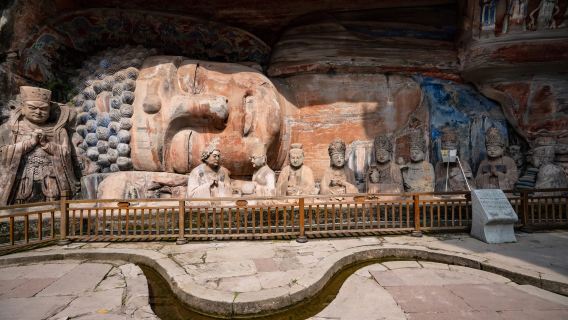
Carved into the horseshoe-shaped mountain bay, the rock face stretches 500 meters in length with cliffs 15 to 30 meters high, featuring carvings on three sides: east, south, and north.
First, it was carved at Xiaofo Bay as a prototype, and afterward it was carved at Dafo Bay.
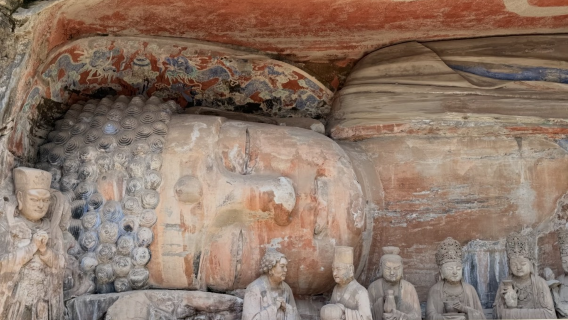
There are over 30 large stone statues, and the most magnificent among them is the reclining Buddha statue depicting Shakyamuni entering nirvana. It is 31 meters long in total.
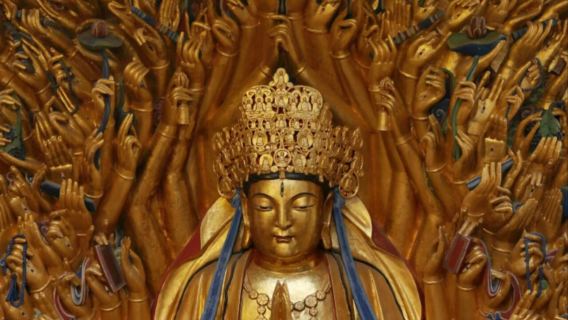
— Thousand-armed Kannon statue (Senju Kannon zō)
It is carved at the eastern end of the south cliff of Dafo Bay on Baoding Mountain.
At a height of 3 meters, it sits cross-legged on a lotus pedestal, wears a jeweled crown, and has a solemn expression with hands pressed together in prayer.
Its distinctive feature is the magnificent composition in which over 1,000 hands are carved across the entire surface of an 88-square-meter rock wall.
Each holds a ritual object in their hands, but the way they are drawn differs, and no two are exactly alike.
Beishan Rock Carvings (Hokuzan Sekkoku)
It is located on Beishan (North Mountain), 2 kilometers northwest of the Dazu town area.
Beishan was originally called Longsong Mountain. The carving of statues began in the late Tang Dynasty and continued for over 250 years until the Shaoxing period of the Southern Song Dynasty.
Two hundred ninety niches are carved to match the rock face, which is 7 meters high and 500 meters long.
The most famous one is called the "Xinshenche Grotto," where Buddha is placed in the center, with Jingbaoping Guanyin on the left and Tara on the right; on the left wall are Manjushri, Yuyin Guanyin, and Ruyizhu Guanyin, and on the right wall are Samantabhadra, Riyue Guanyin, and Shuzhushou Guanyin.
The statues are arranged symmetrically, creating a solemn atmosphere overall.