U.S. Customs Prohibited Items Checklist - Entry Guide

Preparing to return to the United States after an overseas vacation? Whether you're going to London, Paris, Tokyo, Bangkok, Shanghai, or a Philippine island, the most troublesome thing when packing your luggage is the complicated entry regulations of U.S. Customs and Border Protection (CBP).
To avoid fines ranging from $300 to over $1,000, please carefully read the following article to understand U.S. Customs-prohibited items.
From Shanghai
From Bangkok
From Tokyo
See all flights


What Food Items Are Allowed into the U.S.?
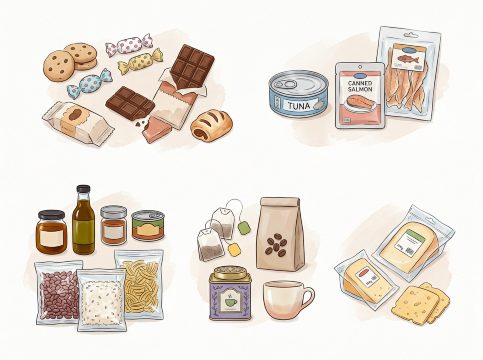
U.S. Allowed Foods
Most commercially processed, well-packaged foods that do not contain meat can be safely brought into the United States.
- Baked Goods and Confectionery: Bread, biscuits, cakes, and chocolates are all allowed to enter. For example, matcha cookies and Shiroi Koibito (White Lover) pastries brought back from Tokyo, or ordinary pastries from Shanghai, are all permitted as long as the fillings do not contain meat or raw egg yolks.
- Seafood Products: CBP generally allows the entry of fresh, frozen, cooked, or dried seafood. Dried shrimp, squid strips, and dried scallops, which are very common in Bangkok or Philippine night markets and islands, can be safely packed.
- Condiments and Dried Goods: Pure curry cubes without meat, Tom Yum soup base, hot pot base without meat, soy sauce, and vinegar are all allowed. Dried shiitake mushrooms and dried wood ear mushrooms are also considered safe.
- Tea and Coffee: Various teas (such as Chinese Pu'er and Longjing) and local Southeast Asian coffee beans/coffee powder are allowed to enter, as long as they do not have plant husks.
- Cheese: Hard cheeses such as Parmesan and Cheddar are safe.
What Is Strictly Prohibited by U.S. Customs?
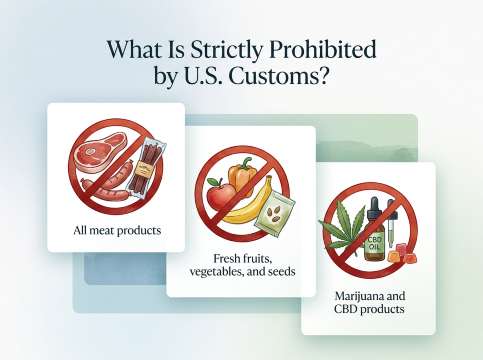
U.S. Customs Prohibitions
The following items are considered "red-light district" items. Being found carrying these items without declaring them will result in fines and credit revocation.
- All meat products (number one red flag): Whether fresh, frozen, cooked, dried, or vacuum-packed, all are prohibited. For example, raw ham and salami from Europe are not allowed; pork jerky, beef jerky, chicken feet, duck necks, etc., bought while traveling to China or Thailand will all be confiscated.
- Fresh fruits, vegetables, and seeds: All fresh fruits and vegetables are prohibited. Do not pack leftover mangoes, mangosteens, or rambutans from Thailand or the Philippines in your luggage, as they easily carry invasive pests.
- Marijuana and CBD Products: Regardless of whether marijuana is legal in the country you are visiting, customs is under federal jurisdiction. It is illegal to bring any marijuana or CBD products containing more than 0.3% THC across the United States border.
What Are the Duty-Free Limits and Restrictions?
These items are allowed, but there are strict quantity limits, and they must be truthfully declared on the customs declaration form.
- Alcohol and Tobacco Duty-Free Allowance (must be 21 years or older): Each adult is limited to 1 liter (33.8 fl. oz.) duty-free. Each person is limited to 200 cigarettes (one carton) or 100 cigars.
- Counterfeit and Counterfeit Goods Policy: "Replica" designer brands, counterfeit bags, or counterfeit watches purchased from Bangkok's hawker stalls or specific markets in Shanghai are subject to strict intellectual property protection by U.S. Customs. Each returning traveler is limited to one item for personal use.
- Cash Limit of US$10,000: Carrying more than US$10,000 or its equivalent in foreign currency (including Japanese Yen, Thai Baht, Chinese Yuan, and US Dollars) into or out of the United States is not illegal, but must be declared (👉 Official:fincen105.cbp.dhs.gov)
If declaring food, souvenirs, or regular baggage (most common)
- Download the official mobile app called Mobile Passport Control (MPC).
- On your flight back to the US, or after landing, log in to the MPC app on your phone.
- Simply check the boxes to answer the customs declaration questions on your phone, take a photo, and click submit. The app will generate an electronic receipt with a QR code.
- After landing, go directly to the airport's dedicated MPC fast lane (usually much faster than the regular queue), and show the QR code on your phone and your passport to the customs officer.
Get Well-Connected!
See all attractions
 62663 booked


How Do You Protect Your Global Entry Status?
- Proactive Declaration: As long as you select "Containing food/prohibited items" on the customs declaration form, even if the items are ultimately deemed prohibited by customs, CBP will only confiscate and destroy them on the spot. There will be no fines, and it will not affect your credit record.
- Overcoming Language Barriers: Many snacks from Asia (such as China, Japan, and Thailand) only have local language packaging. If you are unsure whether they contain hidden meat ingredients (such as chicken powder, lard, or meat extracts), please simply select "Declare."
- The Cost of Concealment: If you select "No food items" but are detected by sniffer dogs or X-ray machines, you will face an on-the-spot fine of $300 - $1,000+. More fatally, your Global Entry status will be permanently revoked on the spot.
Best Hotels on Trip.com
In Shanghai
In Bangkok
In Tokyo
See All Hotels




















Related Articles
Japan Customs Prohibited Items List: Avoid Fines & Travel Delays
Learn about Japan’s customs rules for drugs, food, weapons, and medicine. See what items are prohibited or restricted to avoid fines and travel delays.
October 5, 2026
China Customs Prohibited Items: A Guide to Entry & Exit Rules
Essential China Customs guide: Prohibited items, cash limits, duty-free rules, and med/pet/food regs. Master the latest declaration steps for a seamless trip.
October 5, 2026
Philippines Customs Guide: Prohibited and Banned Items
Essential guide for US tourists: Read the list of banned products in the Philippines, mandatory eTravel rules, and duty-free allowances.
October 5, 2026
Thailand Customs Prohibited Items: What Not to Bring to Thailand?
Traveling to Thailand? Avoid fines and confiscation: Learn which items are prohibited, from e-cigarettes and fake goods to drugs and restricted wildlife products.
October 5, 2026
FAQs about US Customs Prohibited Items
-
Can I bring vacuum-sealed or canned meat (like jerky or pork floss) into the U.S.?
-
What happens if I accidentally pack a prohibited item but honestly declare it?
-
Can I bring counterfeit luxury goods back from markets in Asia?
-
Do I need to declare packaged snacks like cookies, chips, or tea leaves?
-
Is it true that Kinder Surprise Eggs are banned in the U.S.?
Disclaimer: This article has been provided by an individual contributor or third party platform. If there is any discrepancy regarding the copyright, please contact us directly and we will delete the content immediately.
Trending Searches
-
Air travel guide
-
Latest flight deals
-
Getting around
-
eSIM/SIM card