Where to Store Luggage in China: Hotels, Stations & Apps Explained

By Bethy
September 7, 2026
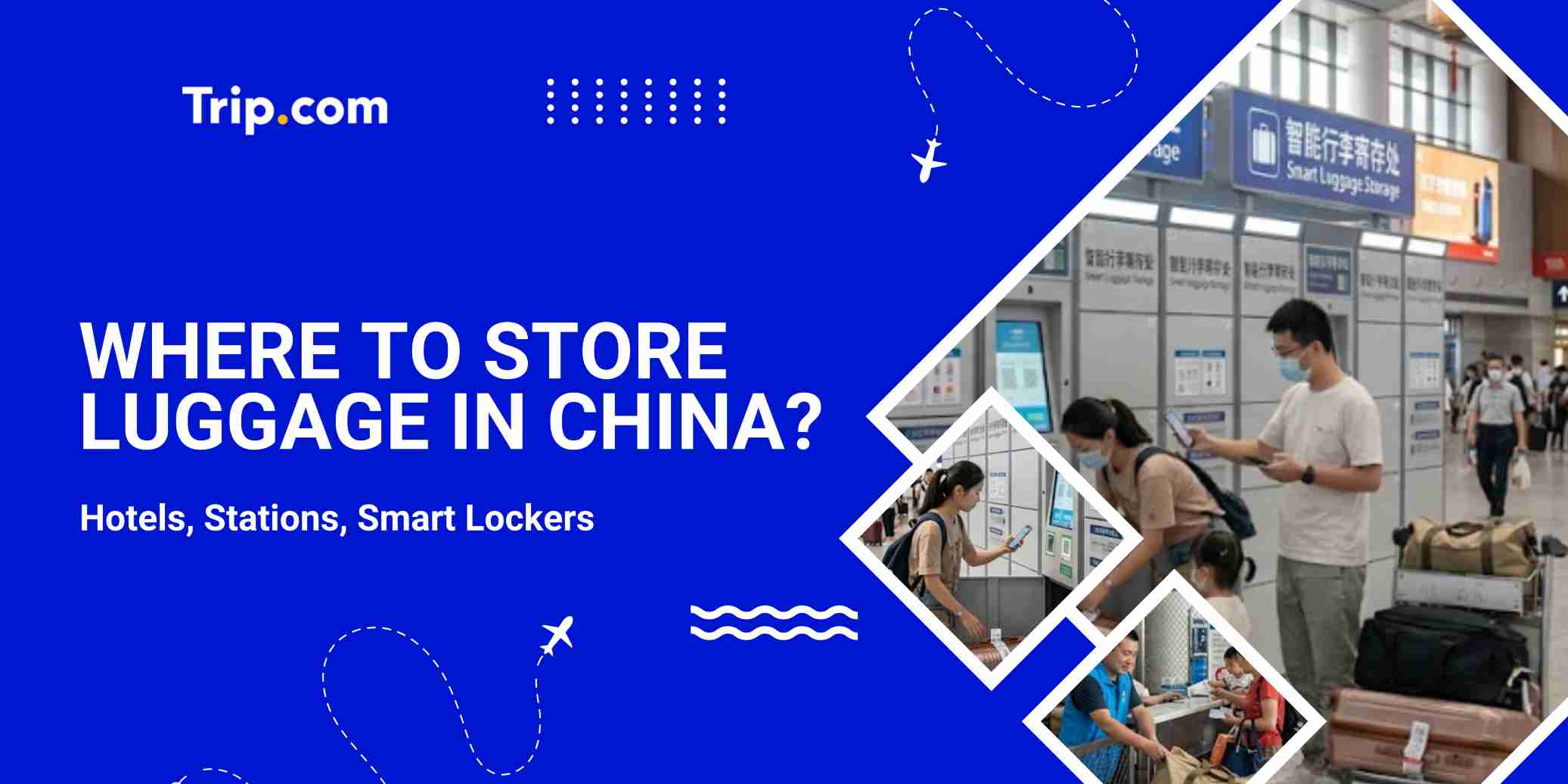
Where to store luggage in China for foreigners: airport and train-station counters, hotels, metro lockers and mini-program platforms.
to Shanghai
to Beijing
to Guangzhou
See all flights


Where to Store Luggage in China? Your options at a glance
Option | Where you'll find it | Typical price | Best for |
|---|---|---|---|
Airport counters | Arrival/departure halls at major airports | RMB 20-50 per item/day (US$3-7) | Layovers; passport + cash is enough |
Train-station counters | High-speed rail stations nationwide | RMB 10-30 per item/day (US$1.5-4.5) | Between trains or after checkout |
Your hotel | Front desk / bell desk | Free for guests | Checkout day, early arrival |
Metro & mall smart lockers | Big-city metros, hubs, malls | RMB 2-6/hour, cap RMB 15-40/day (US$0.3-5.5) | A few hours in one district |
Mini-program platforms | Partner shops near stations and sights | RMB 10-25/day (US$1.5-3.5) | Booked ahead, near attractions |
Theme parks & museums | Entrance storage / cloakrooms | Free up to about RMB 90/day (US$13) | Full-day visits |
Luggage Storage in China at Airports
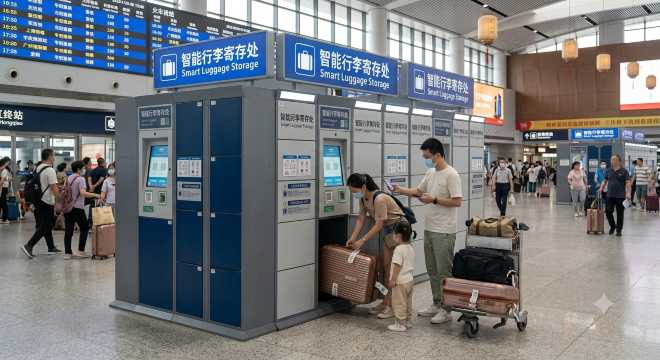
Staffed left-luggage counters at Chinese airports work the same way from Beijing to Guangzhou: find the counter near the arrival or departure hall, hand over your bag, watch it pass an X-ray check, get a receipt, and pay per item. For foreign visitors this is the most dependable option in the country — a passport is expected, cash is accepted, and no Chinese phone number or payment app is needed.
What every major airport offers
- Counters sit in both terminals of the big hubs, usually close to the information desks; smaller airports typically have one near arrivals.
- Prices are tiered by size: roughly RMB 20-30 (US$3-4.5) a day for a backpack or carry-on and RMB 30-50 (US$4.5-7) for a full-size suitcase, with more for oversized items. Hourly pricing exists at some airports for very short stops.
- Hours are typically about 06:00 to midnight; several hubs run 24-hour counters (Beijing Capital and Shenzhen Bao'an are examples visitors report).
- You need your passport to drop off and to collect, and storage periods are usually capped at a month or two — confirm the limit at the counter.
Reported airport examples
Airport | What visitors report |
|---|---|
Beijing Capital (PEK) | 24-hour counters at Terminal 2 and Terminal 3 arrival halls |
Beijing Daxing (PKX) | Staffed counters plus self-service lockers in the domestic waiting area |
Shanghai Pudong & Hongqiao | Counters in both terminals of each airport; Shanghai's transit-facilitation perk (below) |
Guangzhou Baiyun (CAN) | Hourly and daily tiers across Terminals 1 and 2 |
Shenzhen Bao'an (SZX) | 24-hour counter; first hour sometimes free, then daily caps by size |
Chengdu Tianfu / Shuangliu | Counters reported around RMB 20-50/day depending on size |
A perk for 240-hour transit travelers
Since late 2024, eligible travelers transiting China can use the 240-hour (10-day) visa-free transit policy across a wide group of ports and provinces, which makes "land, store the bag, see the city, fly out" a genuinely workable plan. As part of this push, some airports sweeten the deal: Shanghai, for example, has offered transit-eligible passengers free storage for one piece of luggage for up to 72 hours (advertised at the Hongqiao Terminal 1 luggage counter). Perks differ by airport and change often, so ask at the counter when you land rather than assuming.
Tip: staffed counters close at night. For a red-eye arrival, book a hotel near the airport instead of hunting for 24-hour storage, which is rare.
Luggage Storage in China Railway Stations
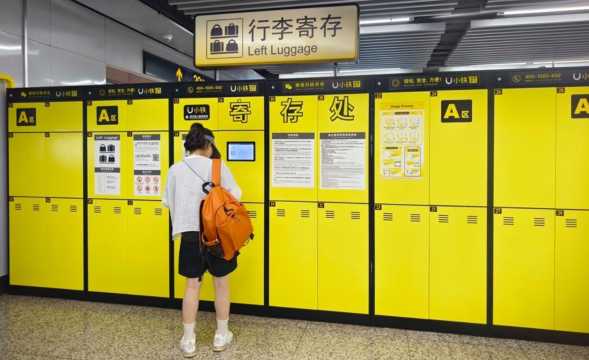
Source: International Services Shanghai
China's high-speed rail network is the backbone of domestic travel, and almost every station of any size now has somewhere to leave a bag: a staffed counter, a bank of QR-code lockers, or both. Prices run lower than at airports — roughly RMB 5-10 (US$0.7-1.5) a day for a backpack and RMB 10-30 (US$1.5-4.5) for a suitcase, depending on the station and the city.
What to expect at a big station
- Counters are usually near the arrival hall or the main concourse; lockers sit beside corridors and metro entrances.
- Staffed counters ask for ID (your passport works), run bags through security, and expect same-day collection before they close, typically around 21:00-23:00.
- Locker prices are hourly with a daily cap; they can hold a bag for up to about 24 hours but are only reachable while the station is open.
- Look for the standard Chinese signage 行李寄存 (luggage storage); many big stations add an English "Left Luggage" label.
Reported station examples
Station | City | Note |
|---|---|---|
Hongqiao Railway Station | Shanghai | Counters and lockers across the huge arrival/concourse levels; shares a complex with Hongqiao Airport T2 |
Beijing South / West / Beijing | Beijing | Staffed desks and locker areas at each of the main stations |
Hangzhou East | Hangzhou | One of the cheapest examples visitors cite, around RMB 10/day |
Chengdu East | Chengdu | Counters plus third-party points around the station exits |
Guangzhou South | Guangzhou | Staffed counters near the arrival level |
Two gotchas that catch travelers
- Some storage sits inside the ticketed waiting area, which you cannot enter without a same-day ticket. If you have not bought one yet, pick a point in the arrival/exit hall or outside near the metro instead.
- Overnight station storage is a bad idea: counters close, lockers shut with the station, and your bag stays locked up until morning. For an overnight rail connection, book a cheap hotel or a day-use room — you will get a shower too.
Luggage Storage in China: Smart Lockers in Metro Stations and on the Street
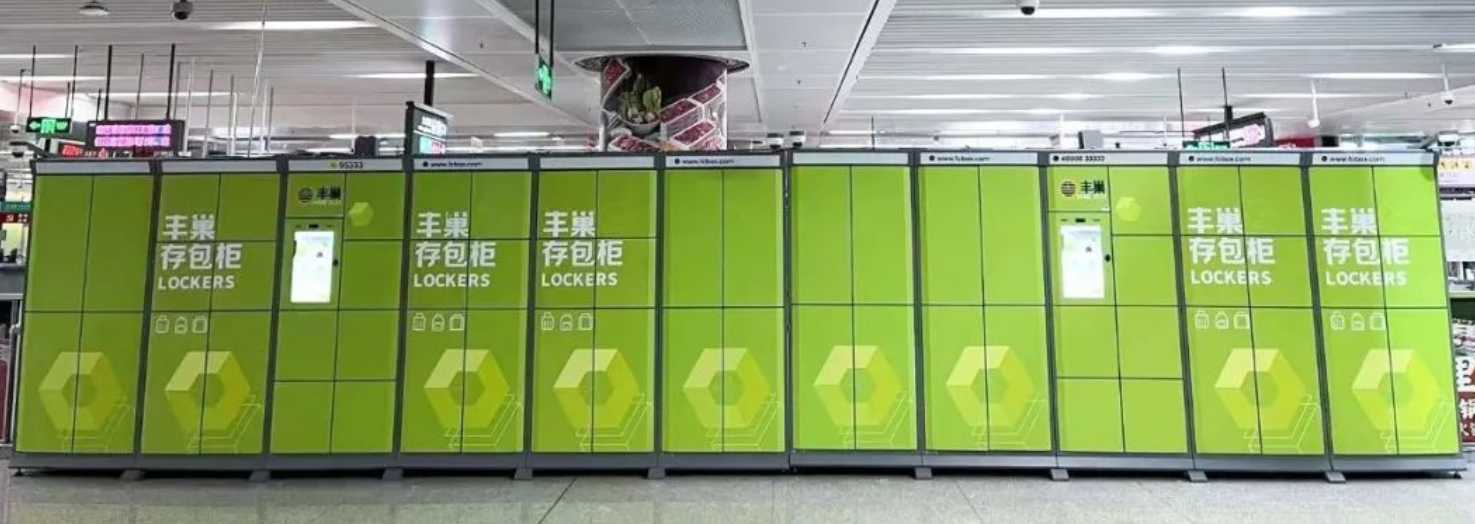
Source: chinajob.com
Smart lockers are the fastest-growing option in China, and the first thing to understand is that there are two very different kinds.
The lockers on the street are not for travelers
Hive Box (丰巢) cabinets line residential compounds and office lobbies in every city, but they are parcel boxes for courier deliveries. Registering and opening one generally requires a mainland Chinese phone number (+86) so pickup codes can be sent by SMS — a dead end for most short-term visitors. Walk past them.
The lockers that do serve travelers
These are self-service luggage cabinets inside metro stations, transport hubs and malls, paid by scanning a QR code with Alipay or WeChat Pay. Several city metros have rolled them out:
City | What has been reported |
|---|---|
Shanghai | Metro rollout began July 2024, starting with roughly a dozen stations (Shanghai Railway Station, People's Square, Nanjing East Road, Xujiahui, Jing'an Temple), expanding since; locate via the Metro Daduhui app |
Hangzhou | The most extensive network so far, with self-service points reported at well over 100 stations, plus trials of station-to-station baggage transfer between hubs such as the airport station and sightseeing stops |
Chengdu | First pilot lockers at Panda Avenue and East Suburb Memory stations, sized up to about 28-inch suitcases |
Lockers also appear at malls and hub concourses in Beijing, Guangzhou and Shenzhen, usually operated by companies such as XiaoIron (小铁) alongside Hive Box's travel-cabinet product.
Typical locker prices
Size | Fits | Typical rate |
|---|---|---|
Small | Backpack, shopping bag | About RMB 2-5/hour (US$0.3-0.7) |
Medium | 20-inch suitcase | About RMB 4-8/hour (US$0.6-1.1) |
Large | Up to about 28-inch suitcase | About RMB 5-12/hour, cap roughly RMB 20-40/day (US$0.7-5.5) |
Rates vary by operator and city; the screen shows the price before you pay.
How to find and use one
- City apps list live availability — Shanghai's Metro Daduhui has a lockers section, and mini programs for services such as XiaoIron work in several cities. Searching 行李寄存 plus your station or mall also surfaces local lockers.
- Scan the QR code on the cabinet, pick a free slot in the right size, and the door opens.
- Keep the receipt or note the locker number; you reopen by scanning again or entering your code.
Caveats worth knowing
- Metro lockers often sit inside the paid area behind the ticket gates, so you need a metro ticket to reach them; some cities require your bag to pass metro security first.
- They follow metro operating hours (roughly 05:30-23:30, varying by line), so no overnight pickups.
- Most expect you back within about 24 hours, after which fees escalate.
- Check the fit before paying: some "large" cabinets still do not take a 28-inch case.
See all attractions
 911111 booked




Luggage Storage in China for Hotels
If you are staying somewhere, your hotel is the cheapest, most convenient storage in the country: free of charge for guests, covering early arrival and late checkout.
- Hand your bag to the front desk or bell desk with your booking confirmation or room key. This is standard at budget hostels and five-star hotels alike — the service is normal, not a favor.
- Many mid-size and large hotels keep luggage in a locked room; some hold bags around the clock. Ask about pickup time when you drop off, since not every front desk is staffed 24/7.
- For non-guests, policies vary: international chains in big cities sometimes store a bag for a fee of around RMB 10-30/day (US$1.5-4.5), while budget hotels usually refuse. It never hurts to ask politely.
- Storage is at your own risk. Hotels refuse cash, passports and laptops — keep valuables with you or in your room safe before checking out.
- In smaller cities with less English, showing your booking confirmation or room key usually communicates everything needed.
Luggage Storage in China: Shopping Malls and Commercial Districts
Shanghai leads the way here: in June 2024 its commerce commission published a formal luggage-storage guide covering around 30 shopping malls in eight commercial districts, with standardized bilingual "Left Luggage" signage and free or cheap storage during mall hours. Similar standardized city schemes are still rare elsewhere, but the underlying service is not — guest-service desks at large malls in Beijing, Hangzhou, Chengdu and Guangzhou routinely hold bags for shoppers, often free within opening hours (typically 10:00-22:00).
- Expect same-day-only storage: collect before the mall closes, and no overnight.
- Some malls run self-service lockers instead of desk storage, priced by the hour with a daily cap.
- Malls sit on metro lines, which makes them ideal mid-day stops: drop bags, walk the pedestrian streets or sights, pick up on the way out.
- Ask at the guest-services desk rather than assuming: policies differ mall by mall, and the Shanghai list is the only one published as an official, bilingual city guide.
Luggage Storage in China: Theme Parks, Museums and Attractions
For a full day at a park or museum, decide your bag strategy before you queue — suitcases and oversized bags are not allowed through the gates of China's major theme parks, and museums require bags to be checked.
Theme parks
Both of China's two flagship international resorts run proper luggage services at the entrance:
Resort | What to expect |
|---|---|
Shanghai Disneyland | Manned storage near the main entrance: about RMB 80/day (US$11.5) for regular or large bags and RMB 10/day (US$1.5) for small items; medium/large self-service lockers around RMB 60-80/day; open until at least one hour after park close; free bag transfer for official resort-hotel guests |
Universal Beijing Resort | Storage before the security check (near the metro plaza) and lockers at the main entrance; standard lockers reported around RMB 20-60/day and large/suitcase storage around RMB 80-90/day; free storage for guests of the resort's official hotels |
Park prices change, so glance at the official app before you go.
Museums, zoos and scenic spots
- Museums across China — including Beijing's National Museum, the Palace Museum and Shanghai Museum's two sites — run free cloakrooms where you leave bags while you tour. Collect before closing, and note that museums close earlier than malls.
- Zoos and parks typically have paid lockers near the main gate (Chengdu's metro locker pilots at Panda Avenue station were designed precisely for the panda-base crowds).
- Government tourism pushes in several provinces now list luggage points at major scenic spots, so it is worth checking the destination's official account for "寄存" (storage) before assuming you must carry everything.
Luggage Storage in China: Mini-Program Platforms (Cunzhiji, Tudan and More)
The most flexible nationwide option is a set of booking platforms that work entirely inside WeChat or Alipay. The two biggest are Cunzhiji (存知己寄存) and Tudan (途简单); both claim nationwide coverage in the hundreds of cities — Cunzhiji lists 130+ cities and 3,000+ points, Tudan 200+ cities and 3,700+ points — concentrated around airports, rail stations, metro exits, convention centers and attractions.
How the booking flow works
- Open the mini program in WeChat or Alipay and search for your station, sight or district on the map.
- Pick a point, book it, and pay online — typically RMB 5-15 (US$0.7-2) a day for a backpack and RMB 10-25 (US$1.5-3.5) for a suitcase, with Tier-1 city hotspots such as Beijing and Shanghai costing more than Chengdu or Guangzhou.
- Walk to the partner shop (a convenience store, tea shop, pharmacy or hotel lobby) and show the voucher.
What to watch for
- Partner shops keep their own hours, usually about 07:00-22:00; overnight is often possible but read the listing first.
- Most platforms cap items at about 110 cm on the longest side and exclude cash, laptops and anything flammable.
- The mini programs are Chinese-first, but maps and payment flow are visual enough to navigate with a little patience.
A warning about Western aggregator apps
Some English-language guides recommend booking China storage through LuggageHero, Stasher, Radical Storage or Bounce. In practice these services have little to no working coverage in mainland China — their partner networks are active in Hong Kong, Japan and elsewhere, but Beijing and Shanghai listings are absent or dormant. Do not plan around them; the Chinese mini-program platforms and the official counters are the options that actually exist on the ground.
How to Pay for Luggage Storage in China as a Foreigner

China runs on QR-code payments, and luggage storage follows suit: lockers are paid by scanning a code, mini-program platforms charge in-app, and even some staffed counters now take mobile pay. None of this requires a Chinese bank account.
Set up before you fly
- Install Alipay and WeChat Pay (Weixin Pay). Both allow registration with an overseas phone number.
- Complete the one-time identity check — a photo of your passport page plus a selfie — and link an international credit or debit card. Visa, Mastercard and JCB are supported.
- Once verified, you pay by scanning the merchant's QR code or showing your own payment code, charged in RMB.
Fees, limits and backups
- Small transactions, roughly under RMB 200 (US$30), are usually free of extra fees; larger ones paid by foreign card can add a handling fee of around 3 percent.
- Daily and per-transaction spending limits apply at first and rise with your verification level — fine for a RMB 20 locker.
- Cash still works everywhere by law, so carry RMB 300-500 (US$40-70) in small notes. Staffed counters at airports and stations take it happily; lockers and apps do not.
- ATMs at Bank of China, ICBC and other large banks accept international cards; airport exchange counters work but give the worst rates.
- Get a travel eSIM or a local SIM (passport required) for data, and finish app verification at home before departure.
Which option needs what
Option | What you need |
|---|---|
Staffed airport/station counters | Passport + cash (or mobile pay where accepted) |
Metro/mall smart lockers | Alipay or WeChat Pay; some cities want you past metro security |
Mini-program platforms | An app account with a linked card |
Street Hive Box parcel cabinets | A +86 mainland phone number — skip these |
Hotel bell desk | Just your booking confirmation or room key |
Three rules before you hand over any bag, anywhere
- Keep your passport, cash and valuables on you — storage is always at your own risk.
- Label your bag with your name and a phone number.
- Confirm the retrieval deadline and take a photo of the receipt or locker number before you walk away.
Do that, and stashing your luggage anywhere in China takes about five minutes.
🔥[Discounted] China Hotel Recommendations
Top Shanghai Hotels
Top Beijing Hotels
Top Guangzhou Hotels
See All Hotels












FAQs about Where to Store Luggage in China
-
Can I leave my luggage at a hotel in China if I'm not staying there?
-
How much does luggage storage cost in China?
-
Where can I leave my luggage in Shanghai?
-
Where can I store my luggage in Guangzhou?
-
Do I need to show my passport to store luggage in China?
-
Can I store luggage at Chinese train stations for a full day during a day trip?
-
Is luggage storage safe in China?
Disclaimer: This article has been provided by an individual contributor or third party platform. If there is any discrepancy regarding the copyright, please contact us directly and we will delete the content immediately.
Trending Searches
-
Featured travel guide
-
Top-rated stays
-
Getting around
-
eSIM/SIM card
- Hotels in Shanghai
- Hotels in Guangzhou
- Hotels in Beijing
- Hotels in Bangkok
- Hotels in Shenzhen
- Hotels in Tokyo
- Hotels in Hong Kong
- Hotels in Chongqing
- Hotels in Seoul
- Hotels in Chengdu
- Hotels in Las Vegas
- Hotels in Zhangjiajie
- Hotels in Kuala Lumpur
- Hotels in Ho Chi Minh City
- Hotels in Taipei
- Hotels in Hangzhou
- Hotels in Singapore
- Hotels in New York
- Hotels in Xi'an
- Hotels in Osaka